
Story written & researched by Sean Fagan for SaintsAndHeathens; Nov 26, 2013
Rugby today means 15 a-side, but 20 was once considered the superior ideal, the more the merrier! At times the game was more riot than football!
The inspiration, of course, were the stories of hard-won glory in ‘Bigside’ matches at Rugby School, not least of all known for the sheer scale of playing numbers.
In 1839, when Queen Adelaide visited Rugby School, the School House team’s 75 boys played ‘The rest’ – all 225 of them. The football match in Tom Brown’s Schooldays pits “fifty or sixty boys” for House against “a huge mass opposite” of some “two hundred”.
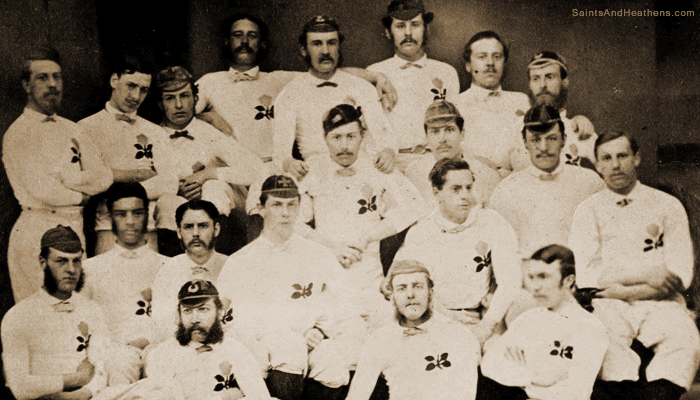
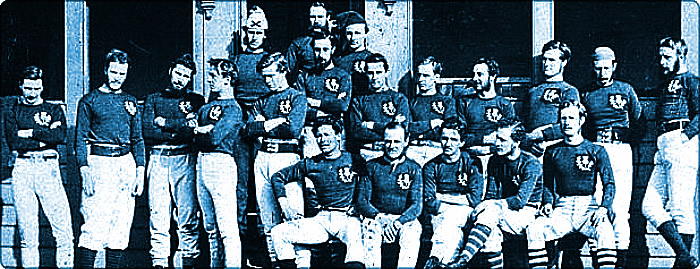
The first meetings between England, Scotland, and later Ireland were all 20-a-side encounters when the international contests began in the 1870s.
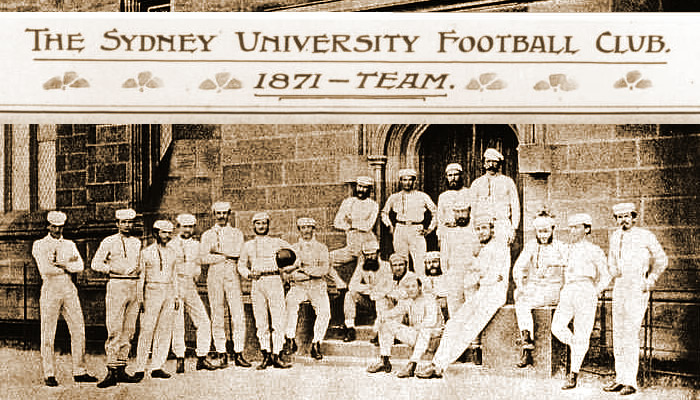
Australian rules kept with the 20-a-side Rugby tradition until the formation of the VFL in 1897 saw the team’s drop to 18 which is still used today in AFL.
Montague Shearman, who was a prominent Rugby player at Oxford University in the 1870s wrote later of the era:
The plain truth of the matter was that the Rugbeian traditions of ‘big-sides’ still remained an article of faith with players … matches as a rule were only between fifteens and not twenties, but … the players … still thought that twenty was the minimum for a model side. So far also did the notion go that scrimmaging [scrums] was the essence of the game … what kept the old system alive was undoubtedly the retention of twenty a side in the international contest with Scotland [vs England].
The bulk of the forwards chosen for the twenty-a-side contests were strong, heavy men, and without strength and weight a player had little chance of making his mark amongst the forward brigade. The result was that under the old regime the typical forward was a man who knew how to ‘shove’ and very likely could do very little else.
So firmly, indeed, was the traditional notion of the ‘big-side’ impressed upon the chief players of the Rugby game, that as late as 1875 the “Football Annual” … was still advising captains … to play twenty-a-side if they could get the men to play. By this time, however, twenties had been abandoned in all but the classical matches of the year …
For those watching on, a dour struggle ensued though.
With 20-a-side each ‘pack’ comprised 14 forwards, who were ‘over’ the ball for most of the game, trying to kick the leather forward to the opposition’s goal and, as a match report stated, “battling for every foot of ground … where the forwards keep it all to themselves and scrummage succeeds scrummage”.
In Rugby scrums in the 1870s heeling the ball backwards and packing with your head down were seen as ‘low tricks’ and severely admonished by both friend and foe alike.
As a half-back the best you could do was hope your opponents kicked the ball too hard and out of the scrum, giving you a chance to pounce on the leather should it suddenly appear.
You were a brave man to pick up the ball and run with it, knowing that if you were caught both packs would descend upon you. Many in rugby possessed “a great objection to see the ball run with and ‘down’ every man who tries it”.
But that was the thrill of it, to “adventure your life” by running with the ball. It was an exhilarating feeling. If you succeeded via a long run or to crown it with a try, you were lauded by one and all.
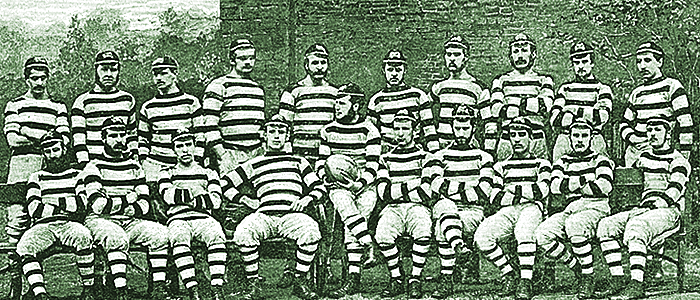
Rugby’s advocates argued that it was the only football game that truly tested a man’s character, while at the same time developed a muscular body from the physical exertion required.
The ‘scrummage’ (or ‘scrimmage’) was called for every time a ball-carrier was tackled to the ground or was ‘held’ and couldn’t advance – ironically, a vestige of 19th century Rugby now long gone from the game, but which has survived in league (play-the-ball) and gridiron (down).
Rugby, especially when 20 a-side, was a game for the players, and no one else. The Argus (Melbourne) informed its readers that the English game wasn’t worth watching or playing: “In the Rugby game half the time is wasted by the scrummaging; which is neither skilful nor graceful, but sheer bulldogism.”
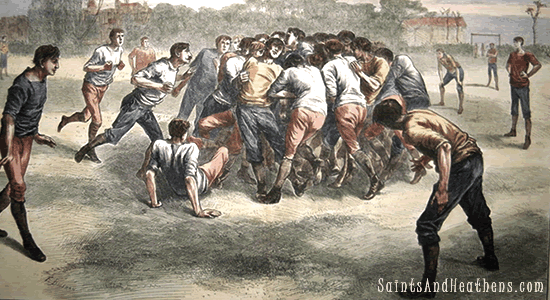
Some twenty metres behind the half-backs were another three ‘backs’. Bigger and stronger men, they were the last resort of their side if the opposition should burst through. They were usually good quick runners, reliable tacklers, secure fielders of the ball, and most importantly the best drop-kickers in the team. If they made a run with the ball the golden rule was to close it with a flying drop-kick for goal, touch or territory before being tackled or cornered. Passing the ball between the backs was rarely seen or encouraged.
 The forwards constituted the majority of a side, but, as Shearman’s recollections have already described, they didn’t require as many special qualifications as backs and half-backs.
Obviously, to be strong in forwards was one of the best qualities that a team could possess. The problem in many places though was that it was near impossible for a club to get fourteen really good men to form a side’s vanguard.
The best forwards needed a thorough knowledge of the game, wise enough to not waste their energies by constantly running from one place to another trying to chase where the ball may arrive. Forwards were invariably sturdily built, able to withstand being knocked about. Forwards generally all kept close around the ball for most of the game.
In a scrummage the forwards of the two sides (28 men) formed a heavy mass, shoving their way for territory, standing shoulder to shoulder and leg to leg as tight as they could, each man pushing the opposite way trying to work the ball through.
The final 20-a-side battles were mostly a game of forwards shoving each other, and the backs making rare long runs and occasionally, and unsuccessfully, taking drop-kicks at the goal posts.
There was soon a growing belief that Rugby with teams of 15 each was a more open game to play and to watch than the ‘shoving match’ that 20 a-side produced.
Though the English RFU’s laws did not finally set down the number of players on a team until 1892, all Rugby in Britain moved to 15 a-side for the 1876/77 season, with the 1875 Oxford vs Cambridge game played 15-a-side cited as the catalyst for the change.
An era had come to an end. With less players on the field, and the shoving scrummages no longer the game, Rugby opened up.
England forward of the 1870s Arthur Budd, writing in the 1892 publication Football : The Rugby Union Game observed:
Scrummaging was then the real article. It meant carrying the pack by superior weight and propelling power … to put one’s head down in a scrummage was regarded as an act of high treason. We were frequently boxed in a scrummage for three or four minutes together, only to discover that the half-back had by that time absconded with the ball to the other side of the ground.
The reduction of the number of players from twenty to fifteen [nine forwards, six backs] may be said to have marked the dawn of modern scientific football. At first, despite this reduction, the arrangement of the back players remained intact, but the forwards, no longer hampered by an overplus of numbers, found themselves able to take an active part in the open play. Fast following up, breaking away en masse, concentrated dribbling, and forward tackling henceforth became features of the game.
In this departure the forwards were greatly assisted by the general recognition of the practice of scrummaging with heads down, which, instead of being regarded with disfavour as hitherto, had by degrees become one of the sine qua non qualifications of a good forward. This innovation was the landmark of scientific scrummaging.
Henceforth players were able to watch with certainty the whereabouts of the ball, and try by skilful manipulation to control its destination, and, henceforth, for this very reason, which so much facilitated a means of exit for the ball, the breaking up of the scrummage became a comparatively easy matter. This fact the forwards were not slow to appreciate, and by breaking up the scrummage as quickly as possible placed this advantage to the scale of open play.
Budd also wrote in England’s Sporting Life in 1899:
The method of scrummaging consisted in straightforward propulsion – still to this day when you can get a body of workers – rara aves [uncommon], it is true, since fashionable innovations have become the rage, still remains to this day the most effective.
© Sean Fagan

 — saintsandheathens.com —