
THE ORIGIN OF STATE JERSEY COLOURS
written by Sean Fagan
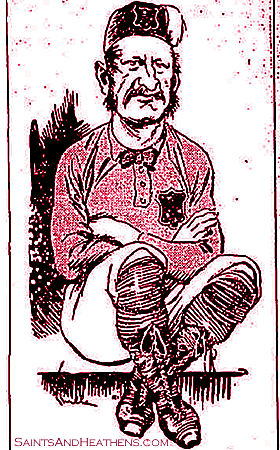
OVERVIEW
The two long rival states of New South Wales and Queensland have been in rugby battle with each other since 1882. Today’s familiar traditional jersey colour clash of light blue / sky blue for NSW and deep red / maroon for QLD was first seen in 1894 and has remained permanent.
These colours were also taken up by the first rugby league state teams in 1908, and are on show in Super Rugby (Waratahs vs Reds) and State of Origin (Blues vs Maroons).
The first NSW sporting use of light blue was the NSW cricket XI in 1858. For maroon and QLD, it came in 1885’s King’s Cup eight oar rowing race. Why these colours were chosen remains largely a mystery as discussed below.
FEATURE ARTICLE
In 1872 the NSWCA (cricket) resolved “The uniform of our players is to be white, with a light blue riband [ribbon],” and for the 1858 game the organising committee “decided that the New South Wales Eleven should wear light blue shirts and white caps – thus to present an agreeable contrast to the white shirts and blue caps of the Melbourne party [the Victorian XI]”.
The NSW light-blue and Victorian dark-blue cricket colours were firmly entrenched by the time NSW and Queensland first met at Rugby football in 1882.
The defining event and influence on our sporting colours appears to have been 1885’s inter-colonial eight oar rowing race (now King’s Cup) held on the Parramatta River course.
The 1885 meet was the first time it had expanded beyond NSW and Victoria to include Queensland and Tasmania. In this race the displaying of colours by the competitors and spectators was particularly prominent, and the first time that Australian sport had witnessed the “Blues” of NSW and “Maroons” of Queensland in battle:
The Sydney Morning Herald [27.4.1885 & 30.4.1885]:
“The New South Wales crew adopted the Cambridge colour, light blue, while Victoria selected Oxford’s, the dark blue. The Queensland crew rowed in maroon, and the Tasmanians in red and white…There were plenty of colours visible on board, the dark [VIC.] and light blues [NSW] predominating. The “banana” [QLD] crew, however, also had their firm supporters, as was shown by the exhibition of that beautiful shade of red-maroon, while the red-and-white ribbons of Tasmania were also conspicuous. It may have been only fancy, but when the steamer [large boat] was returning home it certainly seemed as if the number of gentlemen wearing the light blue ribbon [NSW were winners] had suddenly increased…the crews took their places as follows:- Queensland (maroon) on tho extreme northern buoy, New South Wales (light blue) next, Victoria (dark blue) third, and Tasmania (red and white) on the southern.…the Queenslanders shot away from the Ryde wharf, and pulled over to the Inflexible at a lively pace. Fine muscular men they all looked, their appearance being well set off by their maroon uniforms – if boating costumes may be so called…”
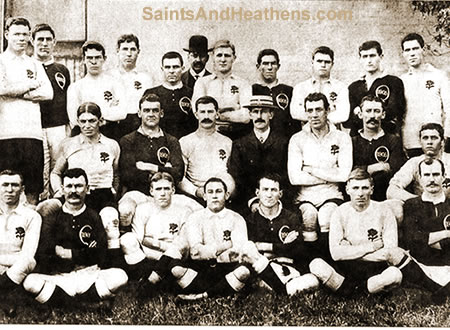
Reporting from the inter-colonial tennis in 1889, Illustrated Sydney News wrote: “The teams wore the colours that have been adopted for all sports except football [all codes] by the colonies, viz. Cambridge blue, New South Wales; and Victoria, Oxford blue.”
Of course, while it can be seen that rowing and cricket, the two most popular and influential sports in NSW and Queensland at that time, soon led to their colours being adopted by the Rugby team of each colony, why these other sports had adopted light blue (NSW cricket/rowing) and red-maroon (Queensland rowing) is not immediately clear. [The Queensland Cricket Association adopted amber and black for its XI’s caps and blazers in 1890, changing to maroon c.1907.]
Unintentionally or not, NSW and Victorian cricketers had created a contest scene between the “dark and light blue” that replicated Oxford and Cambridge. The manner of the NSW cricketers’ 1858 adoption of light-blue though suggests there is no great or hidden significance to the colour, merely that it contrasted with the established Victorian XI’s kit and colour.
It should also not be overlooked that by the mid-1880s each colony’s Rugby body had in mind its place not only in inter-colonial contests, but also the prospect of matches on the international stage, and looking at what colour was still available. Though cricketers had combined to form Australian teams, no attempt was being made to do likewise in Rugby, and it would seem the NSWRU, NZRU and QRU saw themselves as the equivalent of each of the four Home Nations (who had their established colours, and New Zealand went with all black in 1892 when the NZRU was founded). The fact Wales had scarlet (NSW ’86-87), England white (QLD ’86-89, ’93), Scotland a navy blue (QLD ’86-93) and Ireland their green (Victoria 1894) may be why these were ultimately passed over for use by the colonial representative teams.
The light blue in NSW was firmly established in cricket, rowing, tennis and the 1888 centenary celebrations, and it may seem that is why the Rugby team followed, but the NSWRU spent a decade dabbling about with navy blue, green and shades of claret-maroon from 1882 to 1890. The pivotal moment came in 1889 when the Victorian team played in Sydney.
Sydney’s ‘Evening News’ wrote of the Victorians’ outfit in 1889: “They looked very pretty in the field, Victorians wearing light blue jerseys, navy blue stockings, and white knickers.”
With that, seemingly “the penny dropped” for now sky blue envious NSW administrators, but what could they do? The problem solved itself. In 1890 the fledgling rugby fraternity in Melbourne did not play any inter-colonial matches, and then in April 1891 failed to respond to the NSWRU’s invitation for a visit.
In a game at the SCG in late June of 1891, the NSW side entered the playing field in a replica of the Victorian’s “very pretty”light blues playing strip (NSW vs “Central Queensland” from Rockhampton). Other than the badge and minor embellishments, that has been the NSW kit in both rugby codes ever since.
The Queenslanders’ decision to adopt maroon (beginning with their colonial rowing team in 1885) is difficult to decipher, even circumstantially. Maroon was first taken in 1887 by the QRU for the team socks, the same year the Southland RFU (in New Zealand) began to use it for jerseys, and in the following season the NSW team moved to maroon as well. In Melbourne the Fitzroy FC (Victorian rules) began its career in the VFA in 1884 with maroon guernseys. Maroon would seem to have been a stylish and trendy colour that was not previously available, and that may simply be the extent of why it was chosen.
The colour purple has been traditionally associated with royalty for centuries, and given the colony’s name – Queen Victoria herself suggested it be called ‘Queen’s Land’ – a connection seems logical. However, there is no doubt from searching the various Queensland newspaper mentions from 1885-1930s, that the colour chosen by the QRU was specifically “maroon”, a colour tending more toward deep red and not a synonym for purple. While it must also be noted that purple doesn’t appear as an option in football clothing advertisements in the late 1800s, and on that basis maroon could be the nearest option, the much closer “magenta” was available (the Port Adelaide FC a prominent example).
Another theory in Rugby folklore is that the jersey colour was taken from the red deer on the state’s Coat of Arms (though first recognised in 1893, the coat of arms did not include the deer until 1977). In 1873 Queen Victoria donated six red deer to the ‘Queensland Acclimatisation Society’ and their fawns were released into the bush ranges of south-east Queensland. Though the deer would in time become so numerous and destructive to natural flora and fauna to be classed a feral pest, in 1885 they were barely mentioned in newspapers, and not particularly identified with Queensland, given similar releases had gone on earlier in other colonies.
In the absence of any other known source for choosing maroon, the answer may lie with Mount Maroon, located in south-east Queensland near the NSW border. Established on the mountain’s northern base in the late 1840s was the ‘Maroon Station’ sheep grazing farm. It was the most distant point the inland “good bush road” from Brisbane reached by horse-drawn carriage. Anyone but the hardiest travelling from NSW to Brisbane would go by sea – for those that did come up from NSW by horse or foot, following a “bridle track” at times difficult to find, the Maroon Station was the first non-Aboriginal settlement the new arrival encountered on the Queensland side of the border. Originally spelt as ‘Marroon’, the word is an English derivative of Wahlmoorum, the name (meaning ‘sand goanna’) given to the area by the Yuggera (Jagara) people.
Ironically, had the light-blue wearing Victorian Rugby team taken to the field in 1891, NSW may have permanently settled on their scarlet/maroon, and Queensland carried on with dark blue.
© Sean Fagan
