
ORIGIN OF THE ‘WALLABIES’ NICKNAME
written by Sean Fagan
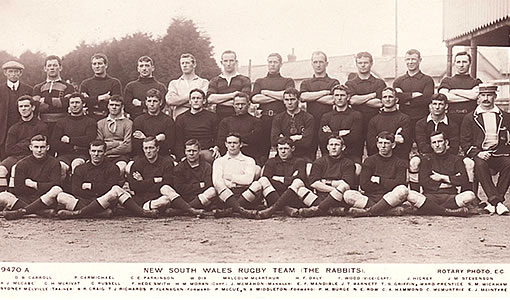
The Australian team made its international debut in 1899, but it wasn’t until their opening tour game in England in September 1908 that they first played as “the Wallabies”. Long forgotten is that their last two games at home in August 1908 were as “the Rabbits”.
The 1905 Australian team that visited New Zealand to play the All Blacks and provincial teams had a large white kangaroo badge on their blue-and-maroon hooped jersey, and a silver kangaroo-shaped lapel or hat pin.
The tourists did not have an official moniker, but newspapers made the obvious connection – for example “the Kangaroo fifteen” (Auckland Star) and “the Kangaroo backs” (Feilding Star).
However, in August 1908 when the first Australian team to tour Britain was being fare-welled it is was clear the team would be leaving under the tag of ‘Rabbits’. The visiting manager of the 1908 British Lions at a NSWRU function in Sydney said:
The Unions in the old country would do what they could to make the visit of the Australians a most pleasant one. At home they had had the ‘All Blacks,’ and the ‘Springboks,’ and now they were to have the ‘Rabbits.’
The name was never officially imposed by the NSWRU, but the news reached England via mail ships well before the team arrived, leading to some confusion in the first weeks of the campaign.

The tourists’ jersey was NSW’s sky blue with waratah badge and ‘Australia’ added underneath. The players also had an off-field coat (blue) in the style now only worn by international cricket teams.
Ernie Booth, a former All Black travelling with the Australians as a reporter for The Referee, wrote from on board the steamship Omrah after leaving Adelaide:
The members of the team are getting along very happily, and are models of decorum. The ‘Waratah’ blazers have a pleasing effect on deck.
On this part of the journey the Australians played against Victoria (at the Melbourne Cricket Ground) and Western Australia (Fremantle Oval), winning both.
Accounts from those on board the ship during the long sea journey northward refer to the team as “the Rabbits”, indicating the party did not yet take exception to the name, at least publicly perhaps (see The Daily Mail report reproduced in Launceston’s The Examiner, 23 October 1908).
In his autobiography book Viewless Winds (see also further below) the team’s captain, Herbert Moran, also confirms they were “the Rabbits” for the duration of the voyage i.e. “we, who for six weeks had been ‘Rabbits’.” As we will see below, “the Wallabies” did not come to be the name until after a team vote was held before the first match which was in Devon.
Moran told the Express that:
We certainly draw the line at being called ‘the Rabbits’, for the only thing I can imagine worse would be to christen us the ‘Convicts’ – both, by the way, came out from England, but whereas one has died out, the other has become a pest. Therefore, let us fix on something as distinctive as ‘All Blacks’ and ‘Springbokken’ were.
After the team settled in at Newton Abbot to begin preparations for their opening games, tour manager James McMahon wrote back to Sydney:
That horrible expression, ‘rabbits’, has arrived, and in some of the papers that is what we are termed. However, I have written to the Press pointing out that it is most objectionable, and we are now being termed the Wallabies. The ‘Daily Mail’ puts it that we are ‘on the wallaby’.
Booth informed readers of The Referee:
A great controversy arose as to what our name should be — ‘Rabbits,’ ‘Waratahs,’ or ‘Wallabies.’ … The discussion as to the name by which the team should be called was settled by the ‘Daily Mail’ wiring to the ‘Wallabies,’ asking them to chose and nominate their sobriquet. They duly choose the name ‘Wallabies’ at a special meeting. ‘Rabbits‘ has, therefore, been dropped by many papers.
The Arrow in Sydney was not particularly impressed:
‘The Wallabies’ as the name for the Australian team was decided upon by a vote of the members [players], on the invitation of the ‘Daily Mail.’ There can be no doubt that ‘The Waratahs‘ would have been more fitting, seeing that the emblem worn on the breast and on the hat band is the waratah.
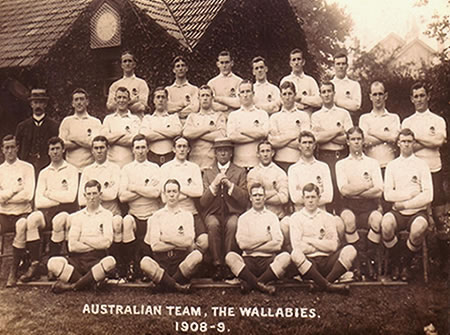
Moran wrote a letter home that included an explanation of how ‘Wallabies’ came to be chosen. Published in Sydney’s Evening News it read:
With regard to our name, we dropped considerable cold water on ‘Rabbits’. Modest though we be, we could not labor under an appellation borrowed from an English imported pest.
There was considerable discussion in English papers. Letters flocked in from all sides. ‘Wallabies, Kangaroos, Kookaburra, and Wallaroos’ were suggested.
The position demanded a conference. For a brief day we, who for six weeks had been ‘Rabbits,’ were ‘Waratahs,’ but that was only emblematic of N.S.W. All were agreed that any name would be preferable to ‘Rabbits.’ ‘
Wallabies‘ won by a couple of votes, so, please, address ‘Australian Team on the Wallaby, England.’
Though many have presumed that the ‘Wallabies’ name was chosen by the team as ‘Kangaroos’ had already been claimed by the rugby league tourists, this is not so.
The Australian Rugby team left Sydney and arrived in England before the league side, and while the latter had a kangaroo on their badge, it wasn’t until the English press pointed out their amateur counterparts had adopted ‘Wallabies’ that they declared themselves as ‘Kangaroos’.
The letter in London’s Daily Mail that had triggered the ‘Rabbits’ debate and swayed the choice of ‘Wallabies’ was written by an ex-pat Australian, using the nom de plume ‘Adelaide’:
Sir.–Relative to the term (Rabbits) to be applied to the Australian Rugby team, may I, as an Australian, suggest a new one, Wallabies.
The rabbit is not native to Australia; it is a pest and an abomination. It was introduced from England and the mere mention of rabbit suggests canned meat.
The wallaby is a native animal, about one of the swiftest and prettiest little creatures alive. I think ‘The Wallabies’ a most suitable name.
Besides, the expression ‘On the wallaby’ in Australia means on the tramp or wander. This interpretation also favours the use of ‘The Wallabies’ for the Australians.
After the vote returned ‘Wallabies’ as the winner, Daily Mail said:
As the New Zealanders have been handed down to fame as ‘The All Blacks,’ and the South Africans as ‘The Springboks,’ so will the Australians be known to posterity as ‘The Wallabies,’ the wallaby being a graceful and agile animal indigenous to Australia, possessed of immense speed. It is a small species of kangaroo, and consequently is a thoroughly national title.

For two decades after the 1908 tour the ‘Wallabies’ moniker referred alone to that team and its players.
The 1912 Australian team that visited North America were unofficially referred to in the newspapers as the ‘Kangaroo Waratahs’. The 1913 side that toured New Zealand were simply the Australian Rugby football team.
NSW teams that played internationals between 1920 and ’28 have been retrospectively granted Wallaby Test status by the ARU, primarily on the basis that with the code not being played in other state at that time, NSW was representative of Australian Rugby.
Of course, today every recognised international game Australia has played since 1899 is regarded as a ‘Wallabies’ appearance.
Older readers may recall that it was a long-held view of some that ‘Wallabies’ officially only applied to Australian teams that undertook a full tour of Great Britain, beginning with the 1908 side. While that may have been the view of those particular Wallabies tourists, as far as newspaper writers at home and abroad were concerned, the Australian team was the ‘Wallabies’ whenever they toured or visited anywhere overseas.
This practice began in 1931 when the Australian team arrived in Wellington, New Zealand, and manager Thomas Davis self-declared to the waiting media, “The team will be known as the Wallabies.”
In 1933 for the tour to South Africa, the NSWRU got in first and successfully recommended to the QRU and VRU that the Australian squad be bestowed the name “Wallabies’,’ and specifically “the second Wallabies,” with the 1908 originals being the first (The Sydney Mail, 10 May 1933).
The change to everyone in the game referring to all Australian teams as ‘Wallabies’, including those on home soil, came in the wake of the success of “the 1984 Grand Slam Wallabies.” From that time on there has been no distinction made in name between home or away appearances.
© Sean Fagan
‘On the wallaby’ is a reference to being on the move, to be travelling from place to place. ‘Freedom on the Wallaby’ was a famous poem written by Henry Lawson in 1891. As discussed in The Rugby Rebellion a ‘Wallaby’ was also a colonial Australian serving in the British navy.

