
HISTORY OF RUGBY IN TASMANIA
written by Sean Fagan
Until the early 1880s the football fields of Tasmania were graced with Rugby goal posts and cross-bars.
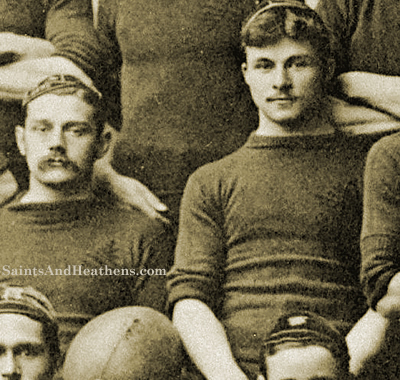
Tasmania’s first Rugby star Henry Braddon (right) – Launceston Grammar School old boy played Rugby for New Zealand and NSW in the 1880s.
The first colony to be established beyond New South Wales’ Sydney settlement, Tasmania (then known as Van Diemen’s Land) has many historical links and landmarks connecting it to England.
Outside of the Port Arthur penal colony, the first half of the 1800s saw the establishment of two of Australia’s now oldest cities of Hobart and Launceston, and Tasmania as the most populous region beyond Sydney and its near neighbours.
In Hobart particularly, newspapers report of the playing and watching of common English sports, including cricket (1820s) and wilder “entertainments” such as cock fighting.
Also common place are holiday fairs and celebrations following the traditional calendar of England. Hobart in particular was a lively city, being regularly visited by English navy vessels, American whaling ships, and home to former convicts, free settlers, and soldiers stationed at the local barracks.
As in Sydney, where folk football was played at festivals and amongst the barracked soldiers since (at least) 1829, documented reports of the old English game begin in Tasmania’s major centres and townships from the 1830s to early 1850s.
In Hobart in 1850 a correspondent to the Colonial Times (10 Sept) lamented the “crying evil” of a recent Sunday football match in the town “by a party of at least 70 or 80 players, composed of boys, youths, and children of a larger growth (men of somewhat respectable exterior), who were heart and soul devoting themselves to a game at foot-ball; and what made the matter worse, the language — cursing, swearing, and shouting were such as would be considered infamous at a fair or on a market day.”
Mentions of football in local newspapers in the ensuing decades though offer little information on the development and type of football in Hobart and Launceston, and the path towards club football and adopting codified football laws in Tasmania is unknown.
With a large proportion of the colony’s population migrating from Britain through the middle decades of the 19th century, it is likely that some local debate about the form football should take presumably took place.
In 1846 Christ’s College was opened in Bishopsbourne (in northern Tasmania), with the purpose of preparing young men so they could further their studies at University in Britain.
One of the College’s earliest students [c.1850] was later Tasmanian politician and Chief Justice, Sir William Lambert Dobson, who recalled that their headmaster was from Rugby School and that he had insisted upon the boys playing football [see Hobart’s The Mercury, 21st April 1888]. The College closed its doors in 1856 (re-opening in Hobart in 1879). More: Rugby made its Aussie debut in 1840s Tasmania
Meanwhile, Thomas Arnold (the son of the famed headmaster of Rugby School from 1824-42) left England in 1850 to become the head of the public education system in Tasmania, overseeing the organisation of 75 schools across the colony, and modelling much of his reforms and initiatives upon Rugby School. Arnold continued in the role until 1856, but whether football was part of school activities is still unknown. The south-west wilderness area of Tasmania includes Mount Rugby and Rugby Range overlooking Bathurst Harbour.
The emergence of Melbourne as a major city through this era saw Tasmania forging a closer economic and cultural connection to its rapidly growing neighbour colony, and less from NSW and Sydney.
Contrary to commonly held narrative, football clubs in Tasmania did not take up Victorian rules in the 1860s. Indeed Hobart’s first two or three clubs did not kick-off at all until 1866 and later, all with just a general observance of the common principles of football from English public schools. Football across the colony in the 1860s was still generally looked upon as a schoolboy game alongside leapfrog and other rough and tumbles.
In February 1865 the Launceston Examiner included an advertisement by a local shop offering a selection of imported footballs, “including the new Rugby shape” ball.
In the capital over 1866-67 matches were played (variously in the Domain and on the ground of the Southern Tasmanian Cricket Club) between the Hobart Town FC and New Town FC. While The Mercury (14 May 1866) noted the latter club “having been established some time.” The contests were per Rugby custom decided on best of three goals and with often twenty-a-side.
A letter to Launceston’s The Cornwall Chronicle of 27 March 1867 confirms that football was played the previous winter under the “XYZ Football Club”, but that it had not adopted any rules of play, and strongly suggested a set based on Eton, Rugby or Harrow games be instituted for the coming season.
In 1870 a Launceston FC was formed (Launceston Examiner, 25 April & 20 May 1871; The Cornwall Chronicle, 30 April 1870) playing through the first part of the decade.
Hobart and Launceston newspapers in 1874 include regular advertisements offering for sale “The full-sized Rugby Match Ball” and “Real Rugby football jerseys”.
A new Launceston FC was raised in 1875 (The Mercury, 19 July 1875) playing games among its members at Windmill Hill under the club’s own football rules (The Mercury, 19 August 1875) and since the “football club had been established it has flourished apace” and that its members were “determined to make all their rules perfect” – a process that would not have been undertaken if they were slavishly adopting Victorian rules.
It would be more accurate to say the Launceston FC was founded as a rugby club and not Victorian rules, as per its opening in-house match:
“The [LFC] match Bankers and Lawyers v. All Comers came off on Saturday afternoon on Windmill Hill, … no goal was obtained by either side before half-time was called. During that time, however, touchdowns were obtained by Barry and Harrap for the Bankers and Lawyers, while Harvey obtained one for the All Comers. .. The All Comers ran the ball up to their opponents’ end, and J. Martin, by a neat drop-kick, scored a goal. Ends were again changed, and after some spirited play, Hobkirk obtained a touchdown for the All Comers, from which no goal was obtained. A run-in by W. Birchall for the Bankers and Lawyers followed, but with a similar result …”
– The Mercury 19 August 1875 & The Tasmanian 21 Aug 1875
In 1878 the Launceston FC was not yet playing under Victorian rules, instead it adopted the football rules of the Hobart Town FC, excluding the latter’s use of a crossbar between the posts (The Tasmanian, 20 July 1878).
The “Tasmanian Football Association” (TFA) was founded amongst clubs in Hobart in 1879, and Launceston’s “Northern Tasmanian Football Association” in 1882 (re-established in 1886).
While convention records that these Associations and their clubs were playing Australian rules football, this is not entirely accurate. As in Brisbane and Adelaide, locally devised forms of football (which had elements of rugby) were being played in Tasmania’s major centres before eventually giving way to Victorian rules.
[See: ‘To The Devil with It! AFL Killed Tassie’s game of our own‘]
Major W.T. Conder, later President of the Australian Amateur Football Council, was blunt when he looked back in The Mercury on 15 September 1936:
“In the ’70s, the Australian game was not played in Tasmania. The football played consisted of soccer, rugby and a cross between the two games known as the Tasmanian game.”
W.H. Cundy, the Victorian missionary who claimed credit for carrying the Melbourne gospel south, arrived in Hobart in early 1878 and discovered what he thought of as “a mongrel sort of game, composed chiefly of soccer and rugby, with some local additions.”
The newspapers of the period bear Cundy out as to the features of the local rules football matches, though not that the game was a mongrel. Hobart and Launceston matches featured rugby cross-bars, goals only counting if they cleared the bar, unrestricted running with the ball, scrimmages that could last an age, place-kick tries, marks from teammates’ kicks, bouncing while running, and constant disputes caused by the variety of rules between clubs.
Adding to the mix through the mid 1870s were other codes. A match between New Town and the Cricket Club that May 1879 highlighted the gulf: New Town’s rules were close to Victorian, while the Cricket Club played under English Association (soccer). The reporter noted dryly that each side would be “victorious when playing under its own rules.”
Meanwhile, the Cricketers’ Club in early 1879 debated its rules at length. Their chairman favoured the full rugby code he had known in England but admitted its sixty rules were “too elaborate to introduce here.” Some pushed for the simpler soccer game, provided drop kicks were also allowed. Others had tried Victorian rules and dismissed them as little more than “a succession of long drop kicks and runs with the ball” and “more the handball played by girls at school.”
Cundy claimed the Hobart clubs resolved to trial every code at the start of 1879: rugby, soccer, Victorian, the local rules, and even a new experimental mixture of all of them. English and Anglo-Indian residents fought hard for the old-country games. Hopes rose for an English Rugby team coming to the colonies and Tasmania, a tour that might have swung the balance towards rugby. But the NSWRU could not raise the necessary financial guarantees, and the venture collapsed.
Midway through that experimental 1879 season, the Hobart clubs formed the Tasmanian Football Association (TFA) and held their ballot as to what rules to play football under. According to Cundy, Victorian rules won—by exactly one vote.
Except, contrary to Cundy’s recollection, the locals took the VFA rules at that meeting, and before adopting them, made fundamental changes; the TFA outlawed tackling and pushing over of ball-carriers, and added between the goal posts the rugby cross-bar, insisting the ball must clear over it to count.
The Mercury was scathing on 16 and 17 June 1879, declaring the compromises “a mockery and a delusion” that changed the entire character of the play, and the adopted rules “effect will be to originate a Tasmanian code of rules, which the colony will enjoy by herself so long as her isolated position is kept up…To say that the Victorian code is adopted, with modifications, is absurd.”
This unique Tasmanian football game evolved from Cundy’s 1870s “mongrel game” (sic) into a formally constituted Tasmanian football code under the TFA by 1879. The majority of the clubs in the north of the colony centered around Launceston took up these rules up as well.
In 1883 a game under Tasmanian rules between North and South was held.
“McLeod then secured the ball from a weak kick off, and taking a flying shot secured the first goal for the South amid loud cheers. After the kick off A. Stuart and Goddard returned the oval to the vicinity of the Northern goal, when Duffy, getting the oval out of a scrimmage, sent it flying over the bar – number two for the South.”
– Launceston Examiner, 10 September 1883
At TFA’s meetings earlier in 1883, Cundy was back. He advocated hard for the assimilation of rules with the VFA to further his dream of adopting the Victorian code. He argued it was particularly needed to bring about inter-colonial matches and visits. This change, however, was “vigorously opposed” by the majority as it meant removing the rugby cross-bar and allowing pushing.
Critics expressed that an entire season of enjoying football under their own game was being sacrificed under the pretext of preparing for the promise of inter-colonial matches; after all, these contests were rare and even then only involved a minority of the players.
So committed were they to their own game that in November 1883, the TFA sent delegates to a Melbourne meeting of all colonies playing versions of the Victorian code. There, with “strenuous endeavours,” they argued that any uniform code of rules should ban pushing, “the abolition of goals from free kicks,” and to add the cross-bar. None of the proposals were taken up, and after reporting this disappointing outcome to members at the TFA meeting in May 1884, the weight of pressure finally told; during a vote, the majority declared in favour of adopting Victorian rules.
In the north of Tasmania the clubs met in Launceston, well aware of the TFA events and the Melbourne conference. They decided to continue “the Tasmanian rules … that the rules which have been formerly recognised in Tasmania be adhered to.” However, by May 1886, the Northern Tasmanian Football Association was under Victorian rules.
How strong an influence rugby had been in football in Tasmania in the 1870s and early 1880s remains questionable. While its sports fields were, at least for a time, graced with rugby posts with a cross-bar, once the firm decision to adopt Victorian rules was made, it had immediate and permanent effect.
When the first British rugby team finally sailed from Plymouth in 1888, their initial stop-over in Australia was at Hobart. Arriving in the early evening, the tourists were entertained at a lavish dinner put on by the TFA. Relations between the two codes were more than cordial, but there was never any prospect of a rugby match being arranged. For rugby’s hopes in Tasmania, the tour had come a decade too late.
In 1905 ‘The Fleet Rugby Football Club’ was formed in Hobart. Composed of officers of visiting British Royal Navy warships ‘Euryalus’ and ‘Psyche’, matches were held on New Town sports ground, offering passing interest to curious onlookers.
The code was so much a mystery that in 1913 The Mercury wrote, “In Tasmania rugby football is not known. It is as foreign to the sports of Hobart and Launceston as tobogganing is to Sydney.”
Ironically the era had seen two Tasmanians gain international caps in the Home Nations while studying in the UK (Allan Stewart for Scotland 1913-14 & Lyndhurst Giblin for England 1896-97) [read profiles]. In the 1880s former Latrobe bank clerk Harry Braddon, son of Tasmania’s Premier (Edward Braddon), had played for New Zealand and NSW, and in the 1920s he became President of the NSWRU [ADB entry].
Organised Rugby finally emerged in Tasmania in May 1933 with the formation of the Launceston Rugby Club. Initial informal games were held at the Showground, and the first official match between the club’s members was played at the Cornwall Ground on 27 May. The chief driver of the movement, and the club’s inaugural president, was J.B. White, who was variously reported to be “a former Scottish international player”, though records place some doubt on what level of the game this honour was achieved.
Upon learning of happenings in Launceston, interest grew in Hobart, and in July a group of Rugby enthusiasts played a game at the Christ College Ground (now called Parliament Street Reserve) in Sandy Bay. The majority of the players were from the College, leading to the founding of the Tasmanian University RUFC. The Harlequins club was established before the season ended, as was the Southern Tasmanian Rugby Union.
The Christ College players also formed a team to participate in the University’s internal competition. The College side still plays today and, based on the College’s 1847-49 era under Gell, holds the oldest (earliest) rugby provenance of any club or team in Australia.
Hobart’s The Mercury writing in July 1933 suggested that, “As Rugby football is played in most parts of the British Empire, it is pleasing to see Tasmanians take to it,” while Launceston’s Examiner added soon after, “Rugby is a universal game, not confined to one country, but spread throughout the world.”
In August 1933 the first annual North-South representative game was held, with the Launceston-men taking a 12-3 victory at the South Hobart Recreation Ground. The following season included a short tour by the Melbourne University team, with games against ‘Northern’ and ‘Southern’ XVs, as well as a 41-0 win over the Tasmanian University team. The two rep teams also played against visiting Naval units from Melbourne and New Zealand.
The 1934 season also saw the first club premierships held. The Hobart competition was played between the University, Harlequins and a team called ‘Huon’, based at Huonville, some 40km south of the city. In the north the Launceston club divided playing stocks, forming the Alhambra and Waratah clubs, who held a “best of three” series over consecutive Saturdays to decide the city’s first premiers.
On the representative scene the first Tasmanian XV was chosen for games against visiting Sydney clubs Gordon (1936) and Western Suburbs (1937).
In Hobart particularly the code found securing a ground close to the city centre very difficult. Early in 1936 the City Council announced that Rugby had been granted the lease for the coming season of the New Town ground, situated within 2 miles of downtown Hobart. However, as reported in the Examiner, “the action of the Council met with strong disapproval from followers of the Australian code as well as residents of New Town”, and the decision was rescinded. The Rugby authorities were instead left with the then more remote Queensborough Oval in Sandy Bay.
By 1938 a “State Premiership” game between the winners of the two club competitions had been introduced – in 1939 Launceston had three clubs (Wellington, Alhambra & Launceston Technical College ‘Old Boys’) and Hobart four (Glenorchy, ‘Army’, Harlequins & Huon).
After WW2 the club competitions resumed, first in Hobart (in 1946) where ‘Army’ were replaced by University (fielding their first team since 1937), and then in Launceston (in 1949) with Glen Dhu club instead of the ‘Technical Old Boys’ team.
The Tasmanian team made its first appearance at the inter-state level in June 1951 when it took part in a four-state tournament hosted by the South Australian RU in Adelaide. The first carnival of its kind, the traditional Rugby states of NSW and Queensland, as well as the ACT, took no part. Tasmania found the going hard, losing the opening game 29-3 to South Australia on the Adelaide Oval, then were swamped by the Victorians 53-3, but at 11-0 down against Western Australia, rallied back to finish 14-9 behind.
A milestone day was reached in 1968 when the New Zealand ‘All Blacks’ made their first visit, playing the Tasmanian state team at Hobart’s Queensborough Oval. Understandably the result was no surprise, with the visitors notching 18 tries in a 74-0 hiding. At the same venue in 1980 against the All Blacks the result was 73-0. The locals at least got some points against other touring teams, France 45-12 in 1972 and Fiji 48-8 in 1976.
Senior club Rugby in Tasmania today is conducted under a state-wide competition that in 2014 has 10-teams. Six of the teams come from the greater Hobart area, with 1930s-40s established clubs Harlequins, Glenorchy ‘Stags’, University, and Taroona ‘Blues’, alongside Easts ‘Roosters’ and Hobart ‘Lions’. The remaining clubs are from the North of the state, including Launceston ‘Tigers’, Burnie ‘Emus’, Devonport ‘Bulls’, and Australian Maritime College RUFC (based at Launceston).
© Sean Fagan
References.
Contemporary newspapers as mentioned.
Fullpoints Footy
 — saintsandheathens.com —