
The AFL proudly boasts it created “A Game of Our Own.” Maybe it did. But so too had Tasmania—forging a unique Van Diemen’s Land-brewed football dubbed by Hobart’s The Mercury as the “Tasmanian code of rules.”
The local code thrived until the early 1880s, when Melbourne’s long-armed influence reached across the strait and, without a shred of sentiment, quietly choked it off.
To the devil with it!
Story written & researched by Sean Fagan ©
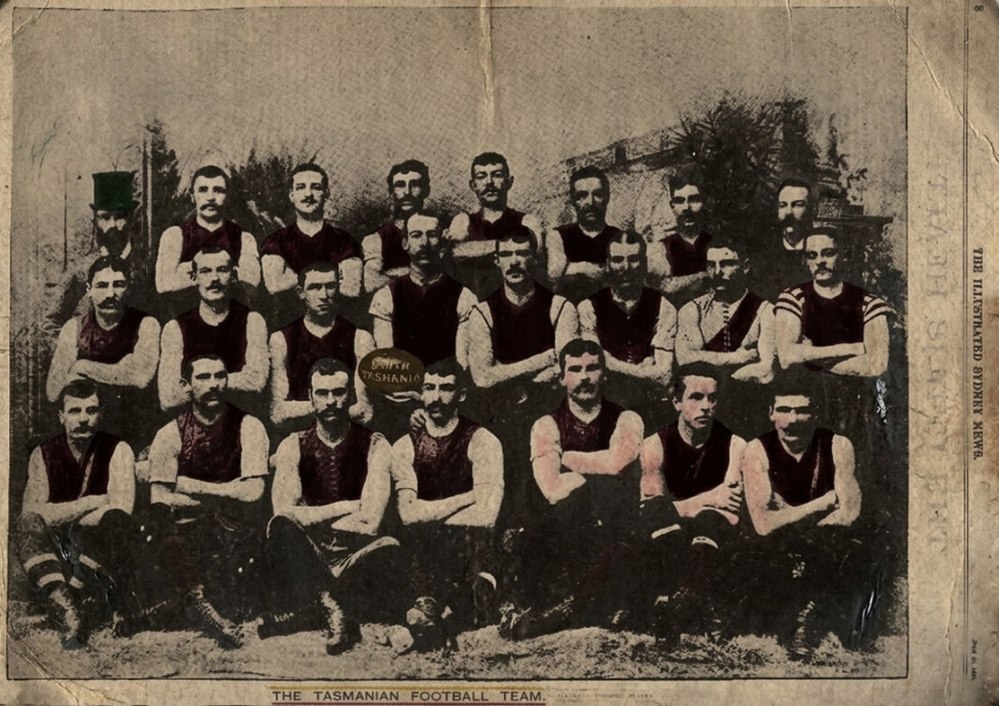
THE DANDIEST FOOTBALL RULES EVER
Listen up, and I’ll tell you the whole story. This is the true story, not the one they still preach from the rooftops in Melbourne. Their stirring AFL creed claims it is “A Game of Our Own.” They make it seem as though a handful of fellows in the late 1850s performed a unique act of colonial Victorian genius, handing down a set of rules touched by perfection. Looking on, and overcome by sheer wonder, Tasmania’s footballers in the 1860s supposedly rushed to join the euphoria.
Truth be told, all around the Empire, clubs and schools were devising local rules to play football. The 1859 Melbourne FC rules were simply one of many dozens of variations. Maybe they were the dandiest set of football rules ever conceived, but given they were soon amended often enough, probably not.
Anyway, as some know, Melbourne was born out of pioneers from Van Diemen’s Land. Hobart (1804) and Launceston (1806) were cities a good thirty years before Melbourne (1835). Heck, the pup of a city was still part of New South Wales and answerable to Sydney until 1851. The southern island gave up its convict prison-island name, Van Diemen’s Land, to the more scenic “Tasmania” in 1856.
LEAPFROG & OTHER ROUGH & TUMBLES
Yet, the island too had forged a football game of its own—rough-hewn, practical, and born of its independent streak—only to see it extinguished not by superior play on the field, but by the economic gravity of a gold rush mainland neighbour.
The 1860s and 1870s were a time when every decent-sized town across the British Empire was having its own crack at football. Tom Brown’s Schooldays had made Rugby School football wildly fashionable, but the actual rules on the ground varied markedly from paddock to paddock.
Sydney leaned heavily into the rugby game. No surprise given it was the first colony, built on the fiery spectator sport of the red-coated NSW Rum Corps against the iron-willed Governor Bligh. The Van Diemen’s Land colony, too, was more British bulldog mixed with convicts, bushrangers and American sealers and not your sunny pink rose tea garden.
At an 1847 meeting in Launceston to support the ending of convict transportation to the colony—attended by local merchants, professionals and clergy—it was noted that while the military and free servants had virtually no leisure time, one could always hear “the shouts of convicts at foot-ball.”
Contrary to commonly held narrative, football clubs in Tasmania did not take up Victorian rules in the 1860s. Indeed, Hobart’s first two or three clubs did not kick-off at all until 1866 and later, all with just a general observance of the common principles of football from English public schools.
Football across the colony in the 1860s was still looked upon by most of the community as a schoolboy game sitting alongside leapfrog and other rough and tumbles. Real emergence of football as an adult sport did not begin until the 1870s.
THE TASMANIAN ‘MONGREL GAME’
Naturalist and biologist Charles Darwin visited Hobart well before these football codes arrived, but his survival of the fittest theory applies well. Pity he didn’t visit a little later! He would have seen his laws of evolutionary pressure playing out on the rutted paddocks of Tasmania, where a localised, isolated species of football was ultimately driven to extinction by the overwhelming size, cash, and aggressive adaptation of the booming mainland variety.
W.T. ‘Wally’ Conder, later President of the Australian Amateur Football Council, was blunt when he looked back in Hobart’s The Mercury on 15 September 1936:
“In the ’70s, the Australian game was not played in Tasmania. The football played consisted of soccer, rugby and a cross between the two games known as the Tasmanian game.”
W.H. Cundy, the Victorian football missionary who claimed credit for carrying the Melbourne gospel south, arrived in Hobart in early 1878 and discovered what he thought of as “a mongrel sort of game, composed chiefly of soccer and rugby, with some local additions.”
The newspapers of the period bear out Conder and Cundy as to the features of the local-rules football matches, though not that the game was a mongrel.
In 1878, the Hobart Town (“City”) Football Club’s rules included a requirement that goals pass over a rugby crossbar, as well as bans on free kicks and the pushing of opponents. The founding rules and matches of the Launceston Football Club (LFC) in 1875 had distinctly non-Victorian features. Rather, its game was or very closely followed rugby football, as it featured long runs while carrying the ball and rugby-style goal-kick attempts after running in tries (touchdowns).
“The [LFC] match Bankers and Lawyers v. All Comers came off on Saturday afternoon on Windmill Hill, … no goal was obtained by either side before half-time was called. During that time, however, touchdowns were obtained by Barry and Harrap for the Bankers and Lawyers, while Harvey obtained one for the All Comers. .. The All Comers ran the ball up to their opponents’ end, and J. Martin, by a neat drop-kick, scored a goal. Ends were again changed, and after some spirited play, Hobkirk obtained a touchdown for the All Comers, from which no goal was obtained. A run-in by W. Birchall for the Bankers and Lawyers followed, but with a similar result …”
– The Mercury 19 August 1875 & The Tasmanian 21 Aug 1875
When the country clubs at Richmond, Coal River and Brighton first began to meet Hobart’s City FC, the captains had to sort out their stark differences in rules beforehand.
The rustics were invariably asked to suspend their use of the “relic of barbarous football, tripping and hacking,” and in return the City side promised to cease “running away with the ball, instead of playing football, or kicking it with their feet.” The countrymen all found themselves “placed at a disadvantage by the novelty of the ‘Mark’ rule, with which they made their acquaintance for the first time.”
Until things settled, City was confronted with goals claimed not by kicks, but by carrying the ball between the posts (Coal River) and pushing the ball through with hands (Richmond).
The games of other Hobart and Launceston clubs also featured the cross-bar, unrestricted running with the ball, scrimmages that could last an age, place-kicks at goal, and marks from teammates’ kicks. These elements were mixed with constant disputes and delays over “mooted points” caused by the variety of rules between clubs.
Adding to the mix through the mid 1870s were other codes. A match between New Town and the Cricket Club that May 1879 highlighted the gulf: New Town’s rules were close to Victorian, while the Cricket Club played under English Association (soccer). The reporter noted dryly that each side would be “victorious when playing under its own rules.”
The members of the Cricketers’ FC around this time were at length debating their football playing rules. Their chairman favoured the full rugby code he had known in England but admitted its sixty rules were “too elaborate to introduce here.” Some pushed for the simpler soccer game, provided drop kicks were also allowed. Others had tried Victorian rules and dismissed them as little more than “a succession of long drop kicks and runs with the ball” and “more the handball played by girls at school.”
Cundy, who in 1879 was captain of the Railway FC, claimed the Hobart clubs resolved that season to trial every code: rugby, soccer, Victorian, the local rules, and even a new experimental mixture of all of them. English and Anglo-Indian residents fought hard for the old-country games. Hopes rose for an English Rugby team coming to the colonies and Tasmania, a tour that might have swung the balance towards rugby. But the NSWRU could not raise the necessary financial guarantees, and the venture collapsed.
THE TASMANIAN FOOTBALL CODE
Midway through that experimental 1879 season, the Hobart clubs* and Richmond formed the Tasmanian Football Association (TFA) and held their ballot as to what rules to play football under. According to Cundy, Victorian rules won—by exactly one vote.
Except. Mr Cundy, that is not the full story at all. Tasmania did not convert to Victorian rules in 1879.
The locals adopted the VFA rules at that meeting but could not resist making immediate, fundamental changes. The TFA outlawed all pushing of opposition players—whether they had the ball or were in motion. They also added a rugby crossbar between the goalposts, insisting the ball must clear it to count. The playing ground was rectangular, and the game commenced with a place-kick from the middle of the field with each team in its own half.
Writing in The Mercury on 16 and 17 June 1879, its football reporter illustrated how a few seemingly minor word alterations or omissions to the rules profoundly changed the game, leaving it out of harmony with Victorian code.
“… when it oozed out that the first rule … terminated with the words: “to these (goal) posts shall be attached a horizontal bar, 10ft from the ground, over which the ball must be kicked to secure a goal.”
These are words which make the so-called adoption of the Victorian code a mockery and a delusion, the innovation being of so glaring a character as to entirely change the form of the play, and to rob it of its principal points of interest.
[With only goals kicked above the cross-bar counting] the post of goalkeeper [full-back], to which one of the coolest and steadiest was ever appointed, and which has been an object of aspiration as a place of trust, is at once swept away; while the occupation of the goal sneak [small forward]—the quickest, sturdiest, and most alert of the forward players—is also gone.
The changes consequent on the adoption of this single excrescence from the Rugby Union code are, however, too numerous for noting in detail…
It is to be regretted that the matter has not been regarded upon a broader basis, with a desire to be in accord with Victoria, the great home of football in the colonies, instead of to take up the isolated position Tasmania will now hold.
Even though, as we anticipate, the new idea is accepted, its effect will be to originate a Tasmanian code of rules, which the colony will enjoy by herself so long as her isolated position is kept up; but as soon as any intercolonial visits are projected, she will have to make a retrograde movement, and take new ground when she is called on to show her strength.
To say that the Victorian code is adopted, with modifications, is absurd.”
This unique Tasmanian football game had now evolved from Cundy’s 1870s “mongrel game” (sic) into a formally constituted Tasmanian football code under the TFA by 1879. Tasmania’s game of their own.
The majority of the clubs in the north of the colony centered around Launceston took up these rules up as well. In 1883 a game under Tasmanian rules between North and South was held.
“McLeod then secured the ball from a weak kick off, and taking a flying shot secured the first goal for the South amid loud cheers. After the kick off A. Stuart and Goddard returned the oval to the vicinity of the Northern goal, when Duffy, getting the oval out of a scrimmage, sent it flying over the bar – number two for the South.”
– Launceston Examiner, 10 September 1883
PUT THE AXE AWAY – THE CROSS-BAR CAN STAY
When the first Victorian clubs visited Tasmania—Hotham FC (now North Melbourne) in 1881 and Essendon FC in 1882—they insisted upon playing under their own rules. The furthest Essendon was prepared to concede to the combined Tasmanian team was letting them keep their crossbars up between the goalposts.
Per Hobart’s The Mercury, the Essendon men won their matches there easily as they were “playing by their own and not by the Tasmanian rules.” Likewise, The Telegraph noted in Essendon’s game at Oatlands that “the local men hadn’t a ghost of a chance, no doubt playing under strange rules was a great disadvantage to our men.”
NO MELTING-HEARTS IN MELBOURNE
At the TFA’s meetings earlier in 1883, Cundy was back. He advocated hard for adopting the VFA rules to further his dream of unifying the football of the colony with Victoria. He argued it was particularly needed to bring about inter-colonial matches and visits. This change, however, was “vigorously opposed” by the majority as it meant removing the rugby cross-bar and allowing pushing.
Critics expressed that an entire season of enjoying football by their own game was being sacrificed on the pretext of preparing for the promise of inter-colonial matches; after all, these contests were rare and even then only involved a minority of the players.
So committed were they to their own game that in November 1883, the TFA and some of the Launceston clubs sent Cundy and Mr C.H. Westwood (Cricketers FC) as delegates to a Melbourne-hosted convention of all the colonies playing versions of the Victorian code. Their mission was audacious: they were to pitch the unique Tasmanian rules to the mainland powerhouse, hoping to convince the other colonies to adopt them.
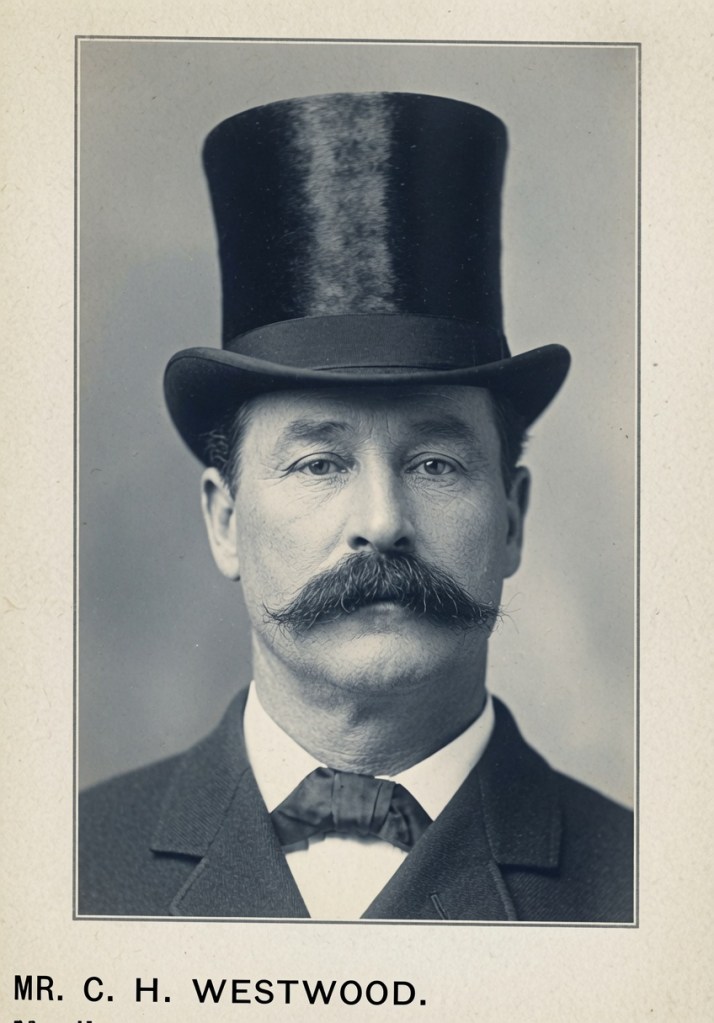
Like Lewis Carroll’s innocent Alice making her way to the court of the Queen of Hearts, the pair set out across the windswept strait and stepped into the Melbourne seat of football power. Yet, once there, it was Westwood alone who carried the true convictions of Tasmanian footballers; Cundy was meant to be by his side arguing the Tasmanian case, however he conveniently went missing (and duly earned a seat in the AFL Tasmania Hall of Fame).**
There, solitary but determined, Westwood made “strenuous” efforts and “had endeavored to establish the Tasmanian rules in Victoria” by arguing for the banning of all pushing with the hands, “the abolition of goals from free kicks,” and to add the cross-bar.
But instead, what this innocent Tasmanian abroad found was that the Melbourne sports big-wigs were more along the lines of that same tyrannical Queen—stubbornly unyielding, with absolutely no melting hearts when it came to football. None of the TFA’s proposals were taken up.
At the TFA meeting in May 1884, Westwood reported that in Melbourne “He did not have a single voice in his favour, so he could do nothing.” The weight of pressure finally told; with Westwood’s advocacy, the clubs voted in favour of switching to Victorian rules. Cundy again was not present; this time he was “on holiday” in Melbourne, where he played a VFA game for Essendon FC.
In the north of Tasmania though the “senior” clubs, aware of the TFA’s decision and the Melbourne conference, still held out, deciding to continue “the Tasmanian rules … that the rules which have been formerly recognised in Tasmania be adhered to.” However, the Launceston FC (L.F.C.) pressed on under its preferred Victorian rules and spoke of joining the TFA.
“The L.F.C. is determined to abide by the Australasian [Victorian] rules, and the City and Alberts are equally determined to stand by the old Tasmanian rules … It seems a rich joke, and one that would be enjoyed immensely in the other colonies, that two clubs comprising, say in round numbers, fifty (50) efficient playing members, should attempt to overthrow a code of rules drawn up by a convention representing several thousands of footballers.”
– Daily Telegraph (Launceston), 16 May 1884
THE LAST OF THE HOT-TEMPERED TASMANIANS
A game in late 1884 at the Longford Cricket Ground between the “first twenties” of the home club and the Launceston FC turned into a free fight, when the visitors insisted in playing under Victorian rules. The Longford footballers were staunchly for the Tasmanian code and most of its team had never played the Victorian version. The Longford captain was confronted with hot tempers trying to convince his own men to concede to the request so the contest could go ahead, especially with the ground bursting with spectators.
“Saturday’s football match here, Longford v. Launceston, turned out an unhappy one from beginning to end. At the outset, the local captain (Hudson) had some difficulty in persuading several of his men to play under the new rules, and their short experience of them to all appearance did not make them any the more liking, exhibitions of temper with main force being brought freely into requisition. The vice-captain (Stokes) came in toward the finish for an ugly blow in the face, quickly followed up by an apology, while other players on both sides had some nasty tumbles, the result in some instances of reckless excitement; in fact, on the whole the game was considered the roughest ever played here, causing several local enthusiastic players to aver that it would be their last game with [against] the Launceston Club, if not altogether.”
– The Tasmanian, 23 August 1884
“The ground was wet and slippery, causing any number of tumbles, and all through the game it was exceedingly rough. Main force, making for the man instead of the ball, was used freely; in fact, so disgusted are the local team that several stated it to be their last game, considering that under the new rules the science of the game is completely gone … At the conclusion of the game, cheers were heartily given by the visitors for the local team, and vice versa, but the angry words exchanged between some of the members of both teams on leaving the ground gave unmistakable evidence that the friendly spirit of rivalry which once existed had been almost, if not entirely, destroyed…”
– Launceston Examiner, 18 & 20 August 1884
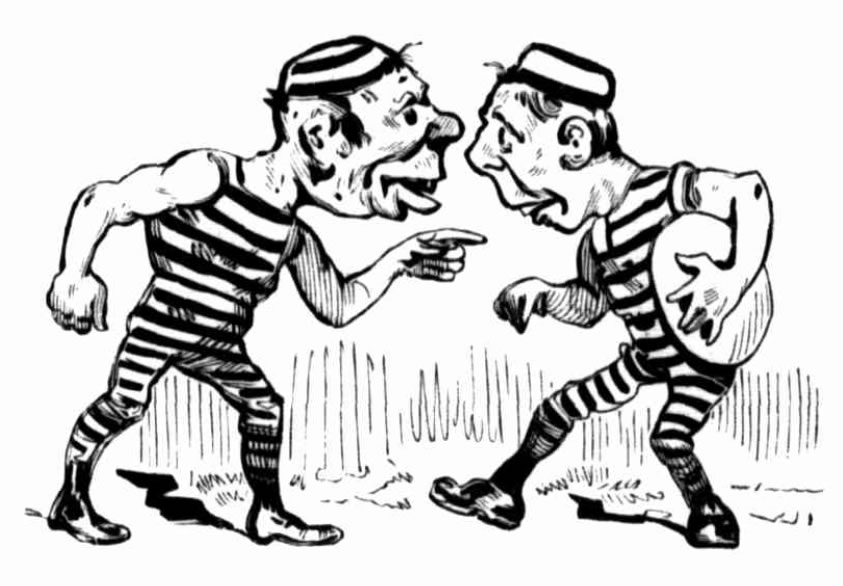
With so few clubs in the region this divided state of affairs could not last long. The Launceston FC induced all of the other clubs to switch. The Longford FC*** disbanded and the town had no senior club in 1885. The whole of the colony was now under Victorian rules.
We cannot say if the Tasmanian game was better or worse than Victorian code to play or to watch just by looking at the rules, and old newspapers have only captured so much information. The insistence upon not having any pushing of opponents allowed at all, suggests the Tasmanian code was less about “going for the man, and not the ball” and not as injurious to the players.
As indicated by the amount of letters to newspapers from old players and supporters bemoaning the change, the loss of the old code was mourned far wider than just Longford. For instance from ‘An Old Footballer’ in The Mercury (Hobart) 5 and 12 June 1884:
“SIR—The experience that footballers have now of the working of the new rules has convinced them, I am certain, that the change has not been for the better. I think that if it were put to the vote as to what rules we should play under, the majority would be for the retention of the old ones. Anybody observing the match last Saturday between Cricketers and City must have seen the great risk the players ran of dislocating a limb or otherwise being injured. If the above-mentioned match is any criterion of what future ones will be, the Football Association ought to see about providing a stretcher in case of accident. Another thing against the new rules is that the practice of pushing allows too much laxity for the exercise of personal spite.
….
It is well known that we altered our rules—not because there was any fault to be found with them, but from a desire to join in intercolonial matches and be on an equal footing with our neighbours in the other colonies in regard to their rules. As an instance to show how dangerous football is considered in Victoria, the banks refuse to allow their clerks to indulge in it…”
The Tasmanian hybrid improvisation had preserved features and rules favoured by the local people, enjoying football on its grounds and as played by its players.
A FOSSIL CODE
What is clear is that the game did not die because it was inferior. It died because it lacked the weight of a metropolis on the scale of Sydney or Melbourne, and depleted the chances for inter-colonial matches and visits. Ultimately, power, influence, and the practical need to stay connected to the mainland mattered more than abstract sporting merit. In place of character, the island received standardisation.
Tasmania kept producing tough, skilful footballers, but under rules made on the northern shores of Bass Strait. Its own game became just another forgotten footnote in the march toward a so-called national code.
The extinct Tasmanian footy was gone, but unlike the extinct Tasmanian tiger, it has not been celebrated and revered in its afterlife. No searches are made for traces of it. No museum exhibitions.
That, sadly, is how football history is often told—by the victors. There are no “Tasmanian football” code historians, and no interest by AFL Tasmania, NTFA and SFL.
So when the modern AFL narrative presents Melbourne’s first football rules invention as a singular act of Victorian or Australian originality, and Cundy as “the father of Tasmanian football”—when he was actually a key figure in helping to kill the real Tasmanian football—well, “To the devil with it!”
© Sean Fagan.
* Hobart clubs at the TFA meeting adopting Tasmanian rules football were Cricketers, New Town, Railway, City, High School & Hutchins School, as well as Richmond club – see The Mercury 16 June 1879 & 12 September 1903.
** Daily Telegraph (Launceston) 30 Nov 1883 “Mr Cundy should also have been present but arrived too late.” TFA switched codes on Westwood’s advocacy, while Cundy was playing for Essendon vs South Yarra in Melbourne per The Mercury 13 May 1884, The Australasian 31 May 1884, Leader 17 May 1884 & Sportsman 14 May 1884. Charles Hutton Westwood is not an AFL Tasmania Hall of Fame inductee. Cundy’s age at the time of his death in 1935 was given in newspapers as 71, however that would mean he was an unlikely 15 years old when he first appeared in Hobart football in 1879 as captain of the Railway FC and advocated for Victorian rules at TFA meetings.
W.H. ‘Bill’ Cundy induction entry > link
C.H. ‘Charlie’ Westwood obituary > link
*** Longford FC (AFL) ‘Tigers’ today appears to claim it was founded in 1878, however per the contemporary newspapers there was no Longford FC until 1880 (see Launceston Examiner 1 May 1880) & as discussed above it was a Tasmanian rules club & disbanded after 1884. The town had no Longford FC in 1885-86, other than an entirely existing and separately formed ‘Longford Juniors FC’. The current Longford FC who joined the Launceston club competition (NTFA) in 1926 was founded as the ‘South Esk FC’ in 1887 by the South Esk Rowing Club – see Launceston Examiner 9 April 1887 & Saturday Evening Express (Launceston) 31 July 1937. In local newspapers over the 1903-04 period the South Esk FC name disappeared and a Longford FC is mentioned, however rather than this being indicative of a mere change in club name, the reports re the meetings of the Longford FC suggest it was a newly founded club.
Note: In the 1870s in Adelaide (South Australia) there too the football clubs had their own distinct local rules prior to 1877, most notably the “Kensington Rules“.
When is a football code established?
Criteria A (The Text-First Standard): If a code is defined by the earliest written club rules that evolved into a modern game, Association Football (Sheffield, 1858) is the oldest, followed by Australian Rules (Melbourne, 1859).
Criteria B (The Association Standard): If a code is defined by the first unified meeting of a multi-club association, soccer Association Football (1863) is the oldest, followed by Rugby Union (1871) and Australian Rules (1877).

