
The Surprising History of Jersey Innovation
Story written & researched by Sean Fagan for SaintsAndHeathens
CARD-SELLERS & BOOK-MAKERS
We are all long accustomed to seeing players in the rugby field wearing numbered jerseys, even in school or junior club rugby, but there was a time when this was a startling new innovation.
In the rugby heartlands of Australia and New Zealand, it was an established custom from the early 1900s onwards in representative matches and club competitions such as in Sydney.
In Britain, though, it was a post-World War One era development.
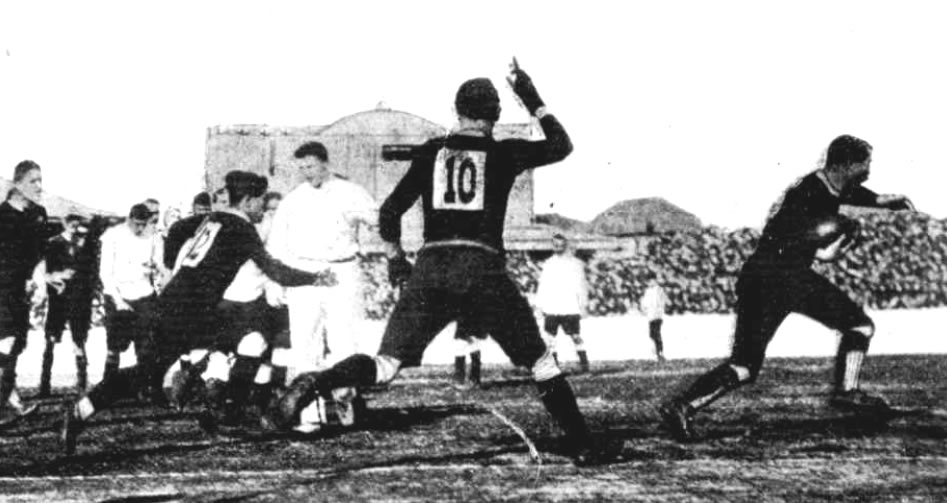
The trouble centred on the fact that having jersey numbers appealed to the interest of spectators and gamblers, and that was not what amateur rugby union and “the team and not the individual” was about. Critics of rugby league and professionalism called it “circus entertainment” for the reason that it was aimed at attracting the crowd.
The trick, of course, was to prepare and preferably sell to the gathered onlookers a match programme with the players’ names and corresponding numbers. It was no different to the reference cards and numbering used since the 1890s for sports with individuals contesting with each other at the same time, such as cycling.
Ernie Booth, a former All Black travelling with the 1908 Wallabies as a reporter for Sydney’s The Referee, wrote from the opening game against Devon County in England:
“Seated at the Press table I asked a scribe why the players had not yet adopted numbers on their backs. His reply was significant. The English ‘Old Granny Union’ will not adopt any innovations.”
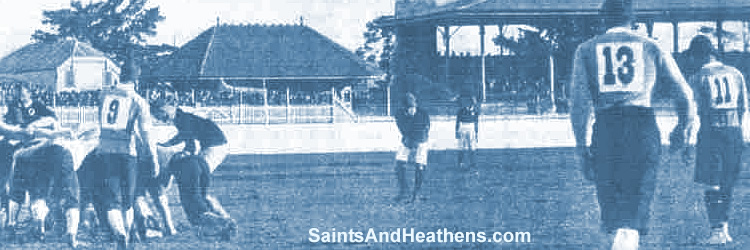
WITH NUMBER-PLATES ON THEIR BACKS
Good sense of a kind though soon came, as London’s The Field observed in 1923:
“It is gradually becoming possible to extract a good deal of entertainment from that most excellent practice, which is daily becoming more and more prevalent, of numbering the players in a Rugby match.
“For instance, it is already evident that the method of allocating numbers to their representatives differs in different clubs. Most clubs seem content to give a newcomer to the fifteen the next highest number to that allotted to the newcomer who preceded him, so that if, in the course of a season, the personnel of a side changes fairly often, it is quite easy for the numbers to run into the 50s.
“The Blackheath Club, however, has apparently decided to use the first fifteen numbers and no more, for on Saturday they turned out against the London Scottish numbered from 1 to 15. What is more, they were numbered in sequence from back to forward. Forsyth, the full-back, was 1; the four three-quarters were 2 to 5; the halves were 6 and 7; and the eight forwards were 8 to 15. This, no doubt, involves a good deal of trouble and some expense week by week, but even from a purely aesthetic point of view it seems worth while.
“By comparison there was something “higgledy-piggledy” about the Scottish numbers, which ranged from 5 to 58, all except three being double figures.”
YANKS IN THE RUGBY RANKS
Having numbers on players’ backs was also present on the American West Coast before WWI, when Stanford and California were in their era of rugby union playing days. They were influenced by visits of jersey-numbered All Blacks and Wallabies, as well as via the Combined Universities team that in 1910 visited Sydney and New Zealand.
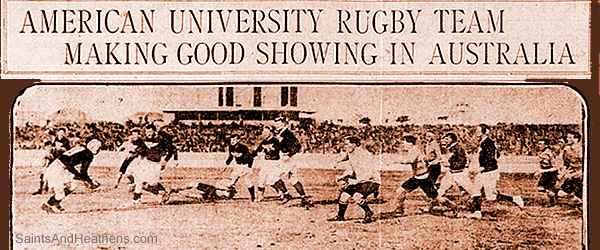
THE RUGGER AND THE TRAMP
In club rugby contests where informality reigned, duplicate jersey numbers were not unheard of. Other players turned out with numbers so dilapidated they were indiscernible, or with poorly stitched white squares tearing away and falling off.
THE MAN OF LETTERS FIRST XV
In some rugby teams in Britain letters were used instead of numbers. While this is most notably familiar with Leicester Tigers (1926), Bristol Bears and Wales (1930s), possibly the first club was Bedford Blues in late 1921. They reportedly preferred letters to numbers due to a “superstitious objection to the number 13 and the ease with which certain figures can he mistaken.” *
The Bedford club’s move may have been from reading that “New Zealand played with letters of the alphabet instead of numbers” in an August 1921 match against the Springboks at Eden Park in Auckland.
However, in the Test matches with South Africa and other tour games the NZRU was seemingly trying to counter pirate printers of teams lists.** Reports suggested that while the Springboks had numbers, there was no rhyme or reason to the ordering, and two of the team were in jerseys marked with letters ‘X’ and ‘T’.
The Auckland Star on 3 September 1921:
“The average spectator who cannot pick the players by personal appearance (and they number the majority), relies on positions and the numbering, and if this is the same for both teams he can make few mistakes.
When, however, one full-back is numbered 1, his vis a vis 9, and the men between him and the pack vary up to 17 and 5 respectively with the other numbers scattered among the forwards, his task is rendered more difficult rather than simplified.
If Saturday’s ridiculous scheme is pursued much further the players will some day come on the field as human zebras, and an encyclopedia.”
WHAT THE KING HEARD
There are some short passages floating around that pass as legendary anecdotes about jerseys and numbers, but their original sources cannot be found anywhere.
The first is of the celebrity name-dropper kind. Perplexed by why the Scotland team did not have jersey numbers as England did, King George V was supposedly told by the President of the Scottish Rugby Union (SRU), J. Aikman Smith, that “This, sir, is a rugby match, not a cattle sale” or “They are rugby players, Your Majesty, not a herd of cattle.”
But as to which particular post-WWI match this was, and whether it really happened, remains a mystery, although the King was in attendance at many of the England-Scotland contests at Twickenham during the 1920s.
The other is a stray quote: “Numbers are not necessary and they savour of professionalism and the circus”. As noted earlier, these sentiments do hold some pre-WWI era truth, but whether it was actually uttered, and by whom, is a search that ends in a cul-de-sac of empty houses.
“Scottish teams do not bear numbers or distinguishing letters on their backs, and from this the spectators are educated towards clapping rather than cheering, and applauding any good work in a national rather than a personal strain. It would be quite common for a relative of a Scottish international player, watching him do something of outstanding note, to applaud the movement with a ‘Good old Scotland,’ rather than ‘Well done, Jim’ — or Bill, as the case may be.”
— Cyril Towers (NSW & Aust 1926-38), The Sydney Mail, 3 June 1936
LIONS & WALLABIES TAGGED & RELEASED
Far away from the reach of the Home Unions, the pre-WW1 British Lions tourists all wore jersey numbers, beginning with the 1899 side in the 1st Test match in Sydney against Australia. Now recognised as the Wallabies debut, this is the earliest instance of opposing teams wearing numbered jerseys in an international match. The Lions were also seen with numbers in Melbourne and Brisbane games.
But these 1899 contests weren’t the first time numbers had been used in Australian and New Zealand rugby.
PENNY BLACKS & SHILLING BLUES
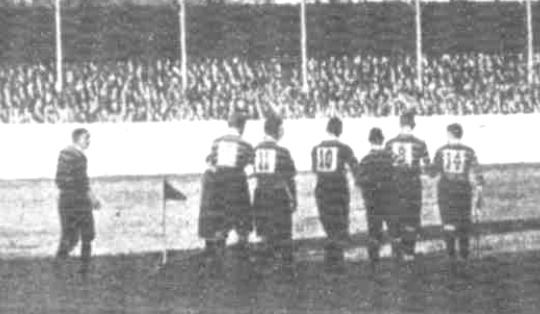
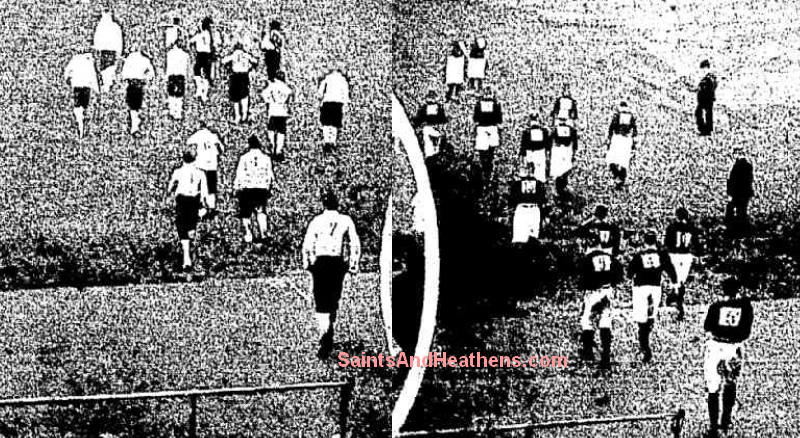
Block numbers inside white squares were added to the NSW (light blue) and New Zealand (all blacks) jerseys for the first game of their July 1897 three-match series at the Sydney Cricket Ground (crowd 24,500). In addition to the opening contest on 3 July, two subsequent matches were held on 10 and 29 July; however, whether numbering was used again is not presently known.
As reported in The Referee newspaper (7 July 1897), it was the NSWRU who had introduced the innovation, although not all of its committee men had been in favour:
“The innovation as far as this colony is concerned, of allotting each player on the field a number affixed to his jersey, and publishing cards at a penny each giving the names corresponding with the numbers, was appreciated by the public. The Union was, however, not unanimous about introducing it.”
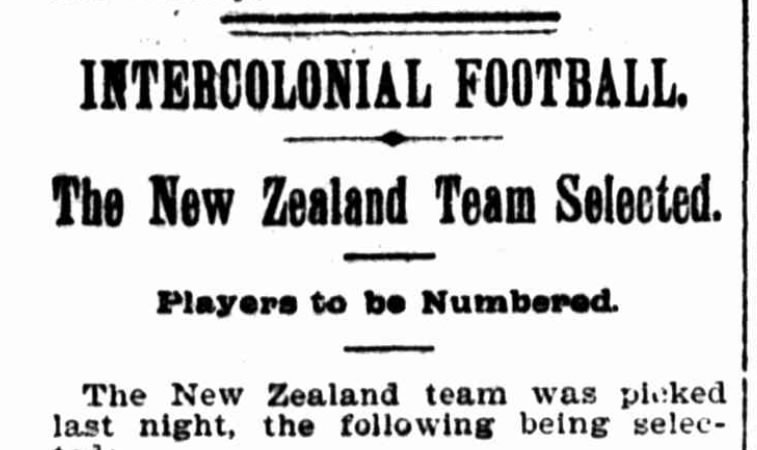
The Daily Telegraph (2 July 1897) provided further details, including an indication the idea was already in use on the other side of the Tasman Sea, and not all of the NSW team were on board:
“Mr. A. E. Sefton brought forward a resolution to the effect that distinguishing numbers be affixed on the backs of the players in the intercolonial match to be played to-morrow, and that cards lie printed and sold for a small sum to the public, so that they might the better distinguish the various players.
It was explained that the custom prevailed in New Zealand, and should be fully appreciated by the public here.
Mr. Rand stated that the majority of the players representing New South Wales were adverse to such a proposal, and they should be entitled to some consideration.
The motion was ultimately carried, however, though it met with considerable opposition.”
This aid to rugby viewing (and presumably gambling) was not just confined to those who purchased the team list card, but was available to all in the ground via the use of the SCG’s original (1895-1905) scoreboard, as explained by The Australian Town and Country Journal (10 July 1897):
“Each player wore on his back a distinguishing number, which corresponded with numbers placed on the scoring board opposite the names of the men of the two fifteens.”
In effect, the above evidence, plus photos, shows both teams were numbered 1 to 15, although by what allocation remains unknown.
Ironically, it was a sports reporter in far-away central NSW who, at the very outset, gave away a trade secret that none of the Sydney newspaper men had revealed in print. Writing in The Bathurst Free Press and Mining Journal (5 July 1897), he innocently shared:
“The members of each team will wear a number on their back in the match tomorrow, thereby greatly facilitating the reporting of it.”
The other beneficiary—and perhaps a key reason why the NSW footballers were such reluctant participants—was that the referee now had a much easier time of it when it came to identifying a guilty party.
TWO RUGBY XVs, BUT ONLY ONE No.8
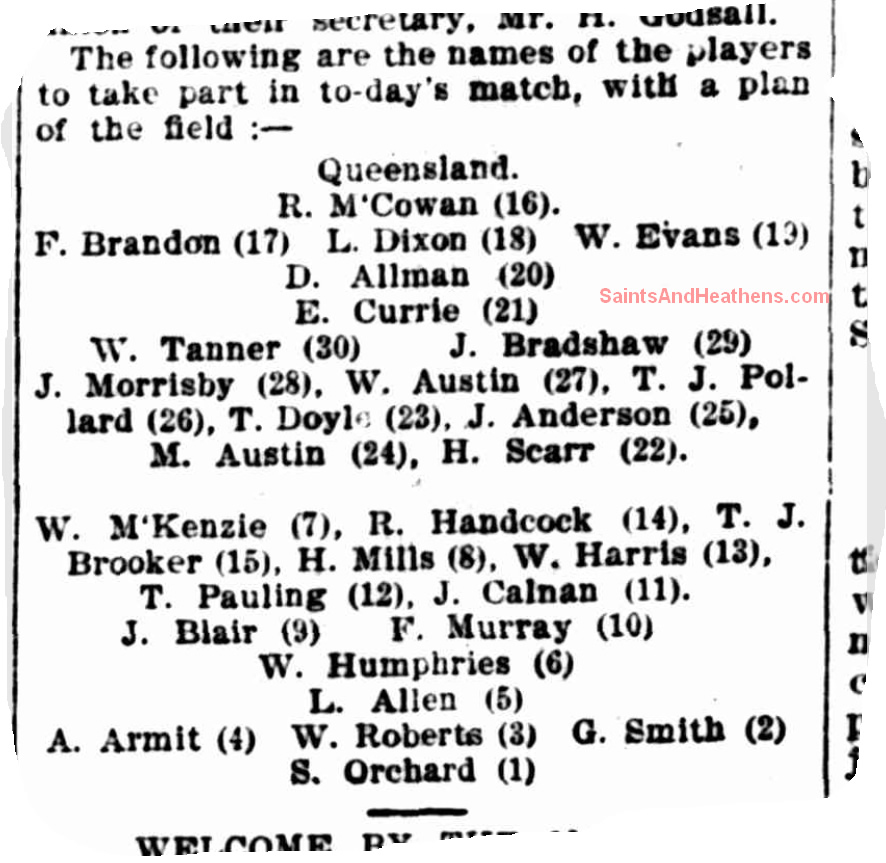
In the Queensland vs New Zealand contest held in Brisbane on 15 July 1897 (misreported in various contemporary sources as the first instance), the players were individually numbered from 1 to 30.
The home side were numbers 16 to 30, and the visitors 1 to 15, with only a notional observance of ordering the numbering of the forwards, who in that era were still more of a collection (pack) of generalists, rather than individuals expert in a specific role.
The Brisbane Courier (17 July 1897) adding:
“With a view of enabling the public to recognise the various players, a number will be placed on each player’s back, and cards bearing the names and corresponding numbers will be distributed.”
NUMBERED MUDDIED OAFS
There were still though teething problems, as shown up the first NSW against Queensland match at the SCG the following winter, per The Australian Town and Country Journal (30 July 1898):
“In order that the spectators might be the better able to identify the players, each man wore a number on the back of his guernsey, corresponding with a number placed opposite his name on small cards, which were sold by scores of boys at the ground…
“…As for the numbers on their backs, they were of no use whatever after the first five minutes in the mud, and they were so narrow that even on a fine day they would have been of little assistance in affording means of identification.”
TARANAKI EVERY TIME
The suggestion of numbers made to the NSWRU in 1897 came from Albert Sefton, manager of the NSW team that toured New Zealand in 1894. His comment that “the custom prevailed in New Zealand” suggests he was aware of multiple matches where teams had worn numbered jerseys.
While no reports of those 1894 NSW tour games have yet confirmed the use of numbers, a domestic match held at Christchurch’s Lancaster Park on 8 September 1894 between Taranaki and Canterbury notes that “the players are to be distinguished by large numbers corresponding with those on a card to be issued” (The Press, 8 September 1894).
This fixture took place just days before the NSW team arrived in Christchurch to meet Canterbury (13 September) and New Zealand (15 September) on that same ground. Sefton could not have witnessed the Taranaki-Canterbury game firsthand, as the NSW squad was in Wellington at the time. There is, of course, no reason to think that jersey numbering was not also used in both of the subsequent NSW games in Christchurch.
However, either way, the Taranaki-Canterbury clash on 8 September 1894 stands as the earliest recorded instance of jersey numbering in rugby union and in any other football code in the world.
A LADY’S FAVOUR
It was in New Zealand too that the pioneering British Lions tour in 1888 saw the first innovation towards identifying players on the field for spectators. This didn’t involve numbers or letters, but ribbons.
As told in The First Lions of Rugby, for the match in Christchurch, New Zealand, the Canterbury Rugby Union devised a scheme where each member of the British XV that afternoon was supplied with a different coloured armband ribbon, necessitating the purchase of a match-day programme so spectators could align the names of the footballers to the ribbons.
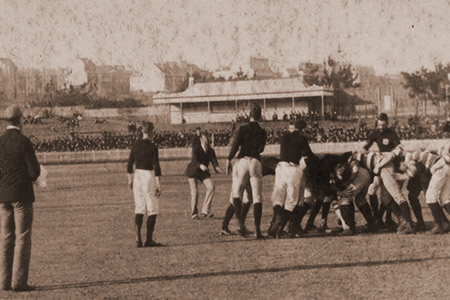
In one sense, it was no innovation at all, being borrowed from horse racing, which at that time used coloured ribbons and then silks to differentiate jockeys. The modern era of numbered saddle-cloths in horse-racing was only just beginning.
Using coloured ribbons in a rugby match with the ever-popular Lions was less about gambling and more to do with helping pick out a particular footballer. It was a modern twist on the chivalric era and knights wearing a “lady’s favour”, except here the pairing up worked in reverse.
This very colourful and romantic branch on the rugby tree of life was short-lived, though jersey numbers still allow one to quietly pick out by eye the whereabouts and movements of their personally chosen ‘champion’.
“All my Saturday afternoon visits to the North Ipswich Reserve left with me was a blurred vision of husky males (with numbers on their backs) hurling themselves at one another all over the place.”
— ‘Patricia’s Patter’, The Queensland Times, 6 July 1951
© Sean Fagan
‘The Official History of the Wallabies Jersey‘ book by Michael Fahey contains an extensive four page chapter on numbering and lettering of jerseys in rugby in ‘What’s in a Number’.
* Bedford RFC quote is found in The Telegraph (Brisbane) of 9 November 1921
** See The New Zealand Times 29 August 1921 and The Auckland Star 5 & 6 September 1921
Note: Issuing of a match card (scoring card) with players names corresponding with a number on their back was suggested by letter writers to London newspapers in mid 1882 for the England vs Australia cricket matches (now Ashes) – see The Age (Melbourne) 14 June 1882.

