
The football code war in the 1880s was in full cry.
Story written & researched by Sean Fagan for InsideSport magazine © 2009
There’s an old Aussie saying: “You can always tell a Victorian…you just can’t tell him much!” When that friendly insult was first uttered is long forgotten, but in the world of football, the sentiment has held true since the mid 1870s when expatriate Victorians first began advocating “Melbourne rules” in each of our colonial capitals.
All of the colonies were developing their own local versions of football. In Adelaide, for example, they were playing with a soccer ball, and demanding it be kicked over the cross-bar for a goal. In a text-book case of “football Darwinism,” Tasmania, South and Western Australia, along with their home-grown breeds of football, were soon convinced by the self-assertive Victorians to adopt the Melbourne game.
North of the Murray River it was a different story, and today the Australian code has still yet to conquer NSW and Queensland.
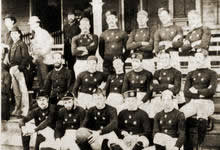
While the comparable examples of Canadian and American football have each won their nations loyalty, Australian rules failed to gain the ascendancy of our country’s populous northern states, and with it the nation. Success should have been a given – after all, it is our born and bred version of football, it is undoubtedly a fine spectacle to watch, and many find it a joy to play.
From deep within their Melbourne citadel, the code’s hopes and dreams of expansion and conquest (even beyond our shores) have always rested in confidence that Australian football is superior to all other versions – that the “heathens” of new frontiers need only to see the game played to become paralyzed by its overpowering brilliance.
The AFL is edging ever closer to the introduction of expansion teams on the Gold Coast and in western Sydney. But is it really entering untapped territory?
While there is little doubt that either or both of the rugby codes could find many people in the southern states and Western Australia with little more than indifferent awareness of these English-born football codes, and thus hope to convert them, is the same true for the AFL in NSW and Queensland? Is merely providing western Sydney and the Gold Coast with their own AFL teams going to win thousands of new fans and footballers for the game?
Australian football is, as its supporters point out, an easy game to grasp an understanding of. It has a tremendous history, fine traditions and enthusiastic club supporters. The Sydney Swans and Brisbane Lions have captured plenty of attention on their way to AFL Grand Finals over the past decade. The AFL enjoys wide match (pay-tv, free-to-air and radio) and media coverage in the northern states.
Awareness of the AFL competition and Australian football amongst sports fans in NSW and Queensland is very high – there would be few who could not credibly explain to you the basic rules of the game, name prominent clubs, and tell you famous names.
The reality is that Australian football has always been part of the winter landscape in the northern states – ever since the late 1870s when the code found sufficient adherents to establish clubs in Sydney, the Hunter region and Brisbane. In the Murray River border towns and the Riverina rugby was rarely played, until the Maher Cup in the 1920s made rugby league at least equally popular. Aussie rules, as the northern states came to call it, never rose to a point where rugby union, and then later rugby league, was ever threatened with losing their place as the dominant code.
While today football codes are fighting an undeclared war amongst each other, the real battle to resolve Australia’s football loyalties was won and lost in the late 1870s and early 1880s. It was then that Australian football missed its greatest opportunity to forge one game for Australia.
Writing in 1887, after a decade of attempts to place the Victorian game ahead of rugby in the northern colonies, Sydney’s The Referee sports newspaper wrote: “All attempts to found a national game fell flat, and so far as I can prophesy, will ever meet the same fate.”
So, while supporters of Australian rules football saw their game as “refined gold” that could not be improved upon, what was it that Sydney and Brisbane footballers of the 1880s saw in rugby that made them turn away from a “football Federation” with the Victorians and the other colonies?
Sure, there was a bit of jealous rivalry between NSW and Victoria that made many Sydneysiders frown on the Melbourne devised rules, particularly on the need to bounce the ball all in the name of preventing a man from running with it.
The prospect of one day exchanging overseas tours against New Zealand, England and the other “home” nations (Wales, Scotland and Ireland) was also a particularly appealing reason to remain with “the Empire game” of rugby….a cause aided by NSW’s Australian rules team in 1881 being thrashed in two matches against Victoria (9 goals to nil at the MCG, then 9 goals to 1 at the SCG).
Ultimately, it came down to playing the game itself; more footballers preferred playing rugby over Australian rules. That’s not to say that they disliked the Victorian game – far from it. The two codes were still relatively close on the football evolution tree, with most seeing Australian rules as “the rugby game divested of its off-sides and scrimmages.”
In Sydney, the NSWRU pronounced that none of its member clubs were permitted to play against clubs playing by other rules. The NSWRU couldn’t stop the frequent occurrence of players forming their own informal clubs to play against Sydney’s Australian rules clubs.
In Brisbane, before the formation of the QRU, the QFA (now AFLQ) administered all football, setting down matches under Victorian and rugby rules on different Saturdays to satisfy the demands of the players.
The controlling bodies soon put a stop to these cross-code dalliances. A clear demarcation began to emerge between the codes, and a public opinion battle waged in the northern cities over the pros and cons of each game.
The Sydney sports editor of the 1885 edition of the Australian Year Book declared that by staying with rugby instead of Aussie rules that NSW was “cutting its own throat, instead of joining forces in the praiseworthy business of bringing a right good athletic sport to perfection.”
A Brisbane footballer, in a letter to the Courier, said he could only “shudder at the Melbourne game, with its childish absurdities, such as bouncing, free-kicks, and mode of placing players in the enemies’ goal.”
Australian (no) rules was portrayed as a simpleton’s game, played and watched by those who couldn’t cope with rugby’s physical demands, nor its complex rules and traditions (its cross-bar between the goal posts to make kicks a challenge, allowances for players to “run in” the ball behind the goal line for a “try at goal” kick, and off-side laws to keep the two teams in Napoleonic battle formations).
Already drawing crowds of 10,000 to club matches in Melbourne, rugby supporters in Sydney argued that Australian football favoured a game for spectators rather than the players. While later Australian rules officials would admit “the game we want, is one which talks loudest at the turnstiles,” Melbourne’s crowds were outstripping Sydney because the ball itself was visible to the spectator throughout the match, and even without recourse to the written rules, you could work out what was going on.
To the rugby players, the scrum was the game – that’s where all the action was. At games on Sydney’s Moore Park (adjacent to the SCG) the crowds were not content to watch from the touchlines, preferring to follow the scrummage as it meandered about the field. For the bulk of the game the spectators and even the players couldn’t see the ball at all, just a “violent agitation” in the middle of the scrum where undoubtedly the pigskin was being fought over.
Don’t imagine for a moment that these scrums are remotely like those in the rugby union game of today. In the 1880s a scrum still involved most of the players – this was praised an advantage over Aussie rules where players scattered around the field, and stood idly about until the ball finally came their way.
In rugby scrums each man stood shoulder-to-shoulder alongside his comrades, hard up against the bodies and faces of the opposition. To look downwards for the ball was cheating. Both teams would shove, push, kick, use whatever took to forge a gap in the opposing pack, and hope to kick the ball goalwards (not backwards) and chase it like a marauding horde.
You were a brave man to pick up the ball and run with it, knowing that if you were caught both packs would descend upon you. But that was the thrill of it, to “adventure your life” by running with the ball was an exhilarating feeling. If you succeeded via a long run or to crown it with a try, you were lauded by one and all. Rugby’s advocates argued that it was the game tested a man’s character, while at the same time developed a muscular body from the physical exertion required.
Rugby was a game for the players, and no one else. The Argus (Melbourne), accurately perhaps, informed its readers that the English game wasn’t worth watching or playing: “In the Rugby game half the time is wasted by the scrummaging; which is neither skilful nor graceful, but sheer bulldogism.”
Rugby was painted as a dangerous sport, full of low-grade tactics, high in risk of injury, and abounding with underhanded abuses and a place for publicly tolerated assault….an easy argument to win when you could point to an early 1870s rule of Sydney’s famous Wallaroo FC which stated: “Though it is lawful to hold any player in a maul, this holding does not include attempts to throttle, or strangle, which are totally opposed to all principles of the game.”
Melbourne’s Leader newspaper pushed the message, offering up “Our game is to rugby as a Sunday school picnic to a bull fight.” There is little doubt that it was. One of the founders of the Melbourne FC plainly stated the code’s first rules were a deliberate attempt to tame rugby as “Black eyes don’t look so well in Collins Street.”
Hardier souls among the Australian rules footballers sometimes called out after full-time: “Let’s have a bit of Rugby!” The call wasn’t always well received with “No rugby! No rugby!” a frequent response as many players with their heads down quickly dashed from the field.
After reports were re-printed in the Australian press from London’s satirical Punch newspaper facetiously described rugby as “thugby,” the moniker spread like wildfire amongst Australian football enthusiasts. Conversely, rugby supporters categorised Australian football alongside effeminate parlour games such as ping-pong, which morphed into the derisive tag of “aerial ping-pong.”
While The Referee’s prediction that the fight for one national code seems destined to never end, perhaps AFL’s expansion success or failure (and for that matter the NRL’s as well) lies in the ability to convince fans and footballers to follow the lead of early 1880s and take up an interest in both codes.
© Sean Fagan.


