
If nothing else, the Sydney University Football Club are Australian sport’s greatest illusionists and trick-artists. Not even in 150 years have Oxford and Cambridge ruggers managed to escape from their varsity-cloaked Rugby box the way their colonial cousins cloistered away on the Camperdown campus have.
Story written & researched by Sean Fagan for SaintsAndHeathens
The Sydney University Football Club (SUFC) could teach Houdini a trick or two. They have survived reform movements, district rules, code wars and the withering scorn of 21st-century internet forums. Somehow, an academic gown excuses every sin — a self-awarded master’s degree in the art of humbugging.
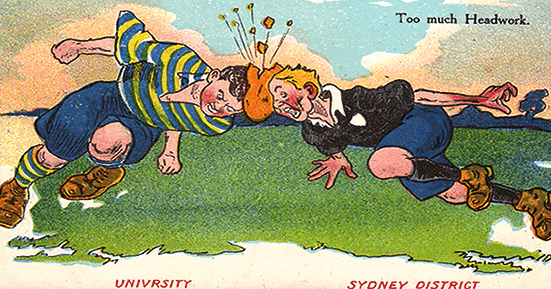
1863: THE GHOST-DATE BOONDOGGLE
Let us begin at the ghostly dawn of 1863 Anno Domini. That sacred number is emblazoned upon their club badge, though it is about as reliable as a politician’s promise. In the 1860s the University barely had enough students to field two sides at whist, let alone the traditional 20-a-side football teams of the era.
Contemporary newspapers, our most reliable witnesses, know nothing of any University club in 1863, nor of even football. Varsity students are first recorded playing against each other in 1865 and once against an outside club. The press of 1865–67 clearly identifies Sydney’s football clubs by name, but consistently treats the University as a mere student side — not a formal club — exactly as a modern school team is not considered a “club”.
The first public claim that the SUFC was founded in 1865 quietly appeared in the newspaper record of the annual meeting in 1876. Someone must have kept an 1865 scrapbook. However, in 1879 a letter published in the press claimed the University team had died away at the end of the 1860s. This appears to be so, as the only two matches played in 1869 were organised with winter nearly over, against the officers of a British naval ship that had been sitting idle in port for three months.*
Yet, if either or all of these claims are mistaken, and 1863 is to be believed, where in 1876 were the not-yet-grey-bearded old boys stepping forward to correct the record?
So, there it sits — “1863” — bold as if carved on tablets of stone. History, it seems, can be written by a clever alumnus with a fine needle and a good tailor.
THE BIRTHPLACE OF AUSTRALIAN RUGBY
Around this time every club was simply a “Football Club”. There was no such thing as “rugby union” in the Australian lexicon until 1874 when the Southern RFU (NSWRU) was founded.
While 1860s newspapers spoke of the “most confusing” hybrid games played by Sydney University, the rules of those early matches were ad-hoc compromises dictated by the whim of opposing captains. It was football by pub crawl: enjoy whatever the host had on tap. None of the games were Rugby football. The University’s rules for in-house contests were at most a modified form of Rugby and there is no evidence they were ever written down.
The era of shifting rules began to dissolve with the 1870 arrival of Wallaroo FC, founded by manic Rugby School old boys. When University eventually faced them, Wallaroo insisted upon playing by their strict, uncompromising rugby rules, forcing the undergraduates to finally fall in line.
Indeed, University players in 1871 (possibly earlier in 1870) had each been issued a copy of the Wallaroo FC rules booklet, providing physical evidence of the lead that club was taking in anchoring Rugby as Sydney’s football code. A surviving copy from that year was marked as originally issued to University player Henry Richardson.
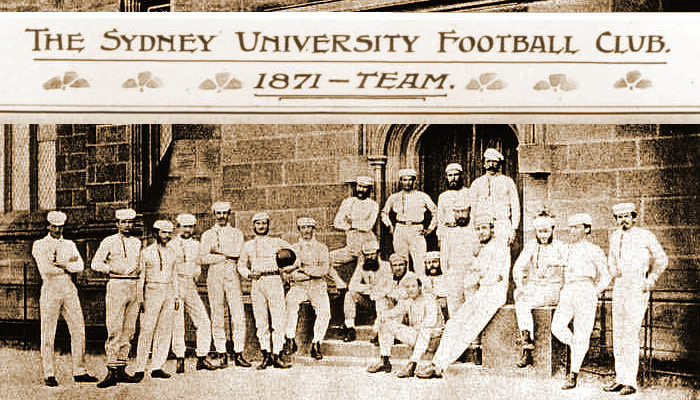
The SUFC was formally constituted at a meeting in the Metropolitan Hotel on 23 June 1871. They did this so they could stand on equal footing with the Wallaroos. Organising a club in 1863 would have been something spectacular — it was six or seven years before Oxford and Cambridge even contemplated similar moves.
In any case, a University students-only team could never really be considered a club in the normal sense. It was more a fraternal lodge meeting.
FOUNDING THE UNION
In 1874 when the NSWRU (SRFU) was born at the Oxford Hotel in Sydney, Wallaroo FC had begun it all by sending out invitations to clubs and schools far and wide, prepared the documents, and led the charge for uniform rugby rules.
Eight of the colony’s clubs then gathered on 5 June: Wallaroo, Goulburn, Waratah, Balmain, St Leonards, and the schools — King’s, Camden, and Newington. Sydney University was conspicuous by its absence.
In a classic schoolboy “late note” tactic, the scholars shirked being at the meeting and instead sent a letter. When opened by the delegates, it requested a postponement so the University could organise its own representative. Poor form, especially with a delegate from distant Goulburn already present.
The others, showing more colonial courtesy than London ever extended to the absent Wasps in 1871, adjourned proceedings. University joined the later meetings, sent a beardless youth as its representative to the last one, and has ever since been regarded as a founder.
Late to the table, yet first in the history books. The escapologist at work.
MEETING THE THREAT OF VICTORIAN RULES
Even after forming a football club, the Varsity collegiate still could not settle on a code. In 1877 their delegates to the Union proposed rule changes to curb the “relentless scrums” and carrying the ball in favour of more drop-kicking and “football proper”—a thinly veiled push toward Victorian rules (now AFL) or a hybrid monstrosity.
In 1878 they again discussed creating an entirely new game blending rugby and Victorian rules. This included arranging matches in Sydney against Melbourne FC, until realising as the hosts they had to carry the travel and accommodation debts if the tour lost money.
By 1880, they were openly supporting moves to establish the Victorian code in Sydney, a push that ultimately helped launch the code’s first local clubs and association. It seemed odds-on that the University meant to join them—until reality suddenly hit, forcing them to shout down a meeting hall full of “punt-monkeys” that they were sticking to rugby.
Only after that winter did these artful dodgers finally commit to rugby with something approaching sincerity. It had taken them nearly two decades to choose a side. (We will give them the benefit of the doubt regarding any involvement with the poor lost souls who cooked up the University’s 1887–89 Victorian rules team.)
“OLD BOYS” & “COLLEGE WIDOWS”
As the only university in NSW and Queensland, each autumn delivered a fresh crop of local schoolboy talent from the best schools, alongside any seasoned arrivals from “Home” eligible in Sydney via ad eundem gradum (reciprocal degree) customs.
Somewhere along the way, observance of the Oxbridge tradition of undergraduates-only in a university’s team had quietly dissolved at the SUFC. Instead, the club turned “college widow”, stubbornly refusing to let go of its old flames while simultaneously devouring this influx of young campus talent.
By actively selecting seasoned university graduate-footballers for its matches in the Sydney clubs competition, “The Students” created massive problems for everyone else as they won season after season. They grew so strong they were even granted their own matches against the British Lions (1888) and the New Zealand Maoris (1889).
Over the summer of 1888/89, some wise old owls at the University recognised it wasn’t healthy for the competition if they kept winning everything. So, it was proposed to lessen the current side’s playing strength by splitting into Past and Present teams—in the English schools tradition—and entering both.
However, once the SRFU showed interest in the concept, the “win at all costs” brigade inside the SUFC prevailed—it was coolly changed into the club simply fielding two XV sides in the Sydney premiership, with the best men all still in place. So, the “University A” side kept on winning, and the “University B” acted as a spoiler in support, robbing opponents of valuable competition points.
No other club received such indulgence. They even played each other, with both sides famously refusing to wear alternate jerseys—like a clutch of chickens fighting for a crumb!
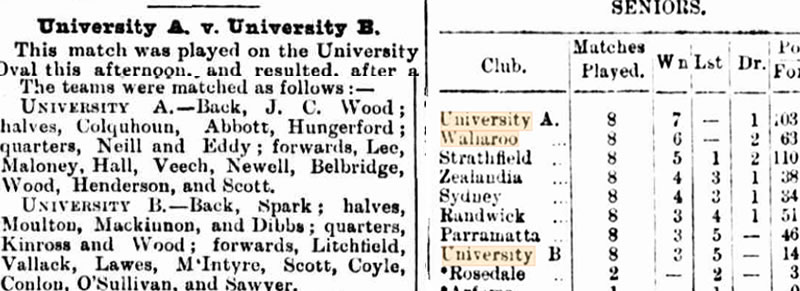
This bizarre arrangement lasted four seasons. Bucking the traditions of universities and schools so it could field teams with cherry-picked grown men—whether graduates or not—kept the SUFC more than competitive in the clubs competition. The bulk of the players in the NSW team were invariably from the Varsity.
Holding these lofty places probably saved the University from any thoughts of them being nudged away with King’s and Newington into the new Great Public Schools (GPS Rugby) competition. The SUFC knew what they were doing, choosing only undergraduates for its contests against the schools and colleges.
The principle is this. That the University proper is comprised of the body of Undergraduates, and that all representative teams should be chosen from that body. This principle is recognised by all the large Home [UK] Universities, and by all the schools.
— Hermes: the magazine of the University of Sydney, 9 May 1889
THE TIME FOR DISTRICT CLUBS
The reform movement of the 1890s gathered unstoppable momentum: district football! Every man for his own electorate.
The crusade had sparked in the early 1890s, born from exhaustion at SUFC always winning everything. By the end, the hypocrisy was glorious. Not content to stop at picking graduated old boys, SUFC had openly gone in for recruiting non-students, including the star five-eighth Harry Braund from Armidale in 1899.
But when the push for local-club purity became inevitable, exceptions magically bloomed to keep the University in the district competition. The University club was no more a district side than Sunday afternoon passengers collected on the Manly ferry.
Soldiers stationed at Victoria Barracks in Paddington had their own ‘Permanent Artillery FC’ that competed at various levels of club rugby in Sydney in the 1880s-90s, and like University they too played the New Zealand Natives team in 1889. No special clause was given for the military men, as they were all made join the new Eastern Suburbs district club if they wanted to keep playing.
The architect of the district scheme, prominent Glebe figure Lewis Abrams, rightly protested that University had no place in it. But The Australian Star offered a defence woven of pure sentiment: the old University Club had a “charm of its own.” Charm!
The Referee came rallying, contending “to restrict its representation to undergraduates means the practical extinction o£ the club”—which confirmed “The Students” two first grade teams era was indeed every bit the comic opera it appeared to be.
While the NSW colony’s rugby clubs evolved to represent civic, town, or suburban-based pride, SUFC wanted it both ways—the permanent roster depth of a city club with the protected status of an academic elite and prestige. Not even Walter Camp and the later “Ivy League” generals of American college football would manage to secure such an advantage for their universities.
Meanwhile, Wallaroo and every other existing club was herded over the cliff. University floated serenely above.
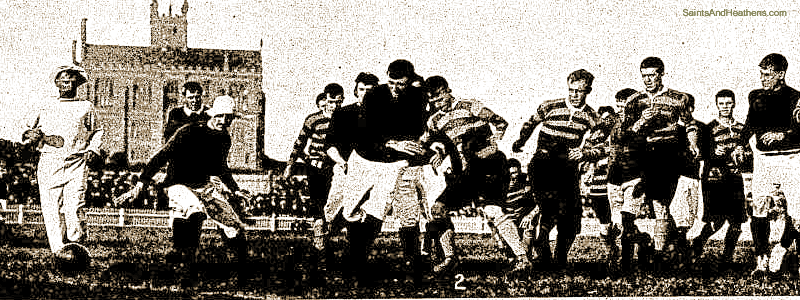
In 1900, as part of the bargain to survive the district scheme, they were granted the right to retain their place in the competition, so long as their team “be restricted to undergraduates proceeding to their degree, or graduates of the University of Sydney.”
Even this was still more generous than the university traditions of good old England.
CARRY ON CAMPERDOWN
Despite the claims in the club’s recent annual reports and tables of “No games due to WW1”, this is far from the case. There was no holy patriotic shutdown or desperate lack of players. The club was instantly ready to roll with three full grades when the competition recommenced in 1919, precisely because the University had not been lying dormant; it had been playing on with rugby matches, albeit non-competition games, right through 1915 to 1918. Opponents included military units, other first-grade clubs (combined) and garrison artillery squads.
And decades on, that magnanimous bargain struck for the club’s retention in 1900 evaporated with the arrival of professionalism. Unlike other ancient rugby clubs that split into distinct professional and amateur entities, SUFC fully professionalised, yet continues to embrace and cloak itself with the historical, amateur mythology of its past.
Oxford and Cambridge still strictly honour the code of active student eligibility. No old boys, alumni, or outside ringers are permitted in their Varsity Match teams. By contrast, since 1995, SUFC has welcomed top-tier, Braund-style professionals by the bucketload. They slipped their University tradition bounds repeatedly for more than a century at every new turn.
So the illusion continues. We all still see the badge with “1863” upon it and nod respectfully. Few trouble to consult the yellowing newspapers or history books. Why spoil a good story with facts?
The trick-artist at their best again, leaving the audience applauding and slightly bewildered. That, ladies and gentlemen, is the highest art.
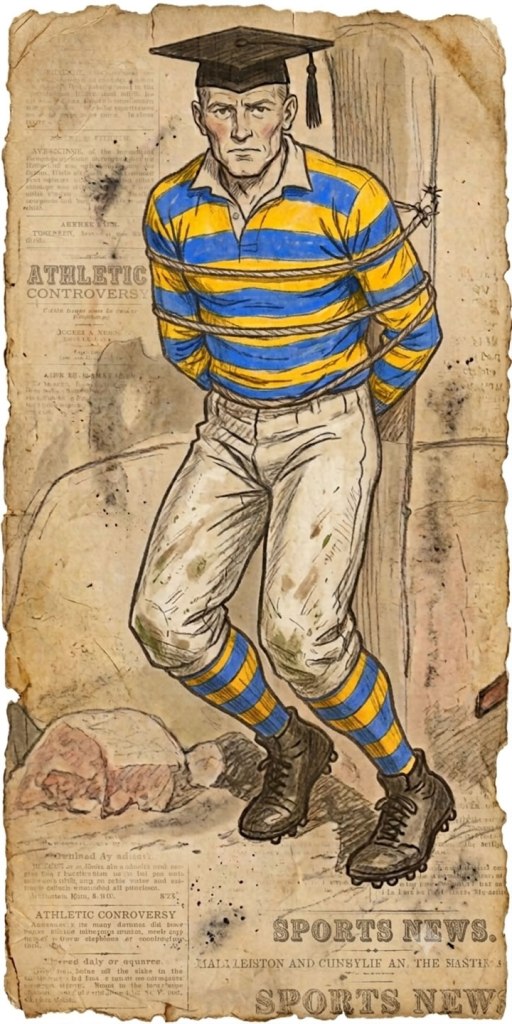
THE ROYAL AND GILT
And so the SUFC sails on—a history of blue and gold that by its end was revealing royal and gilt—a grand old vessel with barnacles of myth upon her hull, patched with exceptions, flying a flag of charm that no reformist gale has ever quite torn down.
In a country founded by convicts who knew how to pick a lock, perhaps it was inevitable that her oldest surviving rugby side would prove the greatest escapologist of all.
© Sean Fagan
My way of life
Is fall’n into the sere, the yellow leaf
— Macbeth
* The University team “died away” mentioned in letter from SRFU (NSWRU) official in Otago Witness, Dunedin NZ, 12 July 1879. Notice of the meeting for the formation of the SUFC at The Metropolitan Hotel is in The Sydney Morning Herald 23 June 1871. There are no contemporaneous reports to verify claims that in 1869 the University played Newington College (Wesleyan Collegiate Institution) in a rugby game. The story first appeared 70 years later in The Referee on 3 December 1930 and states it was “played under University Football Club rules — twenty aside”. The latter is not confirmation it was a rugby game as none of the University’s 1865-69 external games have been verified as rugby. and the first mention of the University having rugby-devised rules is in 1870. Per the College’s own history the headmaster at the time (1866-69) had been George Metcalfe, a former vice-president of the Geelong FC in Melbourne, and “he also introduced an early form of Australian Rules Football” to the young men [link]. Despite the increase in reporting of football matches from 1870 onwards, there is no mention of the College playing externally at all until meeting The King’s School in 1873 and then Wallaroo FC and University in 1874. If the 1869 game did happen, these were in any event not football clubs i.e. they were teams of students from education institutions.
Note 1: THE OLDEST CLUB
The oldest ever-present rugby union club still playing in Australia today, excluding the teams of the schools and universities, is Sydney clubs Eastern Suburbs and Northern Suburbs. Founded in 1900 under the district scheme, both clubs have played each season apart from the WWI suspension of club competition and 1919. The Easts team that competed in 1919 was a war-time Newtown-Easts merged club. The merger was dissolved before the start of the 1920 season, in which Easts, Norths and Newtown were all entrants.
Note 2: Other Universities
While Dublin and Edinburgh Universities were also not full observers of Oxbridge traditions regarding team selection, any comparison with SUFC becomes futile past c.1880.


