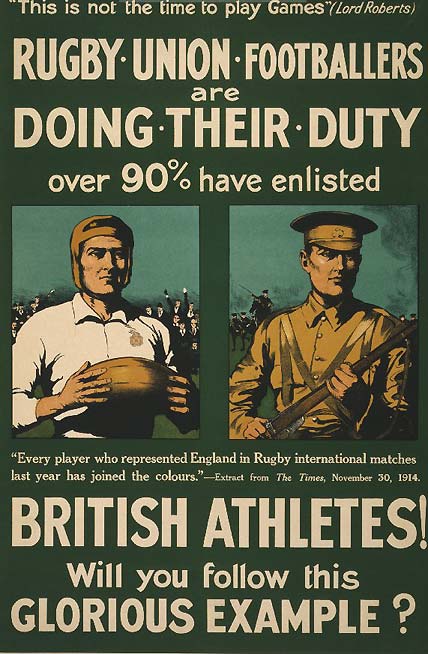
In 1915 Sydney’s rugby union clubs were competing against one another in inter-club rifle competitions.
Story written & researched by Sean Fagan for SaintsAndHeathens
There is a familiar saying that “Rugby is war without the bullets.” As with many such lines, the original was rather different.
In his 1945 essay “The Sporting Spirit,” George Orwell wrote: “Serious sport has nothing to do with fair play. It is bound up with hatred, jealousy, boastfulness, disregard of all rules and sadistic pleasure in witnessing violence: in other words it is war minus the shooting.”
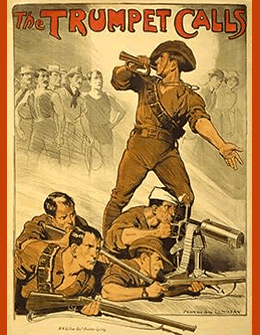
Today, using the language of war as a metaphor for sport is always a risky move. The real relationship between rugby and war is a different story — one that can be hard to picture all these decades later.
When the First World War broke out in August 1914, the New South Wales Rugby Union (NSWRU) cancelled all club football competitions in Sydney and established the Rugby Union Rifle Club.
This organisation was created to prepare men in rifle marksmanship, drills, message-carrying and bayonet work, readying them for enlistment in the Expeditionary Force (the AIF) or for home defence. Most of the city’s rugby union players took part. The two aims were military efficiency and physical fitness.
Under the Rugby Union Rifle Club each district club formed its own unit, including the “Newtown Rugby Union Rifle Club,” and like-named clubs of Glebe, Balmain, Sydney University, North Sydney (Northern Suburbs), Eastern Suburbs, St George, Manly and Randwick. In Brisbane the Queensland Rugby Union Rifle Club was formed along the same lines.
By mid-1915 the government had supplied the clubs with a rifle for every man. These rifles were carried during street marches and training drills, held on Wednesday evenings and alternate Saturday afternoons and mixed with “ball days” (non-competition rugby matches).
Most of the major rifle clubs’ activities took place at Moore Park and the Sydney Cricket Ground, with some at nearby Victoria Barracks and the grounds around Government House. The Sports Ground was used by Eastern Suburbs, Newtown drilled at Newington College, Randwick at the local school, while North Sydney Oval was the scene for the Northern Suburbs players.
Various rifle ranges were occupied by rugby footballers on Saturdays for musketry training, including the Randwick Rifle Range. Many of the men opted for putting in their mandatory rifle practice on Saturday morning so as to be able to take part in a rugby match in the afternoon.
As well as club games, some involving merged district clubs like Balmain-Glebe (now Drummoyne), matches were played against teams from military camps, including Liverpool.
Rifle and drill training and rifle competition between the clubs continued year-round, not only during the winter football season. Across the regional towns of NSW and Queensland that still had rugby union clubs, you could expect to find a rifle club of footballers.
There were impressive mass drills involving hundreds of current and former players and officials, all marching under their rugby union club colours.
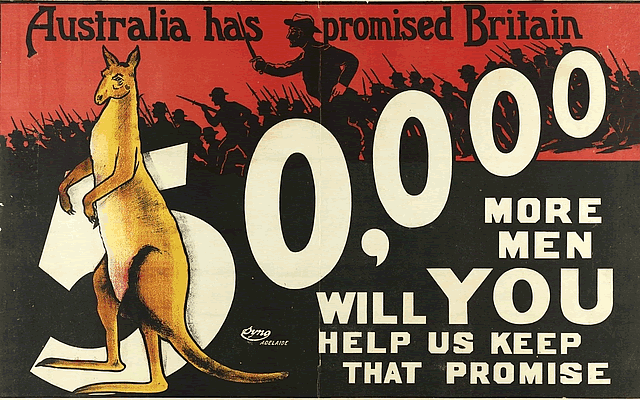
At the initial peak in 1915, following the landings at Gallipolli, there were more than 250 rugby men (current and retired) in the rugby rifle clubs. By September of 1916 this has dwindled down “to a bare platoon” (30 men), not from lack of interest, but due to enlistments for active service in the AIF, and the numbers were still dwindling.
Thus the main object of the formation of the clubs had been met.
It was a striking historical echo, as remarkably the idea of footballers forming rifle clubs was not new.
Nearly sixty years earlier, in July 1858, Tom Wills wrote the famous letter to Bell’s Life in Victoria that is widely regarded as the spark for organised club football in Australia. [Link]
After calling for the formation of a “foot-ball club,” he immediately continued in his letter with an offer of an alternative: if a football club proved impossible, the young men of the colony should “form themselves into a rifle club, so as at any-rate they may be some day called upon to aid their adopted land against a tyrant’s band, that may some day ‘pop’ upon us when we least expect a foe at our very doors.”
At the time, colonial anxieties centred on possible Russian or French aggression — the lingering “Russian scare” of the Crimean War years and fears of Napoleon III’s France. Those distant threats never materialised as an invasion of Australian shores.
Yet by 1914, and again in 1939, the broader fear of war that Wills’ generation had voiced finally came true.
In 1915 Sydney’s rugby men did both of the things Wills had proposed: they put aside the ball and took up the rifle, fulfilling in wartime the dual vision he had sketched at the very birth of club football in Australia.
© Sean Fagan.