
Rugby football club and national team nicknames and colours are familiar traditions, but their origins are often a chequered history.
 The British Lions adopted their now signature red jersey for their 1950 tour of Australia and New Zealand – replacing the dark blue jersey that had been used since 1910 in South Africa (the Union Jack colours, with Ireland part of the United Kingdom until 1922, being replicated in the dark blue jersey along with white shorts with red/white socks).
The change to red jersey had come to avoid a repeat of 1930s pre-tour controversy where the All Blacks reluctantly consented to wear a white jersey while their visitors from Britain wore dark blue.
The long established tradition in Rugby was that the home side gave way if there was a clash of colours, which on wet and muddy fields, meant dark blue and black would soon blend into confusion.
Lions tours before WW1 had been in jerseys of red and white bars of various thickness, and the first three visits to Australia were in red, white and blue hoops (1888, 1899 and 1904).
In 1900 the Eastern Suburbs Rugby club in Sydney resolved at its founding meeting to take the red, white and blue of the local Paddington club that preceded it, but adopt the design of the 1899 British Lions jersey. In 1908 the Easts (now NRL Sydney Roosters) Rugby League Club began and they continued with the same jersey design until the 1950s, and today still use the Paddington c;ub’s colours.
The famous black-and-gold colours of the Balmain rugby league club (1908) replicated those of the Balmain district rugby union club (founded 1900) – the colours had long been synonymous with the district since first used by the Balmain Working Men’s Rowing Club in the 1880s. Bill Beach – “Champion Sculler of the World” – was a member of the club, and always rowed in their colours. The colours are today still seen in the NRL Wests Tigers team and Balmain RU club.
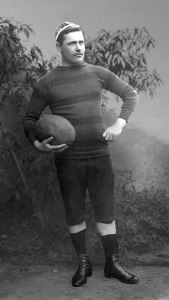
The NRL South Sydney Rabbitohs traditional hooped jersey of large green (myrtle) and narrower red (cardinal) stripes comes from the earlier South Sydney RU club. The latter adopted and kept alive this unique 1890s jersey design of the Randwick RU club (it used indigo and amber gold colours) who were made defunct in 1900 by the very district scheme that gave birth to Souths RU.
Northern Suburbs RU district club when founded in 1900 (as North Sydney RU club) adopted the local cricket club’s colours of green, old gold and cardinal, but it took until 1907 to procure a set of jerseys in these colours. In the mean time they wore red and blue (1900-04) and red and black (1905-06). In 1908 the North Sydney rugby league club, wanting to keep to the RU club’s district colours, encountered the same problem, adopting red and black instead. Northern Suburbs RU decided to revert to red and black in 1913 (The Sydney Morning Herald, 23 Apr 1913) and these colours became permanent.
Western Suburbs RU club (West Harbour) too in the 1920s copied the district’s rugby league club’s black and white colours. When the Wests RU club began in 1900 it wore maroon and white, with the 1899 Queensland kit apparently the inspiration (Australian Town and Country Journal, 14 April 1900), although they changed to blue and white in 1901 (Referee, 8 May 1901).
The ‘Wests’ in ‘Wests Tigers’ for the current NRL club has its origins in a 1900 meeting of the NSWRU’s Metropolitan Branch (Evening News, 17 March 1900) who gave all the new districts their titles, in this case ‘Western Suburbs’ (along with ‘South Sydney’, ‘Balmain’, ‘Newtown’, ‘North Sydney’ and ‘Eastern Suburbs’).
When the red, white and blue wearing Britannia FC were given entry into the VFA in Melbourne in 1892 – the VFL (now AFL) was not yet established – it was conditional upon the new club changing their name to their local suburb, Collingwood, and not having colours that clashed with Footscray. So they took black and white, and in time became “the Magpies”.
The nickname “the Lions” is generally regarded as being first attributed to the British tourists in South Africa in 1924.
As early as 1910 the team had a lion as a jersey badge, and the lion was, of course, already a long established symbol associated with Britain, and England in particular, back to the time of ‘Richard the Lionheart’ (King Richard) in the 12th century.
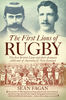
In all four of the Lions tours before WW1, newspapers in Australia made occasional reference to the team and the British Lion, including two instances in 1888 uncovered and revealed in ‘The First Lions of Rugby’.
In 1910 the first ‘Northern Union’ rugby league team that toured Australia and New Zealand was promoted in newspapers as “the Lions” and “the British Lions”.
In a Test match in Sydney the team entered the playing arena behind a rather mangy lion borrowed from a visiting circus.
For the first 30 years of their history the New Zealand rugby league team wore the same kit as their rugby union counterparts, and were often referred to as “the professional All Blacks” – until the New Zealand Rugby Union threatened legal action unless a distinction between the teams in name and jersey design was implemented by the NZRL (who added a white V chevron).
In matches during the Lions’ 1888 tour the NSW team wore maroon, while the Queensland representatives appeared in white.
By the mid-1890s though NSW had adopted their now traditional colour and were called “the Blues”, and Queensland had changed to “the Maroons” – both names today dominate the lexicon and branding of rugby league’s State of Origin, but it was in the amateur code they were established and made into a tradition.
Though the “Waratahs” was first used for NSW’s tour to Britain in 1927-28, and the Waratah emblem badge had been ever-present since the mid 1890s, the name was not widely used by the media or marketing until the late 1980s.
Queenslanders had used both cries of “Maroons!” or “Reds!” until the latter gained greater favour in the state team’s hey-day of the late 1970s.
Even in the national team things may have turned out differently. The 1905 Australian Rugby team visited New Zealand wearing a jersey in sky blue and maroon hoops, adorned with a kangaroo badge. However, in 1908, the first Australian tourists to Britain held meetings and a team vote for their name to be Wallabies in preference to kangaroos, kookaburras, waratahs, wallaroos and rabbits.
Nine decades later. with no say in it, the Australian women’s rugby team were given by the ARU the title of ‘Wallaroos’, the name of all male gentlemen’s rugby club from 19th century colonial Sydney.
© Sean Fagan


