
Beneath every gridiron field of American football lies the buried bone and muscle of 19th-century rugby. Long before Ralph Lauren adopted the rugger style, the football teams of America’s East Coast universities were dedicated to rugby.
Story written & researched by Sean Fagan for SaintsAndHeathens
There is a powerful amount of historical truth hidden away in old moving pictures, if you know where to look and have sense enough not to swallow everything the screen throws at you.
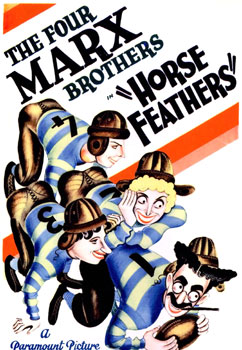
Take that 1932 Marx Brothers piece of inspired bedlam called Horse Feathers—when the riotous quartet (Groucho, Harpo, Chico and Zeppo) were still tearing up the screen before they became a Saturday afternoon matinee trio.
Early on in the feature, young Zeppo (playing the son and student) lets slip to Groucho (the dad and university president) that Huxley College hasn’t had a winning football season since 1888.
True to form, Groucho promptly signs Chico and Harpo as “ringer” football players, while the average viewer chuckles and moves on, figuring it’s all just another jab at a broke athletic department. But if you’ve studied the eccentric habits of American college sports, that 1888 date hits like the thwack of a football striking the crossbar.
How Are You Enjoying The Game, Doc?
The year 1888 was the final gasp of the old rugby order—the last twilight before Eastern colleges traded their drop-kicks and scrums for the armored circus they styled ‘the gridiron.’ Zeppo, reaching for The History of American Sport According to the Marx Bros (second edition) in his infinite wisdom, had borrowed the crown of Yale’s legendary unbeaten 1888 Bulldogs and claimed it for fun times Huxley.
In the film, in a brilliant bit of academic satire, Huxley is pitted against Darwin University. Matching the namesake of “Darwin’s Bulldog” (Thomas Henry Huxley) against the master of evolution (Charles Darwin) was a masterstroke of wordplay. The evolutionary giant could have easily added a chapter on football.
Those grand Eastern institutions—Yale, Princeton, Columbia, Rutgers and their kin—did not set out to invent a new football game. And getting there took an indirect route.
At first, in 1874, Harvard hosted McGill of Montreal, and the American campus fell head over heels for English rugby. The 20-men each side game.
This was the heavy, old-fashioned early 1870s shoving version of rugby—great heaving scrums of thirty men or more, all backs and shoulders and pure beastly determination, with the ball and a lost dog buried in there so deep no sane dog-catcher had a chance.
No forward passes, no nonsense. Just muscle, mud and the ancient joy of boxing up and delivering your friendly opponents to their own end of the field. It was football as Tom Brown of Rugby School fame would have recognised it, frozen in its most primitive and glorious form.
The Password is Swordfish
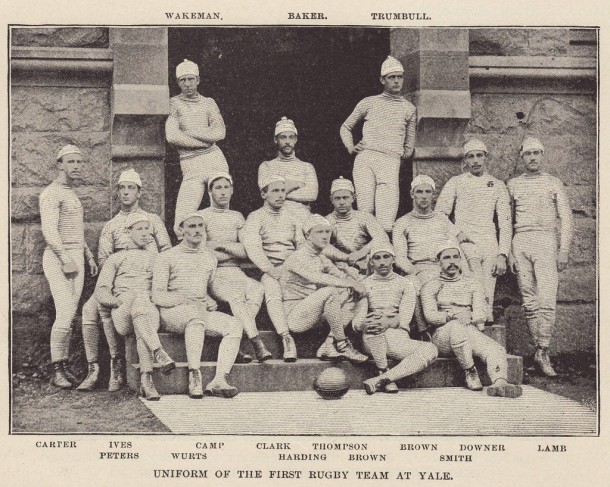
Besotted with ball-carrying and hard-tackling of rugby, late in 1876 the Eastern colleges formed the Intercollegiate Football Association (although Rutgers apparently couldn’t recall ‘swordfish’ and missed it). These teams spent their autumn Saturdays locked in the honest, muddy chaos inherited straight from across the Atlantic, including the new preference for 15-a-side.
This still had the upfront shoving game, but it was now usually ten forwards standing shoulder-to-shoulder trying to kick the ball through an equal body of men on the other side.
Whatever It Is, I’m Against It
In a way, rugby was Archie Leach, but gridiron was never Cary Grant. Rugby football arrived on American shores as a quiet, peculiar foreign traveller, only to strip off its bowler hat, alter its mechanics, and become a thoroughly American institution. All thanks to Walter Camp of Yale, a solemn strategist who preferred football led by brain over brawn.
In 1880, they reduced to eleven men in each side and, taking as his model rugby’s line-out of shoulder-to-shoulder forwards (at the scrummage or the throw-in from touch), Camp persuaded the Intercollegiate Football Association rules committee to make it instead a gentlemanly “line of scrimmage” combined with a “snap-back,” guaranteeing one side clean possession. It was a masterpiece of logic—until it wasn’t.
As any rugby administrator will tell you, tweaking any law of the game risks an unraveling that shows up somewhere else in the oddest, most unexpected way. Camp’s new rules forgot one tiny detail: they never specified what the team with the ball actually had to do with it.
Now in England there was no need, as even any schoolboy would instinctively know how to handle it. So across all fifty-nine of the 1871 RFU laws which Camp and company had borrowed, there was no requirement to advance the ball and no obligation to ever surrender possession.
Some aspiring young legal eagles at Princeton saw a way to secure the 1881 championship. These young Americans, narrowly reading the laws line by line and having no guiding Rugby School tradition, coupled with Camp’s amendments, thought they saw a loophole.
Constant Warfare Between The Corpuscles
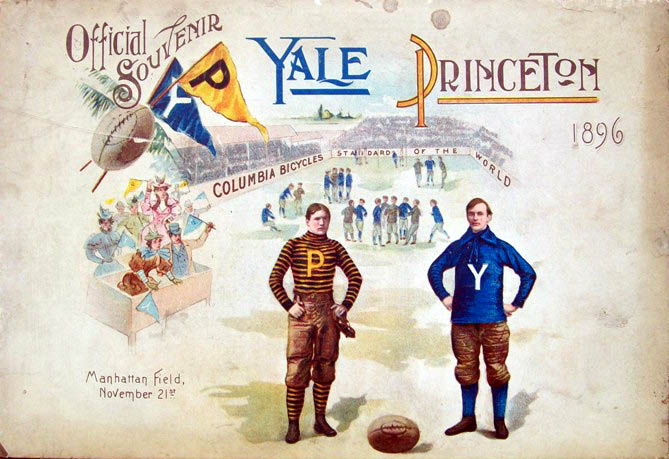
The curtain on this unexpected comedic farce in the rules was lifted in the infamous 1881 “Block Game.” Princeton only needed a tie to retain the title against Yale. So, the Princeton men took the snap and stood perfectly still for the entire first half. Nothing happened. At half-time the game was a tie.
Despite being the architect of the very rule changes used to freeze his team out, Camp and his Yale Bulldogs abandoned all hope of victory. Out of sheer spite, absolute exhaustion, and a heavy dose of malicious compliance, Yale simply repeated Princeton’s sit-down strike for the second half.
The entire match produced a majestic 0–0 tie that left spectators hollering themselves hoarse. Even the old Massasoit House in Springfield, where so many of these early football councils gathered, must have echoed with astonished laughter at the absurdity.
This Needs Closer Examination
By 1882, the rules committee rushed through the five-yard-in-three-downs rule. That single desperate fix severed American football from its rugby roots forever.
The colleges turned away from rugby just as the English code was embracing short pants, tamed scrums and the four three-quarters system with mustachioed Welshmen orchestrating sweeping lateral passing movements à la the Folies Bergère cabaret quadrille.
Despite the obvious high appeal of these stylish innovations, Walter Camp and his fellow collegians instead doubled down on evolving the raw old-time rugby, forging a distinctly American game built on blocking formations, tactical interference, and rigid, schemed ground attacks.
By 1888, Yale’s skull and cross-bones boys—sorry Zeppo, not Huxley—were a machine outscoring opponents 694 to 0.
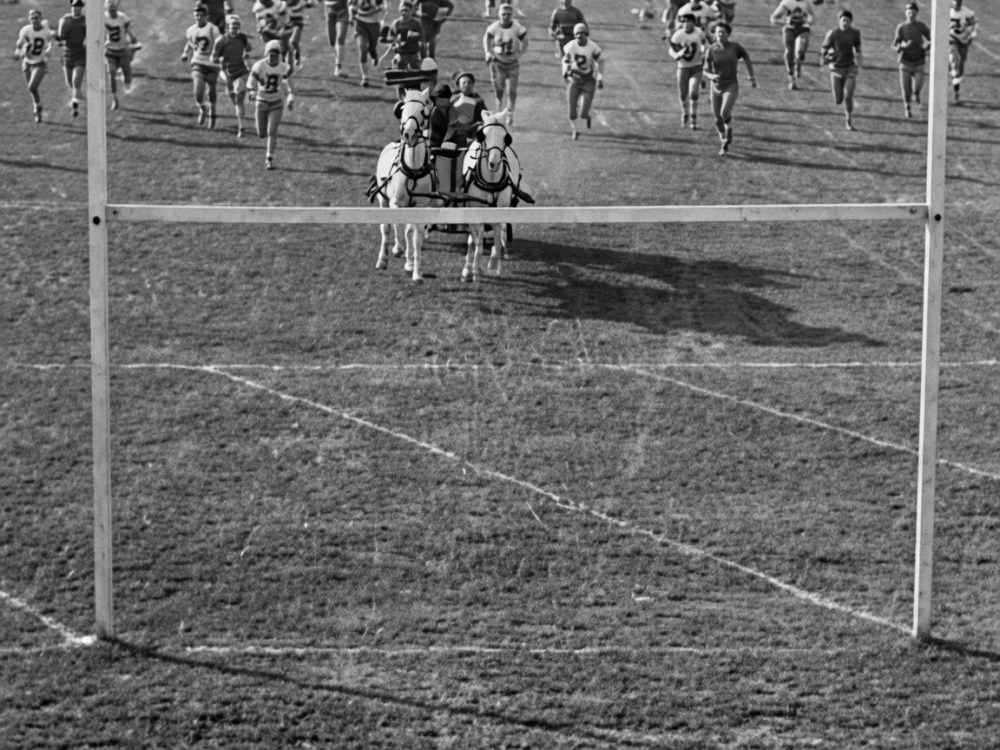
The classic campus rugby game was dead, laid out cold on the turf. All that was left of it to see were the skeleton-boned rugby goalposts.
“It is the modern college football match, refined from the Rugby type which that muscular moralist, Thomas Hughes, has depicted in one of his most vivid chapters.”
— from ‘Football As She Is Played In America’, The Herald (Melbourne), 13 April 1891
Before You Leave The Theatre
If you’re in a mood for more Hollywood popcorn rugby history references in college football flickers, check out Trouble Along the Way (1953) with a short monologue from John Wayne, who picks up the Webb Ellis myth and runs with it straight into the growth of American football. Also of lesser interest The Iron Major (Pat O’Brien, 1943) or The Spirit of West Point (1947).
For the record, the National Football League (NFL) was founded in 1920. An often overshadowed story, given that 1920 was the same year the Marx family gave up chicken farming in Chicago.
© Sean Fagan.
NOYE 1 : There is no book called The History of American Sport According to the Marx Bros (second edition) . That’s a wise quack!
NOTE 2: The 1890s cabaret four-dancers quadrille (quadrille naturaliste) at the Folies Bergère in Paris was a lively can-can performance with petticoats, splits and high kicks. Located near the Moulin Rouge, the Folies Bergère was the setting for the film The King and the Chorus Girl (1937)—Groucho Marx’s only feature-length screenplay credit. Modern backlines across both rugby codes continue to faithfully observe the synchronized alignment and rehearsed principles of the can-can chorus line.


