
Story written & researched by Sean Fagan for SaintsAndHeathens.com
As Australia’s second-oldest colony, Tasmania retains a distinctly English character across its architecture, institutions and culture. Despite its deep English roots, one aspect that is not as prominent as may be expected is rugby football.
Encounters with a Tasmanian rugger are only slightly more common today than with a Tasmanian tiger.
While the rugby game was first played in the Australian colonies in Tasmania [Rugby made its Aussie debut in 1840s Tasmania] and its sports fields were, at least for a time, graced with rugby posts with a cross-bar, its proximity to the city of Melbourne meant that by 1883 the only football in Tasmania was Victorian rules [Tasmania Rugby History].
Club rugby finally started in the state’s largest cities Hobart and Launceston in 1933. Yet decades before this, almost inconceivably, three young Tasmanians had played international rugby football.
Two had gained international honours in the Home Nations while studying in the UK: Lyndhurst Giblin (a forward, 3 caps for England 1896-97) and Allan Stewart (a wing three-quarter, 4 caps for a for Scotland 1913-14). The other, Harry Braddon, had gone to New Zealand on the promise of employment and playing rugby football.
Lyndhurst Giblin
The Hobart-born son of a prominent Tasmanian politician, Giblin had never seen a rugby game until he arrived in England to further his education. Studying at University of London and then Cambridge, while at the latter he won selection for England three times over 1896-97. He also played for Barbarians and Blackheath.
A letter reproduced in the Launceston Examiner on 11 May 1897 stated:
“Giblin, one of your Tasmanian scholars, has been chosen, and has played, for England against Scotland, Wales, and Ireland respectively at Rugby football. He has thus been an “international” in three contests. This means he has been considered one of the best fifteen players of Rugby football in all England.
Whether he had much experience in the field before he left Tasmania I know not, but he is a brilliant player here, having developed into a very strong young man.”
In 1898 Giblin joined in the gold rush to Alaska and the Canadian north-west, returning home in 1904. [ADB entry Lyndhurst Giblin]
BILL STEWART
Allan William Stewart (var. Bill Stewart or William Stewart) was born in Launceston and moving from the family home at Latrobe, completed his schooling at Carlton College in Melbourne (The Herald, (Victoria, 1 Nov 1911). He too had never seen rugby before arriving in Britain in 1908. Studying at the Royal London Hospital to become a doctor and later the University of Edinburgh, he initially came to attention in the world of athletics as a sprinter with the London Athletic Club. He represented Australasia in 100 and 200 yards sprint races at Stockholm at the 1912 Olympic Games.
After playing rugby with the Hospital team, and being of Scottish descent via a grandparent and progressively showing a growing aptitude for the game, he moved on to London Scottish RFC. Possessed of an astonishingly fast starting burst as a runner, he was difficult to defend against. In 1913 he was chosen to play for Scotland against France on New Year’s Day at Parc des Princes, Paris, scoring a hat trick of tries in his debut. Proving it was no fluke, in February he notched up four tries against Ireland to the utter delight of the Edinburgh home supporters.
It wasn’t just Stewart’s speed though that led to his try-scoring success, but also his ability to snatch and secure the ball from teammates’ passes, no matter how wayward they were. As recounted in the famous Athletic News sporting paper (reproduced in The Mercury, Hobart, 1 March 1913):
In commenting on the then projected match, England v Scotland, “W.L.S.,” in the Athletic News (20/1/13), said –
The Scotland backs should also be good, and I do not know who is going to catch W.A. Stewart if the latter gets the ball and speeds off. I was talking last week to E.R. Terry, the well-known professional pedestrian expert, regarding Stewart’s try which won the match for the London Scottish against the Harlequins.
“It was just such a try as I should expect Stewart to have scored. Like myself,” he said, “the latter comes from Tasmania, where they play a funny style of football, 18 a side, with no off-side, and each man marked as in lacrosse in this country.”
“There is thus a great deal of snatching of passes from jumps for the ball. Stewart has not, apparently, forgotten that style of play, and when the Harlequin forwards fired that wide ball and wild pass —well, our boy was on the ball and away.”
“I am delighted to see a player from Tasmania doing so well in the Old Country.”
Stewart was awarded four caps for Scotland 1913-14, however his international rugby career was curtailed by the outbreak of war. He served in the Royal Army Medical Corps and afterwards returned to Australia, settling in Melbourne.
HARRY BRADDON
A name familiar to Australians who closely follow the political game is ‘Braddon’, a federal electorate in north-west Tasmania named after Sir Edward Braddon (1829–1904). In the 1880s former Latrobe bank clerk Harry Braddon, son of Edward Braddon, played rugby football for New Zealand and NSW, and in the 1920s became President of the NSWRU. [ ADB entry Henry Yule Braddon ]
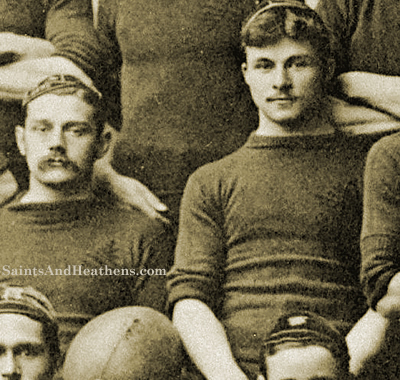
Harry Braddon, born to English parents in India, spent his youth in Germany, France and then England (attending the rugby-playing Dulwich College in London) before finishing school in Launceston, Tasmania—his father had moved there, eventually becoming the colony’s premier.
In the early 1880s Harry Braddon played Australian Rules for the Launceston FC, the Northern Tasmania combined team, and was the founding captain of the Latrobe FC. He had left school and was working as a bank clerk.
His proficiency as a footballer was spotted by a visiting New Zealander who offered him a job at a bank in Invercargill in that colony (Thames Star, 24 April 1926).
Long before the rise of professional rugby, Braddon took up the offer and left Tasmania. Now at home playing rugby again, he soon appeared in the Otago representative team.
Braddon later wrote (see Southland Times, 22 August 1936):
“I arrived in Invercargill late in 1881. After three years in Tasmania where the only football game available was under the Victorian or so-called Australian rules.”
“As football under any rules was better than no football I played under that code at school, and a season or two afterwards, and I confess I thoroughly enjoyed it though I had been brought up on Rugby Union at Dulwich College near London.”
“I was only fifteen when I came out to the Antipodes but the Union code had got into the blood and it was very delightful to get back to it at Invercargill at the age of about eighteen and a half.”
Now recognised as the first All Blacks (their jerseys were blue), Braddon was a member of the New Zealand squad that came to Australia in 1884. He played in five of the tourists seven matches in Sydney and the one game in the NSW country town Bathurst. The New Zealanders were undefeated in all.
Braddon had seen the tour and passage to Sydney as a means to move on from a bank clerk career in Invercargill, remaining in the NSW colony after the tour. In 1888 he was selected in the NSW side against the visiting British Lions tourists. Braddon was chosen at full-back, primarily for his deft tackling and accurate long kicking. He continued to be selected and in 1892 his final season was captain.
In the 1920s he became president of the NSWRU, helping to hold the amateur code together during its darkest decade.
Note: To date no born and bred Tasmanian has been selected for the Australian Wallabies. Brothers John and Eric Ford who played for NSW and Australia in the 1920s were Tasmanian-born, however they moved with their family to Sydney as very young boys and were educated at St. Joseph’s College, Hunters Hill.
© Sean Fagan

 — saintsandheathens.com —