
Rugby football, of all rough-and-tumble pastimes, inserting itself into the Battle of the Eureka Stockade? The very notion smells of special pleading and historical trespass.
© Sean Fagan – this article is taken from the book ‘The First Lions of Rugby’.
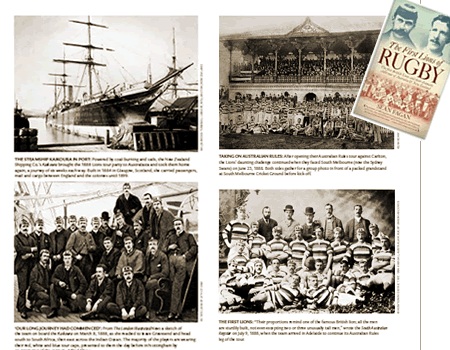
During the 1888 British Lions team’s visit to Ballarat, Swinton rugby club’s fullback Arthur Paul made a remark in conversation that fairly startled the locals. It seems in December 1854 his father was at the vanguard of the British forces that forcibly ended with muzzle-loaded muskets and fixed bayonets Australia’s one and only rebellion.
Now that might not cause much affront today in what were Victoria’s goldfield towns, but in 1888 many of the rebellious miners directly involved and others that were witness to the times and events were still about. And judging by the letters to various newspapers right up to 1904 at the commemoration of the 50-year anniversary, there was little forgiveness for how the British strong hand put down the dissenters that summer morning.
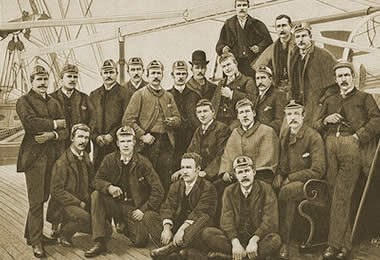
The 1888 British Lions, including famous English cricketer Andrew Stoddart, played three games of Australian rules football in Ballarat against local clubs (Ballarat FC, Ballarat Imperial FC and South Ballarat FC).
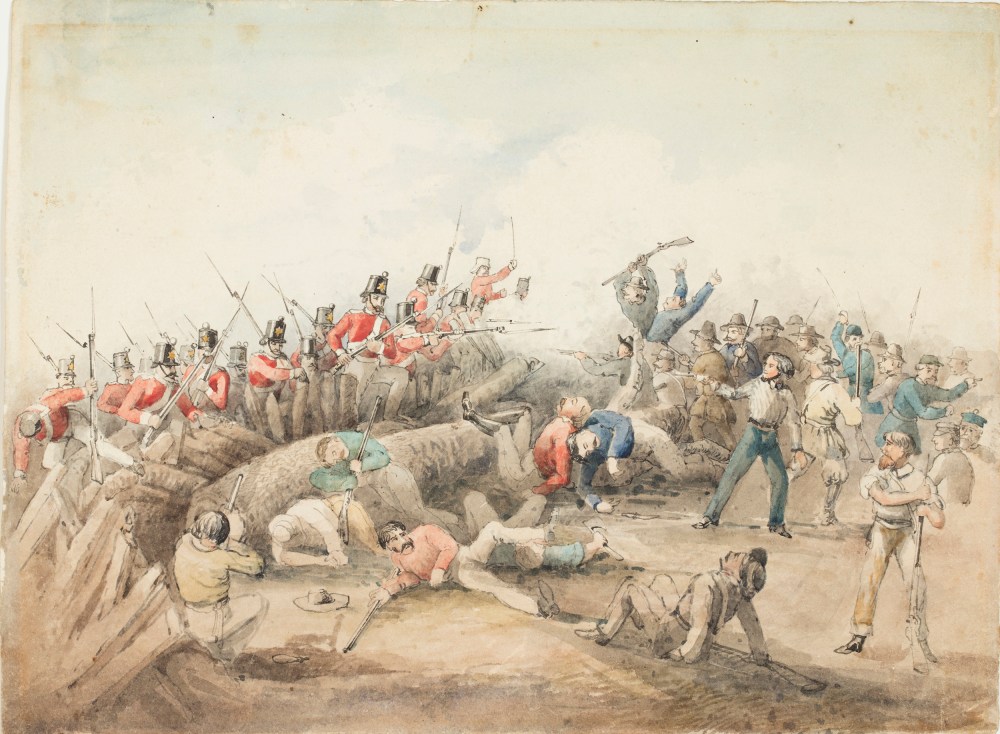
The scene of 1854 conflict was Bakery Hill on the east side of Ballarat, and came to be known as ‘The Battle of the Eureka Stockade’. Generations of Australians have regarded the event as the birth of Australian democracy and nationhood.
The uprising was caused by the Victorian colonial government tripling the fee for gold digging licences on crown land and then followed the infamous “digger hunts” by police troopers, empowered to seek out those mining without a licence and imprison them (or worse). Incensed at their treatment, and with all their peaceable protests being ignored, the ‘diggers’ built a rough fortress, those that had them burned their licenses and they raised their own flag, comprised of the Southern Cross stars in white on a blue background and no Union Jack.
Though thousands of miners were active in the movement and 1500 had been engaged in military drills in preparation for a battle should it come, when the surprise attack from a 275-strong force of British soldiers (of the 12th and 40th Regiments) and Victorian police commenced, the encampment had only 150 men to defend it.
Barely two years out of Eton College, Lieutenant William Paul led 65 rank-and-file of the 12th Regiment (The Suffolk Regiment) in the attack advancing on the Stockade. The official report of the battle states Paul “received a severe wound (shot in the hip) but continued to do his duty in the ranks”. The British forces crushed the rebels in no more than 20 minutes; 22 miners and five of the military were killed, with many on both sides wounded. The flag was torn down and now resides on display at the Art Gallery of Ballarat.
In calmer times, the British military that came to be stationed in Australasia, sometimes played football among themselves on barrack grounds and open fields—the earliest documented in 1829 at the George’s Square Barracks in Sydney, the last remnant of which is now Wynyard Park in York Street. By the 1860s visiting British “redcoats” (army) and “bluejackets” (navy) were meeting civilian teams and clubs in friendly battle on the football field.
The first known instance of a British football team of soldiers meeting an outside opponent came in September 1855, when the now fit and well Lt. Paul was back on duty in the Victorian gold fields. Though the path to fully addressing the miners’ demands was already by then well underway, Paul organised a football game to further help heal and restore a peaceable feeling between the Eureka protagonists.
The match was recorded in Castlemaine Mail:
Foot Ball.
— On Saturday last a match at football came off on the Camp Reserve, between Lieut. Paul, Mr. Naylor, and twelve soldiers of the 12th and 40th Regiments and an equal number of diggers.
Owing to the extremely wet state of the ground, the running was very precarious, and no end of upsets ensued, some of them of rather a forcible nature. After kicking some two hours with no advantage on either side the ball burst, and so the match terminated.
The return ” kick” comes off on the same ground to-morrow, and we cannot refrain from expressing our gratification at the good feeling evidently subsisting on this gold field between two parties lately so antagonistic on others.
During the whole afternoon we did not hear one hasty or angry word on either side, and a parting glass “all round testified the continuation of the evidently predominating feeling.
The game was some sort of a Rugby hacking-style rough-and-tumble football, if how the two groups played in the 1860s can be used as a guide.
Henry Colden Harrison, who chaired the first VFA meeting that refused to sanction the Lions tour, said of his football playing days in Melbourne: “We had many matches with the military, especially with the 14th and 40th Regiments” and these men “played a most vigorous and daredevil game and my shins are still black and blue with the effects of it. But they did not have much science.”
Another Melbourne footballer of that time remembered the military teams, and added it “reminds me of the games played against the miners of Ballarat, which for wild rough, lawless play could not be excelled. Most of the miners were Cumberland wrestlers and the game was more an exhibition of wrestling than football and the idea seemed to be to fell each player, regardless of reason and rule.”
The football team of the 14th Regiment (a predominantly West Yorkshire raised unit) was, as reported in Empire in 1867, “under the command of Captain Noyes, an old Rugbeian, if we mistake not, and a capital player, as most from that noted public school in England are”.
They left a litany of broken and bloodied footballers behind as they slowly withdrew from Australasia at the end of the 1860s. In what were intended as games played to Australian Rules, the 14th simply did as they pleased. This was generally to use any means available to trip, throw, charge or hack an opponent over, dispossess him of the ball, indulge in long and rough Rugby School type scrummages and then run off to the goal without ever bouncing the ball.
The “redcoats” entered the field of play by marching onto the ground, and their football kit was merely “their undress toggery”. Harrison recalled: “They played with their trousers tucked into their heavy boots, and with coloured handkerchiefs tied around their heads. They were mostly big, heavy men, and their appearance was pretty awe-inspiring! They had a playful way too, of kicking an opponent in the shins to make him drop the ball.”
It is perhaps singular to note that every city they played in—Melbourne, Hobart, Adelaide and Perth—tradition has handed down the belief that Rugby (which many subsequent generations never saw a game of) was a brutal game that possessed dangers and violence that were too much for anyone of sound mind to countenance as a sport to be played or watched.
It is also thought that the words “barrack” (also barrick), “barracking” and “barrackers” (barrickers)—given to describe the rowdy, yelling, one-eyed band of heckling spectators aligned to one flag only, which first began to appear across the Australian colonies in the early 1880s—owe their origin to the uniform wearing regimental soldiers who urged their football-playing comrades on with a display of partiality as forceful as that with which they played the game.
A decade later the barracking had spread to cricket in Australia, culminating in Stoddart, now England’s 1897-98 captain, expressing in Sydney at the tour’s end his utter dismay at the local crowd’s behaviour, calling their howls, groans and hooting unsportsmanlike and ungentlemanly.
Ironic, or perhaps entirely appropriate, the Eureka spirit lives on in a form of crowd support taught to the colonials by British soldiers.
© Sean Fagan – this article is primarily taken from the book ‘The First Lions of Rugby’.
Postscript: the Melbourne Rebels in Super Rugby are named with a nod to the Eureka miners, and their blue jersey features the Southern Cross white stars in Eureka flag configuration.


