
Story written & researched by Sean Fagan for SaintsAndHeathens
In the modern game it is the task of the hooker to throw the ball into the line-out. It hasn’t always been the way, with earlier eras assigning the role to the winger, half-back or other positions.
The laws of rugby have never ordained which position must throw the ball into the line-out – it has always been left to tradition, evolution and individual circumstances and preference to decide.
By the 1890s convention had seen the role fairly settle upon the shoulders of the team’s half-back. Looking back from today, it is probably seen as a rather strange option. However, at that time, team’s carried two half-backs, with one either side of the scrum (left and right).
At the line-out the usual practice was for the forwards to try and catch the ball, and whether successful or not, the ball was soon on the ground where all the forwards would compete in a standing ruck and shoving contest.
That the half-back had thrown the ball into the line-out mattered little, as he had plenty of time to regain his position behind his forwards before the ball emerged – more often than not it ended with the referee blowing his whistle and ordering a formal scrum.
The only other option taken at the line-out was to throw long to a fast man at the end of the line, and hope to escape up and across field before any contest amongst the forwards could eventuate.
Adrian Stoop – the great half-back for Harlequins and England in the early 20th century – claimed the only coaching he ever received in the position was as a boy at Dover College in Kent, where he was taught how to throw the ball in from a line-out. [Rugger, My Pleasure – AA Thomson, 1957].
Then the first New Zealand All Blacks arrived in England in 1905, they brought with them a formation that figured just one half-back and two five-eighths. They also used the line-out as a chance to get the ball out to their backs.
Both of these changes were a revelation to the game in Britain, as the All Blacks’ Dave Gallaher and Billy Stead explained in their 1906 book, The Complete Rugby Footballer:
“In England the scrum half is usually delegated to do the throwing in. This is a mistake. Nobody is or should be better able to institute an attack of any kind than this individual, and it is a waste of his valuable time and services to put him to the task of throwing in. Our plan is to give the ball to one of our short hookers as some kind of a short rest for him from his very arduous labours in the front row of the scrum.”
In detailing how their forwards got the ball from the line-out to their half-back, and the early difficulties their innovation encountered with referees, they wrote:
“Reaching high up he does not attempt to seize the ball, but simply knocks it back with his hand to the scrum half – a proceeding, by the way, which, not being used to it, referees in this country [England] are often disposed quite wrongfully and illegally to penalise. We have had some very promising movements stopped at the beginning by this most aggravating manner.”
The referees in Britain had (mistakenly) taken the view that deliberately knocking the ball, no matter what direction, was unlawful.
The 1905 All Blacks original tactics did not catch on, and the half-back continued to undertake the role of throwing the ball into the line-out.
By the 1930s it had come to be realised that the line-out could be an attacking vehicle to unleash the backline, and that the half-back had to be ready to take the ball from the forwards.
However, it was not the hooker who took over from the half-back, but the blindside winger.
A well-familiar photo of Prince Alexander Obolensky who played winger for Oxford University and for England was taken during this period.
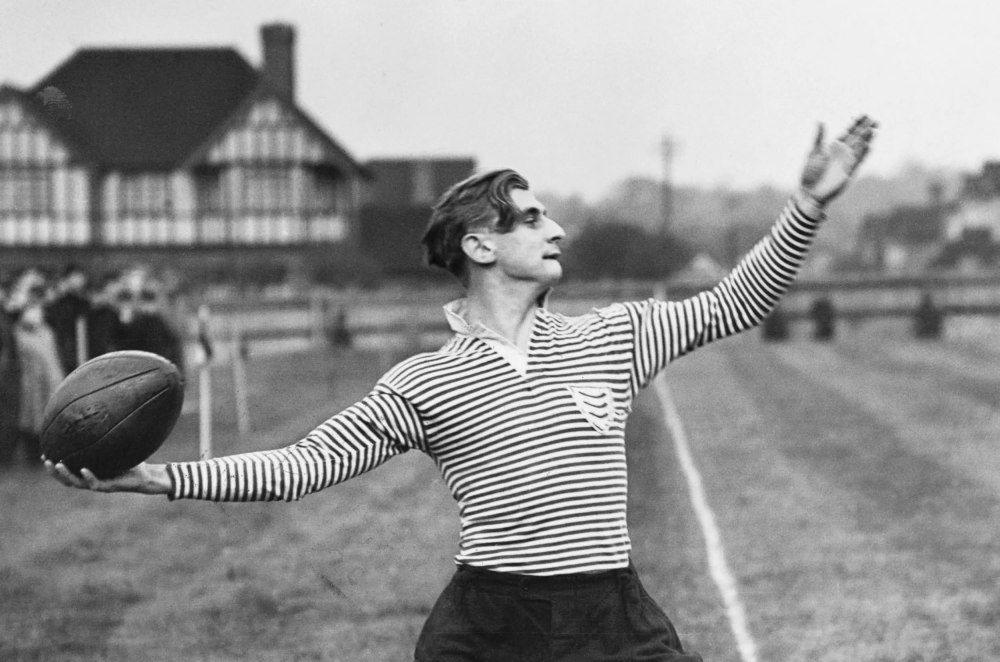
In The Chosen: The 50 Greatest Springboks of All Time, Andy Colquhoun and Paul Dobson revisit the role of the hooker:
“But they had to be hookers first of all. Hookers stood at the front of the line-out at a time when the main jumpers were at three and five. They stood at the front to get them out of the way. They did not throw in at line-outs.”
The theory behind replacing the half with the winger was that not only would gains be made by having the half-back ready to attack, but the winger had the necessary speed to sweep around and support in any backline movement, as well as provide additional cover defence.
While rugby lineout throws had by custom relied on erratic, cricket-style overarm bowling motions or underhand passes, the catalyst for change came in the late 1950s from a “Yank at Oxford.” As a winger, American Rhodes Scholar Pete Dawkins introduced gridiron-style overarm passing to the University’s rugby team. His high-velocity, precise throws revolutionized the technique, shattering traditions and laying the groundwork for the modern overhead lineout throw.
Some international wingers from the 1960s-70s are fondly remembered for their ability to accurately throw the ball into the line-out, including the Wallabies twin wingers James and Stewart Boyce, as well as All Blacks winger Grant Batty.
Batty wrote in his biography (with Bob Howitt in 1977) that:
“Smart coaches know that a winger who can throw-in accurately is as good as an extra lineout jumper, because coordination and timing between thrower-in and jumper is all important to ensure adequate lineout possession is won.”
That’s not to suggest that only wingers could throw the ball at a line-out, with exceptions in teams across the globe. In The World of Rugby (1979) John Reason and Carwyn James note the example of the “Le grand Béziers”:
“… it is interesting to see that the wheel has come full circle in that Beziers, the French club champions, and the most successful club in the world throughout the middle and late seventies, again used the scrum half-back to throw in.”
While well into the 1980s many teams continued to use their wingers to throw the ball in at line-outs, from the mid 1960s onwards the trend was increasingly to have the hooker taking on the role.
It had taken nearly 70 years for the example provided by the 1905 All Blacks to be followed.
© Sean Fagan.

 — saintsandheathens.com —