
Story written & researched by Sean Fagan for SaintsAndHeathens
In true Rugby-speak a “field goal” is not what you think it is. And not just because deep down you know it is a vulgar expression when knowledgeable Rugby folk are talking.
While “field goal” is today used interchangeably by many as the same as a “drop goal,” they are not the same. The “field goal” has been banned since the RFU abolished it from the laws of the game in 1905.
Prior to that year the means to score a goal only restricted a punt kick. Which left open another type of kick to land a goal — a soccer-style flying-kick of a rolling or bounding ball.
Wait, what did you just say?
Now this type of kick for a goal was not common, and frankly it was taken by many Rugby purists as the resort of the novice footballer who did not know what to do in the heat of battle. It was flukish and dubbed “the speculator” kick.
It was also regarded as very dangerous, causing knee injuries and broken legs to the players themselves and anyone else close enough to be hit (kicked) by a wildly thrown about kicking leg. The “field goal” wasn’t allowed if the ball was stationary when kicked. To sum it up, for most involved in Rugby “the field goal … is rank bad football.”
In Sydney first grade (“Seniors”) club games from 1870 to 1905 to this writer’s knowledge there are fewer than a handful of instances, and only two at inter-colonial and Test match level.
The first was in 1888 in New Zealand between the first British Lions and a combined Otago team at the Caledonian Ground. As told in The First Lions book:
Then, in the most unexpected way possible, the deadlock was broken. The Otago forwards again came with a dribbling rush. Within sight of the goal posts, and the ball bounding along in front of him, the team’s captain, Edward Morrison, suddenly took a speculating kick at it. “Greatly, to the astonishment of everyone, it went flying over the bar between the posts,” wrote the Otago Daily Times.
“It was an astonishing piece of play, such as one might not see in a lifetime, and the Otago supporters could hardly realise that their men had scored.” As the Blues went back to the centre the cheering grew louder and louder as the realisation of what had happened spread. Otago 3, Britain 0. Ironically, Morrison was in fact an Englishman, in Dunedin for a time working as the English master at the boys high school.
The most widely seen instance, and the only known one in inter-state matches in Australia, was a goal kicked by Queensland forward J. Patterson against NSW in front of 12,000 spectators at the SCG on 28 June 1894. He kicked the ball between the goal posts at the southern end of the ground. The Sydney newspapers recorded of the kick:
There was also a remarkably lucky score credited to the visitors in the second half, when Patterson, making a running shot at the ball without even picking up, piloted it over the New South Wales bar. It is a very rare occurrence indeed for a goal to be so obtained.
— The Sydney Morning Herald, 3 July 1894
Queensland increased the score by means of a rare fluke, Patterson kicking a goal from a rolling ball.
— The Australian Star, 3 July 1894
The visitors again rallied, Brereton, Welch, and Milne being prominent in the front division. They carried the sphere to the home team’s 25, and as the ball was rolling along Patterson
took a kick, and to the surprise of all a field goal resulted.
— The Evening News, 3 July 1894
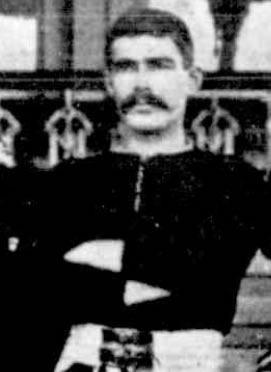
How it came to be, especially in Australia, that a “drop goal” was known as a “field goal” is lost to time. In Queensland in particular this was rife 20 years before the real “field goal” was even done away with.
If nothing else though, this serves to prove how rare a true “field goal” actually was.
© Sean Fagan.
Author’s note: Though no one, to my knowledge, has ever suggested or attempted it, the same loose definition of a “goal” that permitted the soccer-style “field goal” arguably never prevented an old-fashioned rugby place-kick routine from occurring in general play. In theory—akin to modern American football—the ball could from a scrum, ruck or maul have been passed backward to a teammate acting as a holder, who would place it on the turf for another player to immediately attempt a goal kick? Perhaps the rules relating to place kicks would prevent it being used a means to score a goal from the field in open play?

 — saintsandheathens.com —