
In the fading light of a scorching hot late February afternoon in 1885, South Sydney’s finest footballers gathered outside the massive iron guard house gates at the Oxford Street entry to Sydney’s Victoria Barracks.
They were carrying their rugby boots and jerseys of various clubs. Surely the thought of a summer game of rugby was enough to make most immediately turn away from whoever raised the ‘mad dogs’ notion.
But this was a special time of a greater cause.
Story written & researched by Sean Fagan for SaintsAndHeathens
The Daily Telegraph, 27 Feburary 1885:
MILITARY FOOTBALLERS.
At the request of several footballers who are members of the Sudanese contingent, Mr P. H. Gilbert, of the Redfern Football Club, has undertaken to get together a team to meet the “Sudan footballers” tonight (Friday), at the Victoria Barracks.
All gentlemen who play the “noble game” are requested to meet at the Barrack gates at 5.30 p.m. punctually, in order to give the enthusiastic volunteers a little sport prior to their leaving this colony.
Although the weather is rather warm for this kind of exercise, still we are certain that the New South Wales footballers, being as a body loyal to their country and their Queen, will not mind exerting themselves in order to give our brave “Volunteer footballers” a short time to exercise their powers at the game they love so well.
Within days of this game, on 3 March 1885, the 758 men of the New South Wales Contingent would leave by ship for the Sudan—Australia’s first ever military force dispatched to an overseas war. Decades before Federation, this was NSW’s own army.
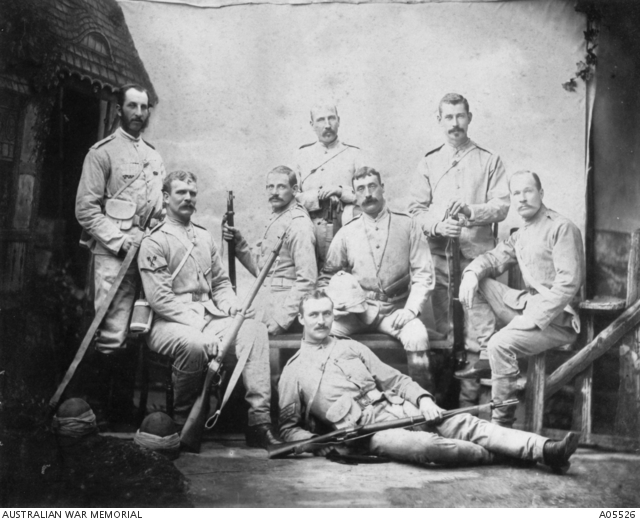
As the volunteers marched from Victoria Barracks to Circular Quay to board the transport ships, the Iberia and the Australasian, crowds topping 200,000 people lined the city avenues. That was roughly 75% of greater Sydney’s entire population.
The sudden “call to arms” had come from the highest levels of government. Following the shocking news in late January 1885 of the death of Britain’s General Charles George Gordon at the Siege of Khartoum, the NSW Acting Premier, William Bede Dalley (the very man “Dally M” was later nicknamed after), offered to send a detachment of troops.
The recruitment drive was flooded with thousands of applicants. A giant muster of young men, many with no prior military connection, took place at the Barracks for drills, assessments, and medical checks.
The impromptu rugby fixture itself was born out of that same patriotic enthusiasm. It was Percy Gilbert of the local Redfern Football Club who answered the call of the military men to give them a contest. This cobbled together ‘Redfern’ civilian side included George “Jumbo” Walker, one of the city’s most popular players and a NSW representative.
The Redferns are part of a lineage of South Sydney clubs beginning with Darlington FC in 1874 and culminating with the South Sydney district club in 1900 and the current day Rabbitohs in the NRL.
The match was contested on the open parade ground adjacent to the main sandstone barracks block in temperatures topping 33 degrees Celsius. These days the Australian Wallabies sometimes train there.
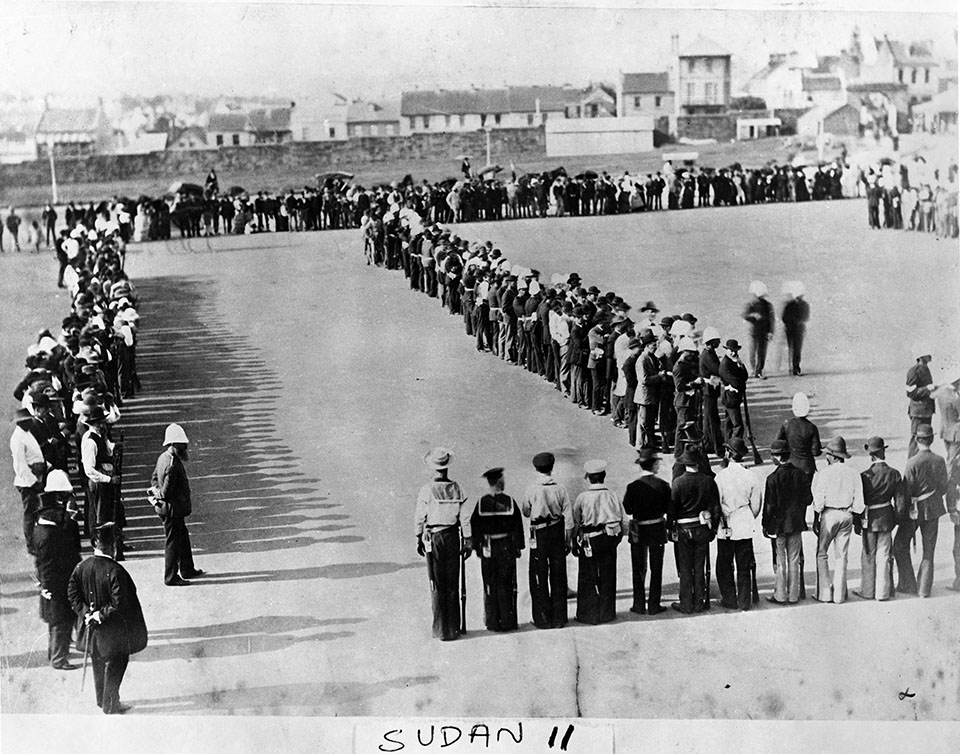
As the footballers took to the field in this 1885 contest, smoke from the city’s rough industries cut a haze through the glaring sunlight. Players and spectators alike raised a hand in “the Sydney salute” to shield their eyes against the setting western sun. If a man couldn’t cope with a rugby game in the early evening of a Sydney summer, he wouldn’t survive the Middle East.
The match itself was a classic rough-and-tumble battle. For the bold “Soudanites,” Sergeant Smith led the vanguard with military precision, twice storming the Redfern fortress to cross the line for tries. He was ably supported by the desperate charges of Privates Ashworth and McRae.
Yet, the civilian Redfern pack held its nerve. Aided by the tactical play of half-backs Warren and Bennett, the club men secured a narrow victory, concluding the match with one goal and one try to the soldiers’ two tries.
Naturally, no colonial football yarn is complete without a touch of mystery. As darkness blanketed the barracks, the Redfern side realised they were a man short. Forward A.E. Godfrey had vanished into the Paddington shadows during the second half—playfully recorded by his teammates as a “deserter” before the real campaign had even begun.
The Contingent arrived in the Red Sea port of Suakin in early April 1885. Their campaign in the Sudan was brief and largely consisted of guard duties and minor skirmishes, though the harsh desert environment took a toll through disease. They returned to another hero’s welcome in Sydney in June 1885.
The loss of General Gordon left such an indelible mark on the local rugby psyche that in 1886, a powerful new club was formed in direct tribute to the fallen hero: the Gordon Football Club. The club was given a large room at the Barracks to use as a dressing room before playing their matches at Moore Park.
The Gordons proved an absolute sensation, winning both the Sydney first-grade premiership and the coveted Gardiner Challenge Cup in its debut season.
© Sean Fagan
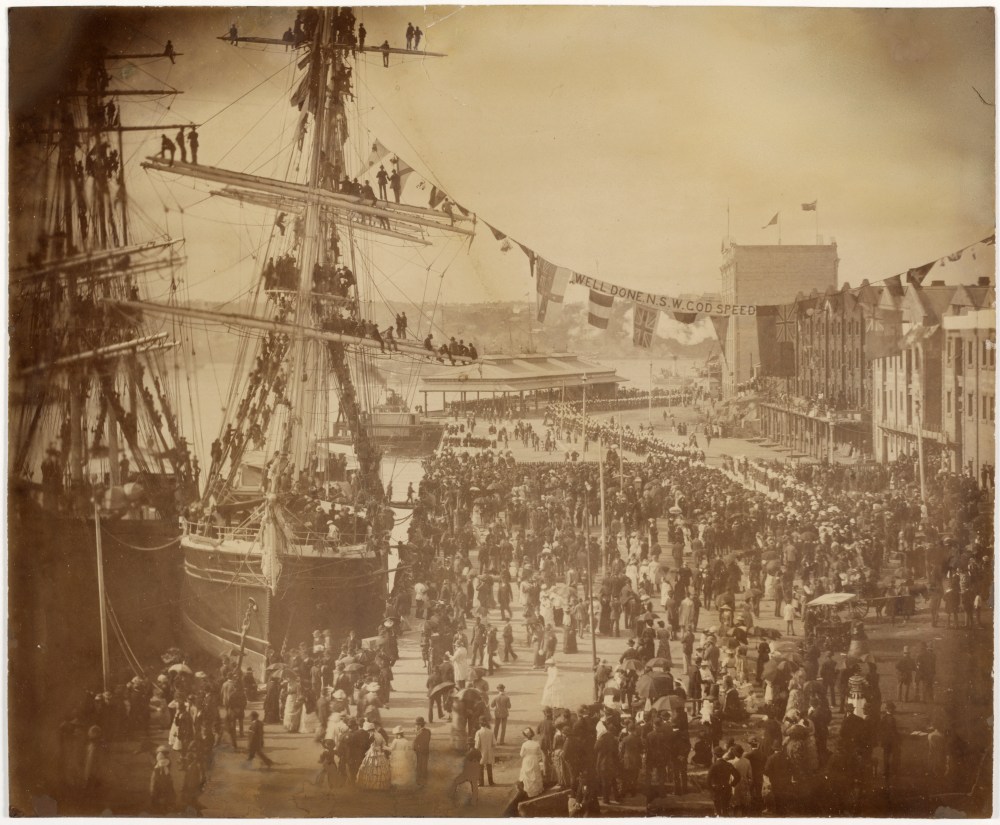
Evening News (Sydney) 4 March 1885:
“It is needless to say, never before has so large a crowd been gathered together in Sydney as assembled on Tuesday to watch the procession of the Australian [NSW] contingent from their barracks to the place of embarkation on board the transport vessels at the Circular Quay.
It would be impossible to form even an approximate idea of the numbers who witnessed the impressive sight of their countrymen departing for the war. No means exist for arriving at such an estimate.
When it is remembered that, in addition to the population of Sydney which turned out en masse,- there were thousands and thousands of provincials and large numbers of visitors from all the surrounding colonies, some faint idea may, perhaps, be formed of the numbers composing the vast multitude which witnessed the first serious military display ever held in Australia.
Truly the enthusiasm of the people was worthy of the pageant, which is without parallel in the history of this or any of the other colonies.
The numbers of the spectators have been variously estimated and guessed at; the different opinions varying between 200,000, 300,000, and 400,000. It would probably be nearer the mark to place the figures somewhere between 250,000 and 300,000.”

