
In Melbourne, a cricketer’s letter sparked a behemoth. Meanwhile, a year on in Hobart, a desperate Young Einstein kind of fellow wrote a letter calling on a winter lounging crowd of cigar-smoking cricketers to play a game of football, only for it to fizz out as no one had a ball.
Story written & researched by Sean Fagan ©

In the cultural landscape of Australian sports history, few documents hold the near-religious reverence of Tom Wills’ 1858 letter in Melbourne to Bell’s Life in Victoria—a media artifact preserved like a holy relic in our premier national archives for launching Australian Rules football. [Link]
Today it is recited with the holy certainty of an immutable fact: “Tom Wills invented Australian football to keep the cricketers fit during winter.” They built a statue to him outside the Melbourne Cricket Ground. [Link]
What if we told you we recently uncovered in those same national archives a similar piece of correspondence in Hobart’s Bell’s Life in Tasmania?
And yet, unlike that of Tom Wills, the life of that cricketer’s football letter, if it found any, was as best wallpaper and bed-stuffing for the poor derelict souls boarding at the city’s notorious “Rat’s Castle”.*
Why did one letter set in train a sporting industry that will long outlive us all, and the other nothing?
The answer begins with a blatant media play that served as a raw forerunner to the 1990s pay-TV network wars. Just as modern broadcasters buy, manufacture, and prop up sports leagues today, simply to secure programming and fill empty broadcast schedules, the editors of Bell’s Life were desperate to conjure local winter content out of thin air, to keep their printing presses profitable during the cricket off-season.
In the midst of the popularity of the Rugby School novel, Tom Brown’s School Days, they aggressively goaded the cricket clubs community into taking up football.
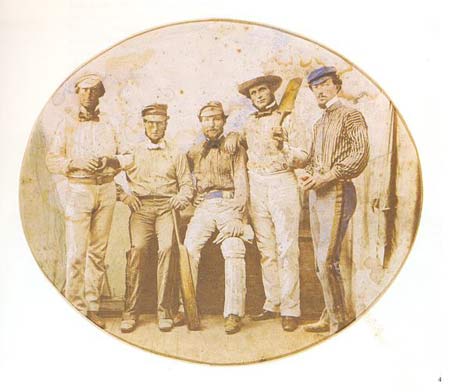
Bell’s Life in Tasmania, 12 July 1859:
Foot-Ball.—The Melbourne Cricketers, determined to keep their muscles and wind in order during the winter, have gone heart and soul into the manly and exciting game of Foot-ball.
Why should our men not follow the worthy example, and have a good bout on the Saturday half-holiday, in place of lounging about with cigar in mouth, and hands in coat-tails, vainly seeking to kill time?
Let us make a beginning at once, and meet next Saturday for a game; The first Secretary of a Cricket club who sends a challenge to another will deserve all honour, and secure lasting benefits to his fellows.
The only objection that could be raised—viz: the tearing up the various grounds, need not be brought forward, for there is ample room to be found in both city and country.
Bell’s Life in Tasmania, 19 July 1859:
Foot-Ball.—Our remarks on the advisability of cricketers binding themselves together, once a week, for the purpose of keeping their bodily energies in train against the coming season, seem to have caused an inclination to follow our suggestion, and we believe a game will be played in the Hobart Town Domain next Saturday.
Bell’s Life in Tasmania, 19 July 1859:
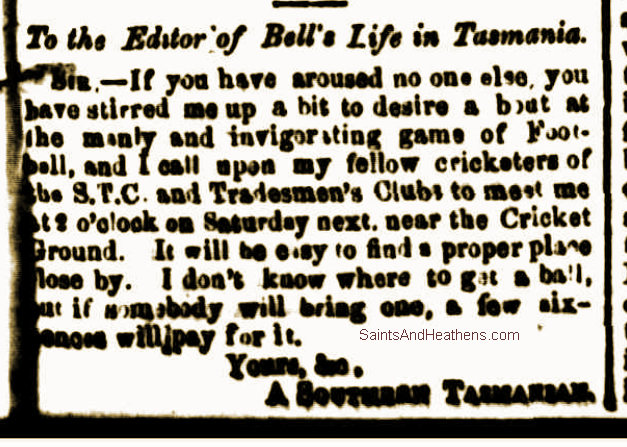
To the Editor of Bell’s Life in Tasmania.
Sir.—If you have aroused no one else you have stirred me up a bit to desire a bout at the manly and invigorating game of Football, and I call upon my fellow cricketers of the S.T.C. and Tradesmen’s Clubs to meet me at 2 o’clock on Saturday next, near the Cricket Ground.
It will be easy to find a proper place close by. I don’t know where to get a ball, and if somebody will bring one, a few sixpence will pay for it.
Yours,
A Southern Tasmanian
This urgent desire to implement football as a means to keep cricketers active during the colder months was uniquely shared by Melbourne and Hobart. In Sydney, there was never such a call; blessed with a sub-tropical climate, where winter was measured in days rather than months, the cricket season was ten months long, and it was only a brief respite from tedium that gave football an opening at all. [Link]
Yet, while Hobart had the cricketers and grounds, they were utterly hamstrung at the outset by a spectacular lack of basic sports equipment – a ball.
To understand the tragicomic reality facing “A Southern Tasmanian” as he rallied players to the cricket field on the Hobart Town Domain, one must realise that in the early colonial era, a physical football was a rare, high-value novelty.
The supply chain was so non-existent that in 1860, when a single football went missing in the north of the island, The Launceston Examiner treated it as a major crime, publishing a public notice offering a reward for its safe return.
This scarcity reached peak absurdity in the Hobart letter itself, where the desperate author confessed, “I don’t know where to get a ball,” before proposing an ad-hoc, colonial whip-around: “if somebody will bring one, a few sixpence will pay for it.”
Given there is in the ensuing editions of Bell’s Life in Tasmania and other Hobart journals no mention of any football, we can be assured the match did not go ahead. The lack of a ball may have been the primary reason, but equally, there may have been a general lack of enthusiastic cricketers.
It was an unfortunate historical mistiming: the 1859 letter arrived just a few years too late for the only generation capable of answering it. A decade earlier, between 1847 and 1849, the Reverend John Philip Gell (the real-life inspiration for “Old Brooke” in Thomas Hughes’ novel Tom Brown’s School Days) had introduced structured rugby football to the students of Christ’s College at Bishopsbourne (near Longford). [Link]
Had this call for club football happened then, a ready-made group of Hobart’s young gentlemen would have existed. But by July 1859, the cash-strapped college had long been closed, and those original Bishopsbourne boys were now in their late twenties, married, and anchored by the domestic realities of mid-century colonial life.
Hobart completely lacked the robust institutional framework that was simultaneously supercharging the game in Victoria. Melbourne’s football explosion was directly ignited by the fierce rivalries of elite, highly populated institutions like Melbourne Grammar, Scotch College, and Geelong Grammar.
Tasmania had no equivalent engine room for youth sports. Christ’s College was gone; the newly established Horton College in Ross had only recently opened its doors and was years away from fostering a sporting identity; and across the rest of the island, significant schoolboy football was non-existent. There were simply no school playgrounds to cultivate, test, and pass down a winter code.
Other than “new chums” fresh from Home, there was no established football player pool, save for the rudimentary football knowledge gained in the rustic games of celebration days, fetes, and pubs. Ultimately, the initiative could not bridge the gap between old-world carnival play and the modern sporting age.

Without a football, the game in Tasmania was hamstrung at the kick-off
This 1859 failure left Tasmania playing catch-up for the next two decades.
By the mid-1860s the colony’s first football clubs emerged. Matches between Hobart Town and New Town in 1866–67, in the tradition of rugby clubs in London, were often twenty-a-side and decided by the best of three goals.
In 1869 The Cornwall Chronicle excitedly reported the news that a club in Launceston possessed “a ‘Rugby’ ball— we believe the only one in the colony — which possesses many advantages over the old fashioned round one here-before used by the club”.
Finally in the mid-1870s newspaper advertisements told of the local availability of “full-sized Rugby Match Balls” and “Real Rugby football jerseys.”
When organised football finally did emerge on the island, it manifested as a chaotic, localised hybrid—a unique “Tasmanian code” that featured rugby-style crossbars, tries, and endless rule disputes before the island finally adopted Victorian Rules in the mid-1880s. [Link]
A plan to tip a lounge culture of colonial cricketing devils out onto the winter playing field, literally beaten from the outset, because no one could source a foot-ball.
© Sean Fagan.
* “Rat’s Castle” refers to a historic, dilapidated building that once stood on the corner of Elizabeth and Brisbane Streets in Hobart, Tasmania. Originally built in 1822, the property was in the mid 1850s a low-cost boarding house, but heavily neglected it fell into severe disrepair with broken windows, missing bricks and rotting timber. Locals affectionately and derisively nicknamed the resulting slum “Rat’s Castle.” Demolished c.1878, the site is occupied today by Roxburgh House. The dilapidated “Rat’s Castle” is immortalised in a well-known watercolour painting c.1919 by artist Blamire Young, who relied upon historical photographs.

