
Establishing rugby football in Tasmania was won under hard labour. While the military and free servants had virtually no leisure time, one could always hear “the shouts of convicts at foot-ball.”
Story written & researched by Sean Fagan ©
Folk football of various varieties had already appeared in Hobart and Launceston from the 1830s.
Rugby football reached Van Diemen’s Land (Tasmania) remarkably early. In the late 1840s, Rev. John Philip Gell, a Rugby School old boy and the real-life inspiration for “Old Brooke” in Thomas Hughes’ novel Tom Brown’s School Days, became Warden of Christ’s College at Bishopsbourne (near the town of Longford). [Link]
Between 1847 and 1849, Gell introduced the rugby schoolboys game he had known to the college boys. This remains the earliest documented instance of rugby football played in Australia, predating organised matches in Melbourne (1858) [Link] and Sydney (1870) [Link].
The educational influence of Rugby School extended further. In 1850 Thomas Arnold—the son of the celebrated headmaster who had transformed Rugby School itself—arrived to take charge of public education across the colony. Over the next six years he organised some 75 schools, consciously modelling many of his reforms and ideals on the Rugby system his father had pioneered.
Although it is unclear how widely football was played in these schools, the intellectual and cultural imprint of Rugby was strong. That connection is still visible in the landscape: the remote south-west wilderness contains Mount Rugby and the Rugby Range overlooking Bathurst Harbour, enduring place-names that recall the English school’s reach into the colony.
By the mid-1860s the first football clubs emerged. Matches between Hobart Town and New Town in 1866–67 and in the tradition of rugby clubs in London, were often twenty-a-side and decided by the best of three goals.
In Launceston a new club formed in 1875 and its first matches featured “touchdowns” (tries), long runs carrying the ball, and conversion goal attempts—clear rugby characteristics. Contemporary advertisements sold “full-sized Rugby Match Balls” and “Real Rugby football jerseys.” Goalposts frequently carried a cross-bar, and goals counted only when the ball cleared it. [Link]
Through the 1870s a hybrid “Tasmanian game” flourished, blending rugby, association (soccer), Victorian rules and local elements. Scrimmages could last an age, players ran freely with the ball, and disputes over rules were common.
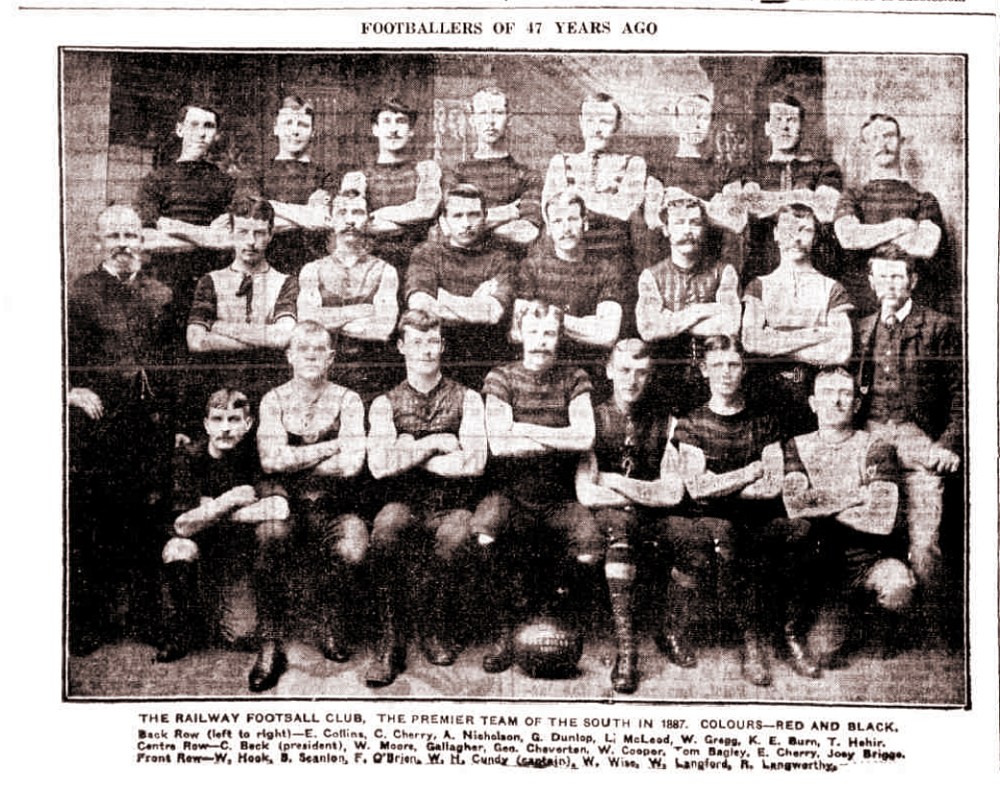
When the Tasmanian Football Association formed in Hobart in 1879, clubs adopted a game of their own, with features of Victorian rules but also those of rugby, including the cross-bar. The Mercury criticised the compromise as creating a unique “Tasmanian code of rules.” North–South matches under these rules continued into the early 1880s. [Link]
Pressure for intercolonial competition with clubs from neighbouring Victoria eventually forced full adoption of Australian rules football by the mid-1880s. Rugby posts disappeared from the colony’s grounds.
The first British Lions rugby team to visit Australia stopped overnight in Hobart in 1888 and was entertained by the local football association, but with so little time no match was arranged.
Occasional games were played by visiting British naval officers and men (notably the 1905 “Fleet Rugby Football Club”). By 1913 The Mercury could declare rugby “as foreign to the sports of Hobart and Launceston as tobogganing is to Sydney.”
Yet individual Tasmanians still reached the highest levels while studying or working elsewhere. Henry Yule Braddon (Launceston Grammar) played for New Zealand in 1884 and later New South Wales; Lyndhurst Giblin (Hobart-born) won three England caps in 1896–97; and Allan Stewart represented Scotland in 1913–14. [Link]
Organised club rugby finally arrived in May 1933 when the Launceston Rugby Club was formed. Interest quickly spread south.
The inaugural Hobart match was staged at the Christ College Ground (now Parliament Street Reserve) in Sandy Bay, with many of the players drawn from the college itself. From that game grew the University of Tasmania club and the Harlequins.
A Southern Tasmanian Rugby Union and the first North–South representative match completed the year’s revival.
Thus the story had come full circle: Christ College, the very college that had first brought rugby to Australian shores in the 1840s, became the birthplace of its permanent modern revival in Tasmania almost ninety years later.
© Sean Fagan.


