
‘We may not have woman’s suffrage, but let us by all means have female football’.
There have been many football clubs in Australia who have in the 19th and 20th centuries taken as their sobriquet the native wallaroo (a marsupial macropod cousin to the wallaby and kangaroo).
Notably, as we shall see below, one long forgotten Sydney-based Wallaroo club is tied to today’s rugby world – but should it?
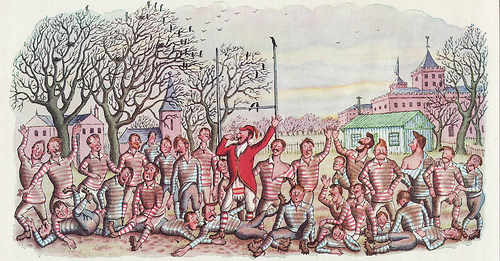
As explained on the ARU’s official website, the Australian Women’s rugby team has also adopted the wallaroo:
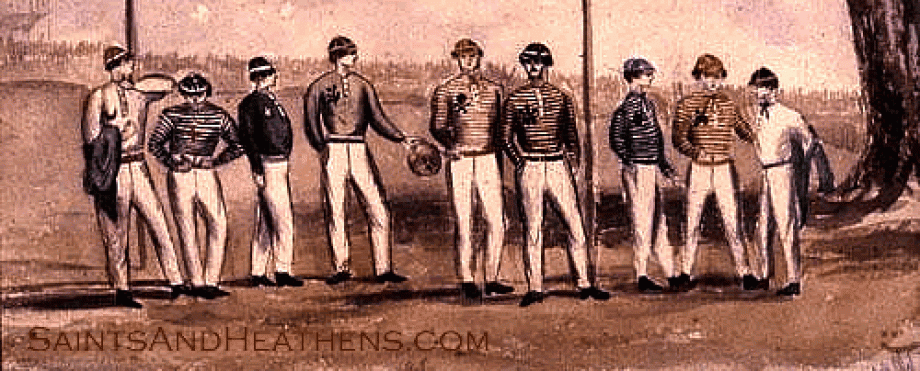
In 1993 the Australian Women’s Rugby Union (AWRU) selected the name ‘the Wallaroos’ as the name for the newly formed Australian Women’s team. This was chosen as it was the name of one of the oldest clubs in Australia, the Wallaroo Football Club, which was formed in 1870.
The first Test match played by an Australian Women’s team took place in 1994, after the AWRU announced that the Australian team would play the Black Ferns in their inaugural Test match on Friday 2nd September, at North Sydney Oval.
Coach of that first Australian women’s squad, Mick (Mickey) Willis, produced an information newsletter for the players with updates on arrangements and training advice. In ‘Newsletter (No.4)’ issued in early August 1994, just weeks before the debut match against New Zealand’s Black Ferns, he records news of the team’s name.
Identity:
Rob has advised the ARFU has decided the Australian Women’s Rugby Team will be known and marketed as the:-
AUSTRALIAN WALLAROOS
Sounds good hey!!!! – Now we can hop to it!!!! – Ha!!!!
(Apologies to the ACT team for borrowing their name).
So, while the first Australian men’s rugby squad had in 1908 been given the freedom and honour to choose their own nickname, ‘the Wallabies’, if the history is as put forward above by the official website and in the coach’s newsletter, it wasn’t the players in the first Australian women’s team who chose ‘Wallaroos’ as their name.
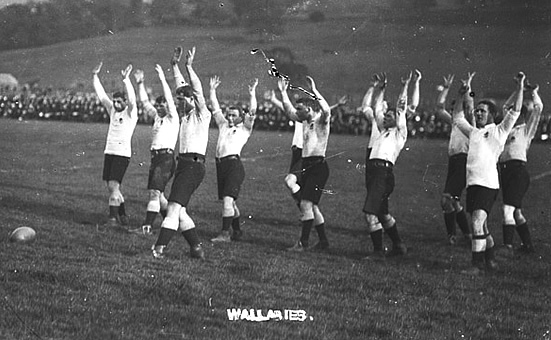
However, if the playing group had made the mascot choice, it would be no surprise that many could have opted for ‘Wallaroos’ given the representation, success and presence of the Canberra Wallaroos (aka ‘Canberra Royals Wallaroos’ and the ‘A.C.T. Women’s Rugby Union team’).
The Canberra Times newspaper on 25 August 1994 reported:
The best women’s rugby team in Australia, the ACT Wallaroos, will play the first women’s international match on Australian soil when it meets New Zealand at Manuka tomorrow at 12.30pm. Australia will play New Zealand in a Test match at North Sydney Oval tomorrow week. Six of the Australian team are from the Wallaroos line-up and the Wallaroos camp probably feels it should have more after the recent Australian Championships in Brisbane.
It doesn’t seem the members of the first Australian women’s team were given any say or even background story on the original Wallaroo club and this being the raison d’etre for the new team being bestowed their Wallaroos name.
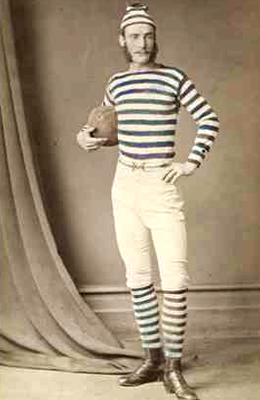
The original Wallaroos were a members-only football club founded in colonial Sydney in 1870, a club that only men could join, and a club that barely anyone in the 1990s outside the rugby history aficionados would have had any knowledge of.
If the women players in 1993-96 had made the choice, and been provided with information about the old Wallaroos club, would they have opted to take on the name of a men’s rugby club that lived its entire existence in the 19th century and all that this colonial world entailed?
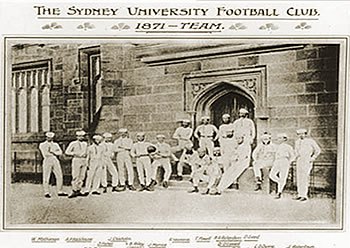
This was a time long before NSW women could vote at an election or become members of parliament, before the colonies were combined in 1901 and Australia came into existence as a federation. Almost all of the Wallaroos players and members would have been born in the United Kingdom of Great Britain and Ireland, or their parents and grandparents were.
The only role for women at the Wallaroo club of the late 1800s (or any other football club in the colonies) were as wives, girlfriends and supporters. If any were present at the post game dinner, they were bestowed ‘A toast’ to ‘The Ladies’, but not usually until after a long line of other toasts that began with ‘The Queen and the Royal Family’ (that’s Queen Victoria), and eventually concluded with toasts to ‘Absent Friends’ and to ‘The Press’. [See also below ‘We may not have woman’s suffrage, but let us by all means have female football‘.]
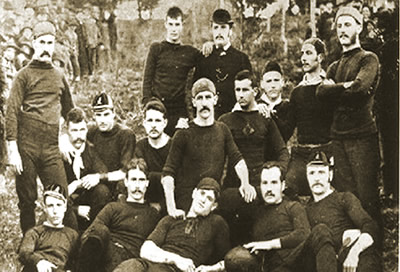
The Sydney Mail in 1876 on Wallaroos vs Sydney Grammar Schoolboys:
There were a good many spectators, including several ladies, who manifested great interest and pleasure in witnessing the exploits of the stalwart and athletic knickerbockered knights who fought and charged and maneuvered in the field with marvellous skill and pluck.
At the close of the 1891 football season the Wallaroos enjoyed a ferry and picnic day on Sydney Harbour water and shores. Afterwards The Referee somewhat took the club to task, but even so, the newspaper’s comments are just as telling about the modern times of the Wallaroos and life in Australia:
The catering was on a very liberal scale, and although the lemonade was a bit ‘strong,’ everyone appeared to have thoroughly enjoyed himself. I cannot help thinking, however, that the club would do far better to give their next outing on a week-day, and invite their lady friends, as such a picnic is far more enjoyable, especially from a social point of view.
With the input of the current Wallaroos and the 1994 pioneer players, perhaps a timely rewrite is due of the Wallaroos history website page , including removing ties and references to the 1870 club if appropriate.
Interestingly, the Wallaroos do not have a wallaroo on their jerseys. Instead there is a wallaby (Rugby Australia logo) and emu and kangaroo (Australian coat-of-arms).
Addendum:
‘We may not have woman’s suffrage, but let us by all means have female football’.
A column by ‘Follower’, football writer for The Mount Barker Courier (South Australia), in the winter of 1894 provides an illustrative example of the prevailing sentiments in Australia’s cities and towns in the last quarter of the 19th century about female footballers:
It is an undeniable fact that women are throwing off the cloak of obscurity and coming out to vie with men in nearly every department of employment. In matters of sport, too, we have lady participators, but one branch has been sadly neglected, and that is football. Why have we no lady footballers? What an attraction 40 costumed nymphs playing on a wet day would be! And a scrimmage!!! Too long have the fair sex remained in the background; let them go in and win. We may not have woman’s suffrage, but let us by all means have female football. Ladies, take the matter up.!
An important matter is that of costume. The present form of feminine attire would be out of the question, skirts being awkward in scrimmaging. My imperfect knowledge on the subject of dress prevents me offering any suggestion, but the ladies would no doubt settle the trouble satisfactorily. But I am certain of one thing—no club would be able to adopt a regular uniform. Amy might fancy blue becoming, Laura would perhaps think red necessary to set off her complexion, while Kate, May, Lucy, and Annie would each hold out for her favorite color, so that Joseph’s coat would be eclipsed in the point of variety. But this is immaterial. I look forward to the day when our sisters and cousins and aunts will make their mark in the football arena.
I shall be pleased to hear from ladies their views on the subject.
Note: the above news article as originally published 27 July 1894 used the then contemporaneous/alternative expressions “woman’s suffrage” [women’s suffrage] and “scrimmage” [scrummage / scrum].
© Sean Fagan

 — saintsandheathens.com —