
In Australia during the 1920s rugby league usurped rugby union for prominence in Australia’s three eastern state universities – the University of Sydney, the University of Queensland (Brisbane), and the University of Melbourne.
Sydney University in time had so many rugby league players that a seven (7) team inter-faculty competition was being played. A combined “Australian Universities” rugby league team was regularly selected, playing matches against the code’s touring British Lions and New Zealand Kiwis, and twice ventured on overseas tours. University teams traveled to other states and country districts, and the first annual inter-Varsity rugby league contest was played in front of a 50,000 strong crowd at the SCG.
Meanwhile the rugby league code’s officials dreamed of there being one rugby code in Australia, uniting all classes of society, where the men from all walks of life would positively influence the good character of each other.
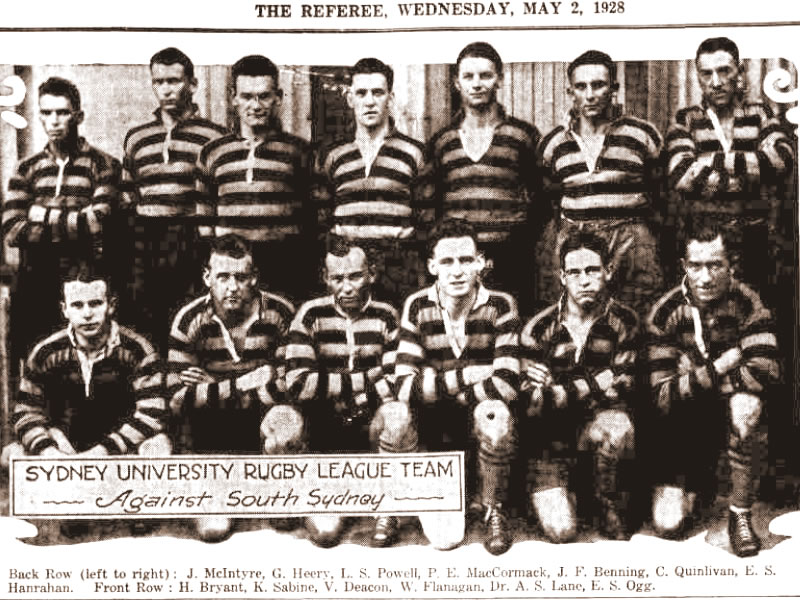
A largely untold story, much remains to be uncovered and confirmed about the extent of rugby league in the Universities during this decade. In particular, its inter-Varsity history between the three institutions, and the combined “Australian Universities” team, has never been explored and, as a result, is almost completely forgotten. This story though is not only about the inroads that league made, but also how they were soon lost as rugby union battled back.
Rugby union at Australia’s universities had a long history in respect to Sydney University FC who had been playing other teams and clubs since 1865, whereas at Queensland and Melbourne the clubs were recent arrivals in 1911 and 1909 respectively.
The first Australasian inter-varsity games were played between Sydney and Otago Universities in 1904 (in Sydney) and ’06 (in Dunedin). A combined New Zealand Universities team (Auckland, Wellington, Otago & Canterbury) met Sydney University in two games held in July 1908 on the University Oval. More than 18,000 were in attendance at the first game (3-all draw).
While the first Sydney-Queensland inter-varsity game was in 1919, this was a decade after Sydney-Melbourne had met. In July 1909 the Sydney University team had journeyed to Melbourne, playing matches against Melbourne University and Victoria.
The Melbourne University’s Sports Union Council had urged the newly formed rugby club to put off the visit from Sydney University until after the latter was prepared to meet under Australian rules first. Unsurprisingly, given Sydney University had no Australian rules club (other than 1887-89) and no students making any moves to organise one, the ‘request’ to put the game off was never seriously advanced, and the Sydney men won Australia’s first ever inter-varsity rugby clash 15-3.
A year on the Melbourne University team came north to play Sydney University, coinciding with a visit of the American [Californian] Universities rugby side. At the same time Melbourne University’s Sports Union affirmed that no ‘Blue’ honour badge would be given to students for appearance in an inter-varsity rugby contest.
Edgar Kneen, captain of the Melbourne University’s VFL (now AFL) club, which itself had only played the University of Adelaide’s cobbled-together football team a handful of times since the first outing in 1904, and apparently never at all met Hobart’s University of Tasmania club, opposed the ‘Blue’ being given:
… on the ground that Rugby was an unknown game, played by a few enthusiasts, and it was a most unimportant sport. If “blues”, were given for this sport, it would depreciate the “blues” of the other clubs.
Sydney’s The Referee sports newspaper offered at the time:
If Oxford University is good enough for the Rhodes’ Scholars of the Empire, surely the games of Oxford [which includes rugby] are good enough for the University of Melbourne.
In 1910 the Melbourne University team came to Sydney, playing against Sydney University. The latter in this same period also had three games against a visiting American [Californian] Universities rugby side.
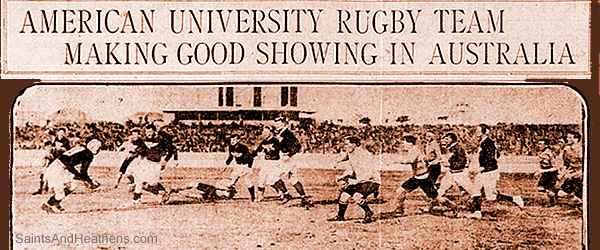
At the start of the 1920s decade at Sydney University both rugby codes were on offer for students, while the 13-man version was the only rugby code being played in the universities of Brisbane (1920-29) and Melbourne (1923-25).
Rugby union in the early 1920s was extinct in Queensland and Victoria, and only being played in the NSW in the capital, where it was confined to schools, the University, and a handful of Sydney clubs.
Many within the Universities were enamoured with rugby league at that time as a game to play, commenting that it was a faster and cleaner game, and they were encouraged by NSWRL and QRL officials to join the code, particularly Horrie Miller, NSWRL Secretary and a former Sydney University student. QRL official and colorful identity Harry Sunderland, living for a while in Melbourne for business reasons, also played his role in that city.

The Queensland University switch to league in 1921 was the result of more pragmatic reasons, namely that there was no one else to play as the QRU under a sea of debts was closed up and all the Brisbane clubs and schools were now playing 13-aside rugby.
The most prominent example of the advance was the formation of the Sydney University Rugby League Club. It was no secret that the NSWRL had its eyes on having the University of Sydney enter the Sydney club premiership. The first by-laws of the NSWRL as signed-off by founder James J Giltinan at the start of 1908 provided for clubs to formed on a district scheme based on state electoral boundaries, plus a Sydney University club, mirroring the system in use by rugby union.
Much to the efforts of people such as Dr Herbert Vere Evatt, on his way to becoming a celebrated jurist and politician, ‘The Students’ entered the Sydney first grade competition (now NRL) in 1920, participating until the close of the 1937 season. The new rugby league club adopted the rugby union club’s traditional blue and gold striped jerseys and coat of arms badge.
Evatt prepared a report which set the scene:
Owing to the general dissatisfaction with the management of the Rugby Union during the 1919 football season, and the fact that University footballers were starting to realise that rugby league was a faster and cleaner game, several leading members of the football club, including seven “blues” of the past season, took steps to introduce the league game into the University for the 1920 season. A special meeting of league supporters was held and decided to enter three teams, all members to play as strict amateurs.
University students playing league, as noted above, all remained amateur, declining to take any form of professional payments or allowances for playing, other than for travel or accommodation. To take any reward or compensation, or indeed to play rugby league at all, risked a ban and declaration of being a professional from the University’s athletic society and from other sporting bodies overseeing the amateur side of sports such as swimming or boxing.
This wasn’t such an issue outside of Sydney and in the other states as there was no rugby union authorities in existence. However, any students who had thoughts of progressing to Oxford and Cambridge were warned that they very likely wouldn’t be permitted to play rugby union if they had played league in Australia, whereas no such penalty was ever considered for those playing Australian Rules football in the VFL in Melbourne.
By 1922 an agreed ‘understanding’ on the amateur-professional question was sufficiently reached so that the Sydney University undergraduates wanting to play for the first grade rugby league side could confidently do so, but the animosity never quite dissolved with, in the most notable example (further discussed below), a permanent ban was imposed on their use of the University Oval. For many seasons the rugby league players were not even permitted to train on University Oval, until public and media pressure forced the Sports Union (of the University) to relent.
 Players from Queensland and Sydney Universities were chosen in an ‘Australian Universities’ rugby league team that toured New Zealand in mid 1922, playing against ‘Metropolis’ in Sydney upon its return. The ‘Metropolis’ side, who won a close encounter 34-31, was players from the city’s first grade teams, including stars of the day Frank Burge (who got 3 tries), Duncan Thompson and Harold Horder (The Sun, 5 July 1922).
This match was also considered unique in that it was the first rugby league game given permission by the Sydney University Sports Union to be played on the University Oval. In the Sydney University RL Club’s 18 seasons, it was never permitted to host a home game there.
The University of Melbourne became the third University to bring a rugby league team to the field, when it competed in the local club competition in the Victorian capital in 1923 to ’25. After finishing as runners-up in the 1923 club competition, the club succeeded in being officially affiliated to the University’s Sports Union – something which was never attainable by their compatriots at Sydney University.
A number of Melbourne University’s players were among the Victorian rugby league team that lost 45-13 to the visiting England side in their 1924 tour-opener at Fitzroy in late May (crowd 12,000). The Victorian team’s winger, P. Stott, was later selected in a combined “Australian Universities XIII” that faced the Lions in Sydney in their final match in Australia.
Held mid-week at the Sydney Sports Ground, according to a cable news report in The Argus “It was only towards the end of the match that England gained a lead and won by 31 points to 28” in an entertaining contest. The home team was primarily Sydney players, but along with Stott, it also included J. Vidulich and J. O’Sullivan from Queensland University.
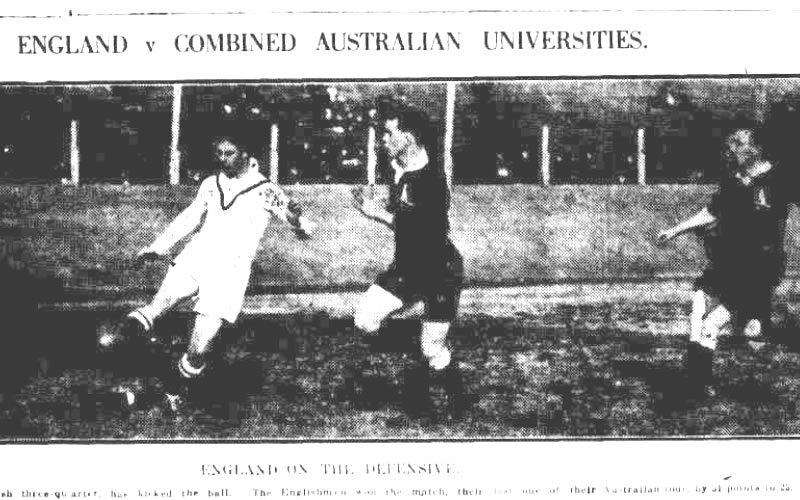
In just one of the many unanswered questions about this period, The Argus revealed on 15 April 1924 that “A combined Universities’ team will play against the Englishmen, and a combined Universities’ team will tour Auckland.”
In regard to this second Australian Universities rugby league team, on 26 June 1924 The Argus stated that two Melbourne University players “K. Fraser and J. Love who have been touring New Zealand with the Australian Universities team, have returned to their studies, and will be a tower of strength in the ‘Varsity, for their match with Melbourne.”
The detail of this tour is scarce, and conflicting. Brief mentions in New Zealand newspapers refer to the team being from Sydney University, but are ambiguous as to which code the team’s matches were played under.
However, in the Rugby League News of 5 September 1931, the Sydney University RLFC’s treasurer Bob Cunningham, in writing very briefly about the history of combined Australian Universities sides, states: “A second tour of New Zealand was made in 1924, the team being drawn from the Universities of Queensland, Melbourne and Sydney.”
In explaining the first tour, Cunningham wrote: “In 1922 an Australian Universities team toured New Zealand under the control of the Australian Universities Sports Association, and the members of that team were awarded Australian ‘Blues’.”
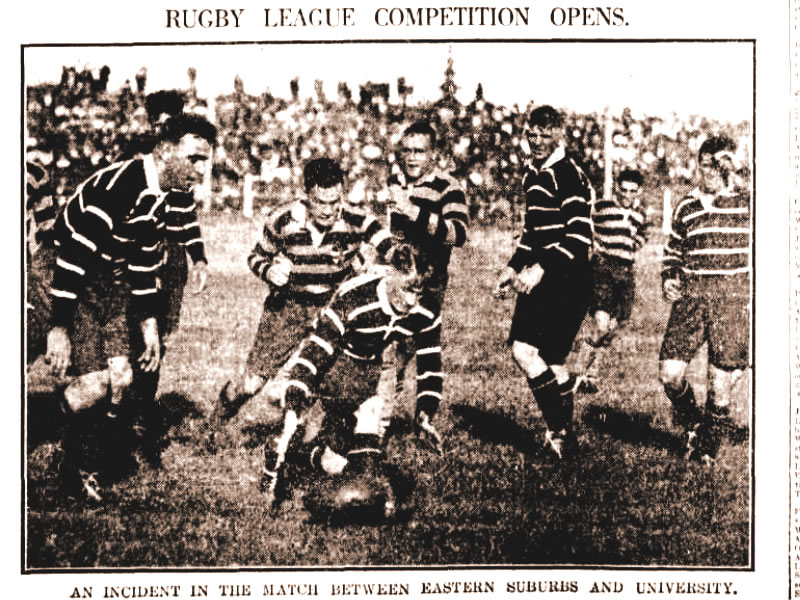
Aside from taking the lead role in the national combined team and playing in the Sydney rugby league club competition, the Sydney University club itself was particularly keen on mounting development tours.
Commenting in the Rugby League News of 6 June 1931, Frank Benning, one of Sydney University’s finest league forwards, revealed that the club had been undertaking extensive tours since its inception in 1920:
If we cannot boast of a premiership record, we can claim to have done more for Queensland and NSW country football than any other club.
In eleven years we have conducted two New Zealand tours [a reference to the Australian Universities teams of 1922 and 1924] and visits all along the Queensland coast as far north as Townsville, including Rockhampton, Bundaberg, Maryborough, Cairns, and at centres like Toowoomba, Ipswich, and nearer home in the Northern Rivers, in Tenterfield, Inverell, Tamworth, Newcastle, Katoomba, Leeton, Griffith, to mention a few of the better known districts.
The Australian Universities rugby league team (‘Combined Australian Universities’) are known to have made other appearances, including:
- In 1925, with NSW Blues star Frank O’Rourke in the centres (he would later play for Leeds rugby league club) and Evatt in the forwards, the Australian Universities team sprung a surprise 15-13 win over New Zealand at the Sydney Sports Ground.
- In 1929 for a game against ‘Northern Districts’ on Tamworth Oval in the New England region of NSW in August.
- In 1930 the New Zealanders defeated Australian Universities 18-12 in what The Sydney Morning Herald described as “a hard and rugged game”, which was the second and final rugby league fixture permitted on University Oval.
Challenges issued annually by the University’s league club to a match against the University’s rugby union club went unfulfilled, even after the latter were offered the advantage of the game being played under their own rules (Daily Telegraph, 9 April 1924). The code had become so dominant and popular at Sydney University that inter-faculty teams were formed each season for regular Saturday and mid-week competitions. In 1934 the participating teams were: Arts, Medicine, Science, Economics, Law, Pharmacy and Engineering.
Significantly, there were also rugby league matches between the Universities.
A triangular inter-University series appears to have been played in Sydney during the August vacation of 1924. The Argus of 15 July 1924 stated that the tournament would begin on August 23. Later reports refer to Sydney University coming out winners, and that Melbourne lost it’s match to Sydney (by referring to the game being the 3rd time that the two institutions had met – the others being in 1909 and 1910 under rugby union).
An extensive report in The Sydney Morning Herald on 28 August 1924 covers an inter-Varsity rugby league clash won 38-8 by Sydney over Queensland (Brisbane), and confirms this particular contest had been an annual fixture since 1920: “The engagement was the fifth between these Universities, and the Queenslanders have not succeeded in winning a match.”
That first contest in 1920 between the two Universities had been held at the Sydney Cricket Ground, a curtain-raiser to a NSW v England rugby league match that drew well beyond 50,000 fans.
The next year future Australian Wallabies captain Tommy Lawton played rugby league for the University of Queensland in the local Brisbane club competition and against Sydney University at the Exhibition Ground. Lawton then left for Oxford University, arriving in England in September 1921. He immediately became a regular member of the Oxford University XV at fly-half, and then also of Blackheath, the oldest and most famous club in the game.
It was an open secret that Lawton had played league in Australia and therefore was seemingly a professional, but no one was bothered about his eligibility to play, and his form was so impressive he seemed certain of selection for England in the Home Nations.
However, after the question being raised by former England international Adrian Stoop, the ‘colonial’ Lawton was suspended by the RFU pending an inquiry. The ban was soon lifted as the RFU creatively found the rules were not breached as Lawton (and two other Queenslanders playing in England) had “no choice” but to take up league as the QRU was defunct. Lawton was very highly regarded by many, but never gained England selection.
Ironically, the saga in effect gave the NSWRU and later the QRU the clearance to again allow Lawton to play rugby union, where in 1929 he became captain of the first full-Australian team since before WW1.

Bob Cunningham, in the 1931 Rugby League News article referred to above, recounts that when the Sydney University RL club was formed, one of its first resolutions was to institute an annual inter-Varsity match with the Queensland University’s RL club. The first, as discussed earlier above, was in 1920. The second meeting came in 1921, and it was one of the games that got Lawton into his difficulties in England. Cunningham added:
… these contests have been maintained to the present times and are essential for University bodies as they provide the competition between Universities that helps so much to mould their sporting traditions … These games are played alternately in Sydney and Brisbane and provide excellent opportunities for many young undergraduates to extend their first-hand knowledge of Australia by actual contact with the people and industries of the centres visited.
The involvement of the Melbourne University league team however was short-lived, with the brief attempt to forge a club competition in the Victorian capital collapsing in the summer of 1925/26. The reality was most of the footballers in the city’s clubs were ex-pat Britons and New Zealanders. In the absence of VRL founder Harry Sunderland, who had returned to his QRL role in Brisbane, the prospect of a NSWRU organised game between Victoria and the New Zealand All Blacks in Melbourne was the deciding factor that saw the VRL and all its clubs, switch codes and became the VRU. The latter decided for itself that all of its now former rugby league players had not broken the RFU’s laws against professionalism, citing their lack of being paid anything.
The loss of Melbourne to rugby league was pivotal as, in August 1927, rugby union was able to select its first combined Universities teams.
In May 1927 after Sydney University played a three-game series against a visiting Combined New Zealand Universities, a NSW/Metropolitan XV met a team selected from the latter two teams plus Melbourne University. The NSW side, which was captained by Johnnie Wallace (Glebe-Balmain) and included Lawton (Western Suburbs), won easily 28-11. Players chosen from Sydney and Melbourne Universities met on St Kilda cricket oval a XV from the visiting Japanese side, Waseda University (aka the Japanese University Rugby Union team). The home team won by 35 to 14.
The Waseda tour came about following a visit to Japan in late 1926 by former Sydney University RU player and current NSWRU council member Ernest Marks (who Sydney’s ES Marks Athletics Field is named after), where during his stay he found rugby (and more noticeably soccer) was being played and he was impressed at the standard of play. In early 1927 a comprehensive report was submitted by Marks to the NSWRU. He reassured journalists that the Japanese students would be on par with Sydney’s combined high schools and the University.
The team, backed by a Tokyo’s The Mainichi newspaper, paid all of its own expenses, and were promised 90% of the gate proceeds by NSWRU (who warned the venture was not likely a profitable one). The matches were primarily in Sydney and Newcastle, but the tour opened in Melbourne with contests against Victoria and the combined Universities. Waseda’s final game was a 17-3 loss to Sydney University on University Oval. Sydney’s The Truth said the visitors “were completely outclassed, were too polite, and lacked system”.
This ‘rugby union revival’ was crowned by the success of the NSW Waratahs 1927/28 tour to Britain, France and Canada, again with Lawton and Wallace to the fore. At its annual meeting early in 1928, the NSWRU declared it was in its most buoyant position in its history, and certainly since the 1908 split. Meanwhile Lawton, who as the only Queenslander in the Waratahs and in the view of many the star of the tour, returned home to Brisbane as a ‘conquering hero’, and pledged to do all he could to assist with the revival of the QRU.
The reformation of the QRU in 1928, beginning that season with many high schools switching away from league, impacted on Queensland University league’s club, amidst mounting pressure on students to eschew the professional code (even though they were playing as amateurs) and join the new Brisbane rugby union club competition (which started in 1929). An ongoing bitter dispute between the QRL and the Brisbane RL body further fueled dissatisfaction. With the assistance of coaching from Lawton, in July 1928 a Brisbane selection played an exhibition game against Sydney University. Brisbane’s The Telegraph stated that the match “constituted the first serious bid by followers of the old game for popular support”.
The University of Queensland rugby league side won the Brisbane competition in 1928 and 1929, but this wasn’t sufficient to keep the club in the code. The Lawton-captained Australian side in 1929 played a Test match in Brisbane against the New Zealand All Blacks with a 20,000 crowd. After in August 1929 playing Sydney University in the annual inter-varsity league contest, at season’s end University of Queensland football was divided, resulting in having clubs operating in both codes.
As had occurred in Melbourne with the VRU, and was indeed also happening in Sydney with the Sydney University rugby club and the NSWRU, the willingness of the local rugby union bodies to put aside the code’s rules against professionalism and to reinstate ex rugby league players was astute (although critics might argue such practice was somewhat duplicitous in the broader context of past sentiments and why the rugby league code ever needed to be founded at all).
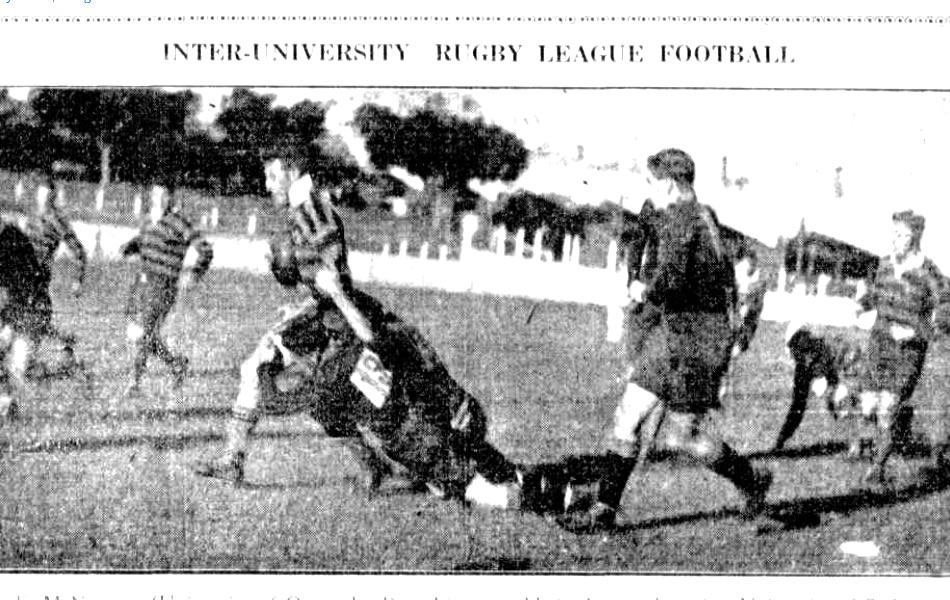
A now fully revived rugby union on Australia’s eastern seaboard organised a tri-state carnival in Melbourne in 1931 between the Sydney, Queensland and Melbourne Universities. The event was closed with a game between Victoria and a selected combined Australian Universities team. Earlier in the season the New Zealand Universities had come to NSW for a tour, including three games against Sydney University.
Rugby union clubs also now appeared in the other Australian universities, with University of Western Australia (1929), University of Adelaide (1932) and University of Tasmania (1933) each playing in the local club competition.
By 1933 the inter-state series had grown to four entrants by the addition of the University of Adelaide. That year also saw a combined Australian Universities side tour to Japan (two Tests plus games against Keio, Meiji & Waseda Universities) and Hong Kong. Brisbane’s The Courier-Mail noting the composition of the squad:
The Rugby Union team from the Australian Universities, which will tour Japan, will comprise 11 from Queensland, seven from New South Wales, two from Adelaide, and one each from Melbourne and Western Australia.
There were promising signs for the Sydney University rugby league during 1933, and had they all come to fruition, the club’s history may have told a story of success and longevity.
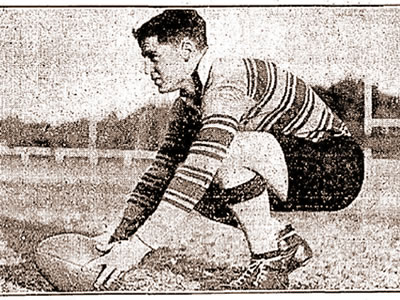
In that season winger/fullback Jack Gray-Spence topped the list of try-scorers in the Sydney club premiership, despite University finishing just one win above last place.
Then, after St Joseph’s College teenage schoolboy rugby union star Jack Beaton (centre and goal kicker) turned out for the University’s league team in a NSWRL post season 11-a-side night football tournament between the Sydney premiership clubs, propelling University into the semi finals, hopes of him joining for 1934 and combining permanently with Gray-Spence caused wild speculation.
Newspapers reported that Beaton’s chief cohort in the St Joseph’s XV, Jack Kelaher, who was now a both a Wallaby international and University student, would join the league side too. Along with promising undergraduate Ross McKinnon (five-eighth/centre), as well as the pending return of the experienced centre Frank O’Rourke from Leeds rugby league in England, all of a sudden University had a club back-line that both then and now would rival the best anywhere.
However, Beaton first and then McKinnon both went to Eastern Suburbs (and from there to the Australian Kangaroos), O’Rourke’s return ended in his first game with a foot injury, Kelaher stayed with rugby union, and Gray-Spence moved to St George (then gained reinstatement from the NSWRU, and played for Randwick and the Waratahs).
Queensland University dropped out of the Brisbane rugby league competition in 1934 and Sydney University voluntarily fell at the close of the 1937 season. Sydney University’s final NSWRL third grade game at Belmore Oval was replaced by a team of University ‘old boys’, who wanted one more chance to wear the blue and gold.
For rugby league it had been an all too brief flirtation with University and amateur football. It was the dominant code at Sydney University, and the only code at Queensland and Melbourne Universities.
Now it was over.

As each Sydney and Brisbane rugby league season passed, the game on the field had demanded more training, increased athleticism and brought with it greater risk of injury.
By the end of 1937 it was obvious to the Sydney University RL club that they could no longer compete on the field or in attracting any crowd interest. They were amateur footballers in a professional competition where the other teams’ footballers income was dependent on gate-takings and crowds.
It perhaps though demonstrates the tenacity of the University’s league club that their time in the professional world far outlived that of their compatriots the Melbourne University Football Club who, for similar reasons, voluntarily withdrew from the VFL in 1914 after just seven seasons.
Despite the reassuring and welcoming words from NSWRL Secretary Horrie Miller, that pointed towards a desire for rugby league to be an inclusive game for all classes of society, the code seemed content to leave the Universities, and amateur football generally, to play under a re-established rugby union
While Miller had hoped for rugby league to be a game that traversed across all classes of society, (as in Australian football in the other states), and Cunningham demonstrated how the University men playing the game and meeting Australians of all ilks rounded off the undergraduates’ knowledge and character, some will point to the relentless parade of miscreant NRL footballers as evidence of the ultimate benefit that the code lost when it indifferently let the men of the Universities and their clubs fade from the Sydney and Brisbane club competitions, and embolden the revival of amateur rugby union.
Miller’s dream of one rugby code, united across all Australians from all walks of life, positively learning from each other, influencing each other, was gone. Worse for rugby league it left a professional sport with far less ties than it might have had in terms of sponsorship, corporate board rooms and political connections in Australia.
Even though the club only was part of the league for less than two decades, there can be little doubt it saw in that short time more future doctors, lawyers and judges wear the jersey than NRL clubs now over a century old.
Even a small sample shows University rugby league players did impact the code, which illustrates Miller’s goal.
Dr Hubert Finn (who also played for the NSW Blues) became the NSWRL’s chief medical officer after retiring in 1926, a role he held the rest of life.

As Australia’s Minister for External Affairs, in London in 1946 Dr Evatt first convinced the English RFL to reverse a decision not to mount an Australian tour so soon after the end of WW2, and then set out out securing the Lions passage on an aircraft carrier sent south to obtain vital food supplies, dropping the tourists at Fremantle. It was an immensely popular tour with the public and reinforced league’s stronghold over NSW and Queensland.

Perhaps the most telling legacy of the University influence on rugby league came in the form of retired solicitor Jim Comans, who while a law student had played 35 first grade games for Sydney University rugby league club between 1932-36, first as a centre before moving into the forwards.
Comans was in the early 1980s appointed as chairman of the NSW Rugby League judiciary committee, where with his “There is no room for thugs” mantra, he went on to become the man credited with cleaning up the public image of rugby league in the early 1980s after serving up lengthy suspensions for rough and violent play to Les Boyd, Steve Kneen, Bob Cooper and many others.
The efforts of Comans laid the groundwork for the popular appeal that came to rugby league in the late 1980s and early 1990s in ‘Tina Turner era’, making it so popular it soon became the target a war between pay-tv providers and a new Super League.
Comans though had long given up the role, sensationally resigning early in 1986 after he was out-voted 2-1 by fellow judiciary panel members over a spear tackle charge against Parramatta Eels’ prop Geoff Bugden.
Comans believed the decision could legitimise the spear tackle, and as a consequence the dangerous lifting tackle was not at that time rubbed out of the game.
Sydney University still has an active rugby league club and for many years played in the NSWRL’s Second Division. The latter competition began in 1963. The University club had re-formed in 1962, playing in the South Sydney Juniors. In July 1962 the Queensland and Sydney Universities met in a rugby league contest for the first time since 1937.
During this period in the Second Division the University team played against Penrith Panthers and Cronulla Sharks (as Cronulla-Caringbah) before they themselves entered the NSWRL’s 1st Grade competition (now NRL) in 1967. Cronulla and University met again in the opening game of the pre-season Wills Cup in 1970. The competition also saw University once more face old foes Newtown and North Sydney.
The University rugby league club is also remembered by a trophy that they donated in 1922 for presentation to the winner each year of the NSW high schools rugby league competition – the University Shield.
© Sean Fagan

 — saintsandheathens.com —