Story written & researched by Sean Fagan for SaintsAndHeathens.com
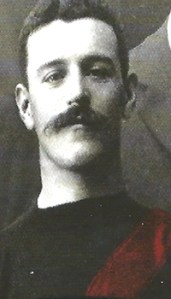
Albert Thurgood
The ghosts of Aussie rules’ greatest goal-kicking footballers from a century ago and earlier reside in the rugby stands of Olympic Park watching the Melbourne Storm and Rebels, not in the ‘spiritual home’ MCG.
As is now accepted truth, Australian rules football’s (AFL) roots are founded in the rugby code. Of course, as with any Darwinian evolution, some traits long ago dropped off the body (rectangular fields and onside kick-offs), others exist but unused and forgotten (place or drop kicking for goal), and others we just view with a squinted eye and convince ourselves they were our own unique design (the fair catch or the mark).
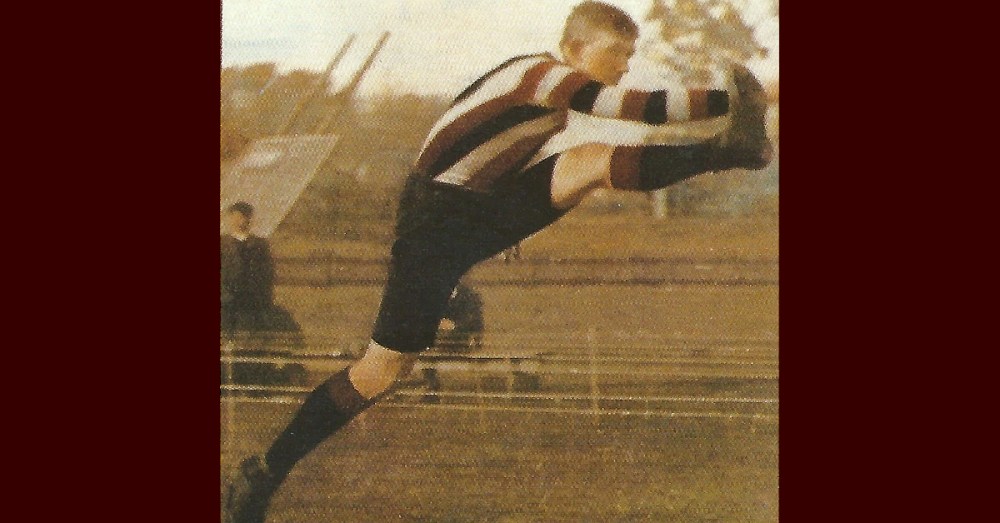
Albert Thurgood was the first icon of Australian rules football, and an inaugural member of the Australian Football Hall of Fame. Renowned for his extraordinary kicking distance and goal-scoring prowess during the sport’s formative years, his first class career extended from 1892 to 1906, much of it with the Essendon club in Melbourne.
Thurgood purportedly could consistently clear 80 yards (73.2m) with his punt kicks. In 1899 in a kicking contest Thurgood place-kicked a football that on the full traveled 107 yards, 2 feet, and 1 inch (98.5m). He was equally talented with the drop kick, regularly reaching 90 yards (82.3m) during practice sessions.
But Thurgood’s place and drop kicks were not mere circus tricks turned out for the public.
When kicking to the goal posts the football could be, then as now, transported by way of a punt, drop, place or ‘soccering’. While today the punt kick alone is ubiquitous, in Thurgood’s era the punt was seen as a low returns option (‘the treacherous punt’) and left to novice rookie players, with the experienced and knowledgeable using the place kick or drop kick, which was more reliable and achieved longer distances.
The drop kick (or what in the rugby codes or NRL is often called a ‘field goal’) was phased out of general use and favour in Aussie rules football in the 1960s, while the place-kick had long gone from general play (1920s) and the centre-field on-side kick-off (1891).
TO IMPROVE SHORT-RANGE KICKING. [from ‘The Art of Kicking’ by Old-Timer, The Sunday Times, 8 June 1913]
I have one hint to give, which may improve short-range kicking — say, from the 25-yard line. Place the ball perfectly upright, and when kicking do not strike it hard, but ‘lift’ it, and I venture to say not many short-range goals will be missed. Try this method, ye Rugbyites and Australian Rulers, and you will soon prove it to be successful.
Saturday after Saturday goals are missed through the employment of the treacherous punt in the Australian game.
Under the laws of rugby a goal cannot be scored by a punt kick and between the two posts is a cross-bar which the ball must clear above.
When in 1888 the first British Lions rugby tourists played Aussie rules games in Victoria against the big Melbourne clubs (Essendon, Carlton, Fitzroy and South Melbourne), they encountered teams predominately using the drop-kick to score goals. Jack Anderton (Wigan/Salford) recalled that:
“Why I should think that nearly 40 goals were registered against us by drops taken at least 50 yards from the goal posts. The Victorians are really grand and accurate dropkickers.
They had a tremendous laugh at us when, in ye good old English fashion, we placed the ball for a kick, a proceeding they never dream of doing, so skilful are they at drop-kicks.”
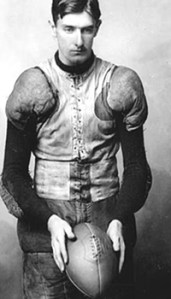
Pat O’Dea
When as a boy Dally Messenger lived in Melbourne in the early 1890s, the two new stars entering local football were Thurgood as well as another long-kicker Pat O’Dea at Melbourne FC.
O’Dea too preferred the drop kick and went on as the ‘Kangaroo Kicker’ to have a remarkable trail-blazing career and kicking influence in USA college football for the University of Wisconsin (‘the Badgers’).
Messenger of course soon built a resume of sporting legend with his record-setting place and drop kicking and other exploits in the rugby codes back in Sydney.
After his playing days were over, in 1914 at the SCG at an Australian rules inter-state teams carnival, Messenger took part in and won a goal kicking contest. He didn’t win the longest place-kick though, with that going to Victoria’s Dave McNamara.
A comparison between Messenger (Easts rugby league & NSW Blues) and McNamara (Essendon VFA) over 1911 and 1912 reveals some remarkable similarities between the two men, and indeed says much about how related the two codes were at that time with goal-kicking and scoring points.
Both footballers, who preferred to place-kick goals, had their most prolific seasons in those two years: McNamara kicked 188 goals, Messenger 183. In both cases, their phenomenal goal kicking led to their clubs winning the premiership in their city.
Within a decade though the place-kick was rarely seen, fading from popularity among footballers and coaches in the Aussie rules states.
By the 1950s the drop kick at goal too and in general play was also near extinct. As the 1880s introduced innovation of forwards high-leaping to ‘mark’ (fair catch) the ball gradually became more expert and refined over the decades, the punt kick’s ability to deliver the ball quickly into the air began to outweigh the drop kick’s legendary accuracy in hitting a teammate on the chest.
Dave McNamara
In Perth the Westralian Worker 21 May 1926 lamenting in a long article:
Dearth of Players who use the Place Kick.
The place kick has almost died out, probably as a result of the passion for speed in modern football.
Similarly in Adelaide, another Australian rules only city, The Register News-Pictorial of 6 September 1929:
One of the most pronounced changes in football has been in the manner of securing goals. In days of old place-kicking was practically universal; today it is the exception.
Melbourne’s daily newspaper The Age 8 August 1944 observed:
A feature of the original Australian football code, which brings back memories of the spectacular deeds of players of the real winter game at its best and which was appreciated by onlookers, who waxed enthusiastic over unerring kicks over long distances was the good old safe — “Place kick” of happy memory!
In the haphazard, hurried attempts at rush goal kicking these times, good kicking is a lost art, and one of the game’s brightest phases is missing. Ardent football followers of the past can recall the stalwart Albert Thurgood, one of the giants of the game, and often ranked as Australia’s all-time star footballer, whose place kicks soared with marvellous precision for 65 yards right through the goal posts.
…
A few years ago coaches gave their football charges practice at place-kicking to cultivate a sense of direction — even if they were drop and punt addicts … The place-kick makes for concentration. It teaches the player to watch the ball. The goal kickers of to-day kick on the run. They watch the goal posts and forget the ball … The players of to-day are too impatient to concentrate …
The last recorded place-kicked goal in the AFL (then VFL) was in 1955 by Fitzroy player Tony Ongarello. That same decade also saw the drop kick fade from anything like regular use for goal attempts. A drop kicked goal by Sam Newman for Geelong in 1980 thought to be the final AFL level occurrence.
To the many AFL fans today who know little of the game’s past, and its rugby football DNA, it will come as a revelation that drops and places were once the dominant kicking techniques and not punts. But what is new, as we find no surprise that in 1887 the newspaper Melbourne Punch ignorantly declared Geelong FC’s William ‘Trusty’ Hall to be our planet’s undisputed champion exponent:
As a drop-kick Mr. Hall has never had an equal in Australia — which, of course, means the world, as dropkicking is not a feature of the Rugby game
In any event, it is perhaps ironic that if Thurgood, O’Dea or McNamara came back to life today, it would not be watching Essendon playing AFL football at the MCG that would pique their greatest interest, it would be to watch the rugby codes’ Melbourne Rebels and Storm at Olympic Park.
Here they could see and regale in stories about the style of football-kicking they more fondly favoured.
As the football season [1889] is approaching, we consider the following Rules of the Rugby Game of Football will interest our readers:—
Dally Messenger
1. A drop kick or drop is made by letting the ball fall from the hands, and kicking it the very instant it rises.
2. A place kick or place is made by kicking the ball after it has been placed in a nick made in the ground for the purpose of keeping it at rest.
3. A punt is made by letting the ball fall from the hands, and kicking it before it touches the ground.
4. Each goal shall be composed of two upright posts, exceeding 11 feet in height from the ground, and placed 18 feet 6 inches apart, with a cross-bar 10 feet from the ground.
5. A goal can only be obtained by kicking the ball from the field of play direct … over the cross-bar of the opponents’ goal … A goal may be obtained by any kind of kick except a punt.


 — saintsandheathens.com —